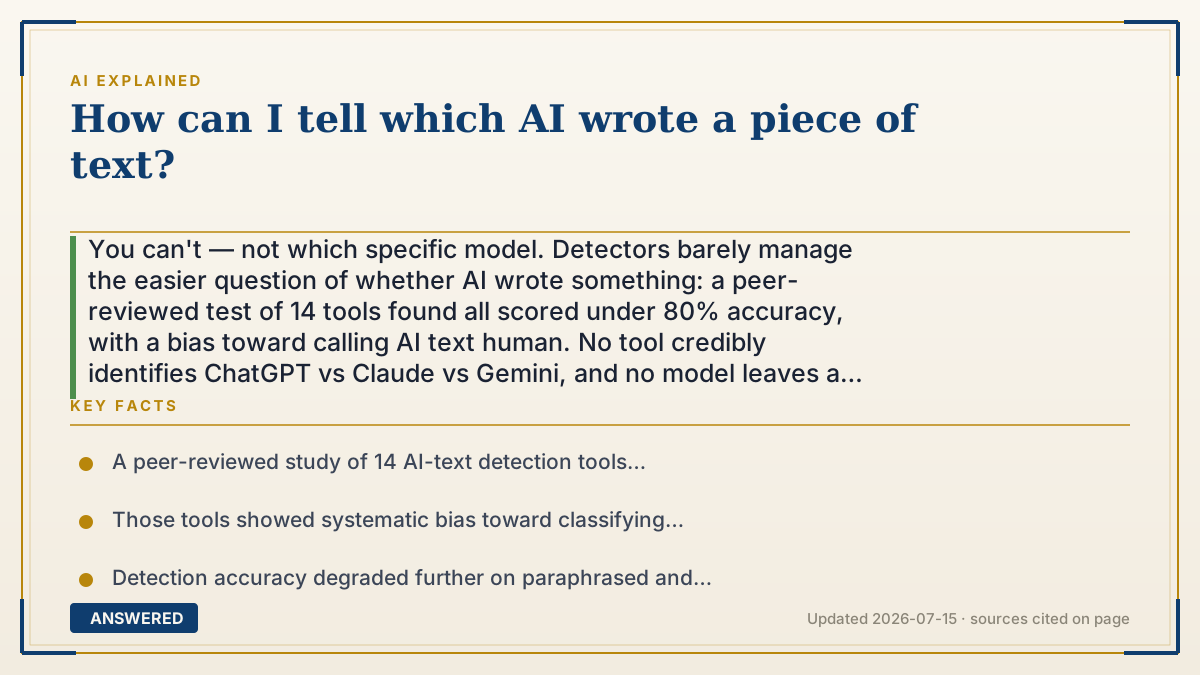
How can I tell which AI wrote a piece of text?
You can't — not which specific model. Detectors barely manage the easier question of whether AI wrote something: a peer-reviewed test of 14 tools found all scored under 80% accuracy, with a bias toward calling AI text human. No tool credibly identifies ChatGPT vs Claude vs Gemini, and no model leaves a reliable signature.
Why — the first-principles explanation
Two questions are hiding in this one, and they have different difficulty levels. "Was this written by AI?" is hard. "Which AI wrote this?" is effectively unsolved, and the reason is structural.
Detectors work by measuring statistical predictability — language models choose likely words, so their output tends to have low perplexity and unusually even variation between sentences. Notice that this signal says machine-like, not which machine. It is a single dial. All large language models are trained on overlapping internet-scale data, often with similar architectures and similar alignment techniques, which pushes their outputs toward the same region of that dial. Distinguishing them would require each model to leave a distinct fingerprint. They do not — and they are actively converging, because labs train on similar data and increasingly on each other's outputs.
Even the easier question performs badly. Weber-Wulff and colleagues tested 14 tools — 12 public plus Turnitin and PlagiarismCheck — in the International Journal for Educational Integrity. Every tool scored below 80% accuracy; only five cleared 70%. Six produced false positives, 13 produced false negatives, and accuracy dropped further on paraphrased or machine-translated text. Their conclusion was that the tools are neither accurate nor reliable, with systematic bias toward classifying AI output as human-written. So a tool claiming to name the model is making a much stronger claim than the field can support on a much easier task. Treat those claims as marketing.
There is one technology that would genuinely work, and it is worth knowing why it does not save you: watermarking. A lab can bias its model's word choices in a secret statistical pattern that survives light editing and is detectable with the key. Google has deployed SynthID for this. But it only works if the lab implemented it, kept it on, and gives you a verification tool — and it does not survive heavy paraphrasing. It also cannot tell you about a model that never watermarked at all.
So what actually works? Weak, human-noticeable stylistic tells — house tone, formatting habits, favored transitions, characteristic hedging, default structures. Experienced users genuinely do guess above chance. But "above chance" is not evidence, tells shift with every model update and every system prompt, and a single custom instruction erases them. This is intuition, not identification. Never accuse anyone based on it.
An example that makes it click
Imagine trying to identify which factory made a plain white t-shirt. You can sometimes tell it's factory-made rather than hand-sewn — the stitching is too even. That's the easy question, and even that is only sometimes.
But which factory? They all use the same cotton suppliers, the same machines, the same patterns. There's no label. You might notice one factory tends to use a slightly different collar seam — until they change machines next month and that tell vanishes. Anyone claiming to name the factory from a photo of the shirt is guessing confidently, which is worse than guessing.
How to do it
- Reset the goal. Identifying which specific model wrote text is not currently possible with any credible accuracy. Decide whether you actually need that, or just need to know if the work is the person's own.
- Check for watermarks where they might exist. Google's SynthID covers some Google-generated content and can be checked with Google's verification tooling — but only for content Google watermarked.
- Look for metadata, not prose. Document properties, editing time, revision counts, and cloud version history reveal process and are far more informative than any detector.
- If you use a detector, understand what you're getting. It estimates 'machine-like or not' at under 80% accuracy, and its 'human' verdicts are especially uninformative due to the known bias.
- Never accuse based on a detector score. False positives fall disproportionately on non-native English writers, whose simpler prose reads as more predictable.
- Ask about process instead. Request the draft history, an outline, sources, or an explanation of a specific choice. Someone who wrote it can answer instantly.
- For your own curiosity, note stylistic tells — but treat them as intuition. Model updates and custom system prompts erase them without warning.
Key facts
- A peer-reviewed study of 14 AI-text detection tools (Weber-Wulff et al., International Journal for Educational Integrity, 2023) found all scored below 80% accuracy, with only five above 70%.
- Those tools showed systematic bias toward classifying AI-generated output as human-written; 6 of 14 produced false positives and 13 of 14 produced false negatives.
- Detection accuracy degraded further on paraphrased and machine-translated text, meaning light editing defeats the tools.
- Detectors measure statistical predictability (perplexity and burstiness), a signal that indicates machine-like text but carries no model-specific identity.
- No published, independently validated method reliably distinguishes ChatGPT from Claude, Gemini, or other models from text alone (as of 2026-07).
- Watermarking (e.g., Google's SynthID) can identify content from participating models, but only where the lab implemented it and only until heavy paraphrasing removes it.
▶ The 60-second explainer (script)
Can you tell which AI wrote something? No. And there are actually two questions buried here with very different difficulty. "Was this AI?" is hard. "Which AI?" is basically unsolved — and here's the structural reason. Detectors measure predictability. Language models pick likely words, so their text is unusually smooth, with even variation between sentences. But notice what that signal is: one dial, reading machine-like or not. It doesn't say which machine. And every big model is trained on overlapping internet data, similar architectures, similar alignment methods — they all sit in roughly the same spot on that dial. They're converging, not diverging, partly because labs now train on each other's outputs. And the easy question already fails. A peer-reviewed study tested fourteen tools, including Turnitin. Every one scored under eighty percent accuracy. Only five broke seventy. Thirteen of fourteen produced false negatives. The verdict in the paper: neither accurate nor reliable, biased toward calling AI text human. So any tool claiming to name the model is making a much bigger claim than the field can support on a much easier problem. That's marketing. There's one thing that would actually work: watermarking. Google's SynthID biases word choice in a secret pattern you can verify with a key. But it only works if the lab turned it on, and it doesn't survive heavy paraphrasing. What's left? Style tells. And experienced users do beat chance guessing. But above chance is not evidence, and one custom instruction erases the tell entirely. Never accuse anyone on a vibe.
What authoritative sources say
People also ask
Are there tools that claim to identify the specific model?
Some claim it. None have published independent validation. Given that the far easier binary question is still under 80% accurate, treat model-identification claims as marketing rather than capability.
What about em dashes and phrases like 'delve'?
These are folk signals, not evidence. Plenty of humans write that way, model habits shift with each update, and a single custom instruction removes them. Using them to accuse someone is unjust.
Does watermarking solve this?
Partially, and only for participating models. Google's SynthID can flag some Google-generated content, but it requires the lab to have enabled it and does not survive heavy paraphrasing.
Why do detectors flag my own writing?
Because they measure predictability, and clear, simple, well-structured prose is predictable. This is why non-native English writers are flagged disproportionately — a documented fairness problem, not a quirk.
What should I do instead?
Look at process rather than prose: document metadata, editing time, version history, and whether the person can explain their own choices. All of it beats a detector score.