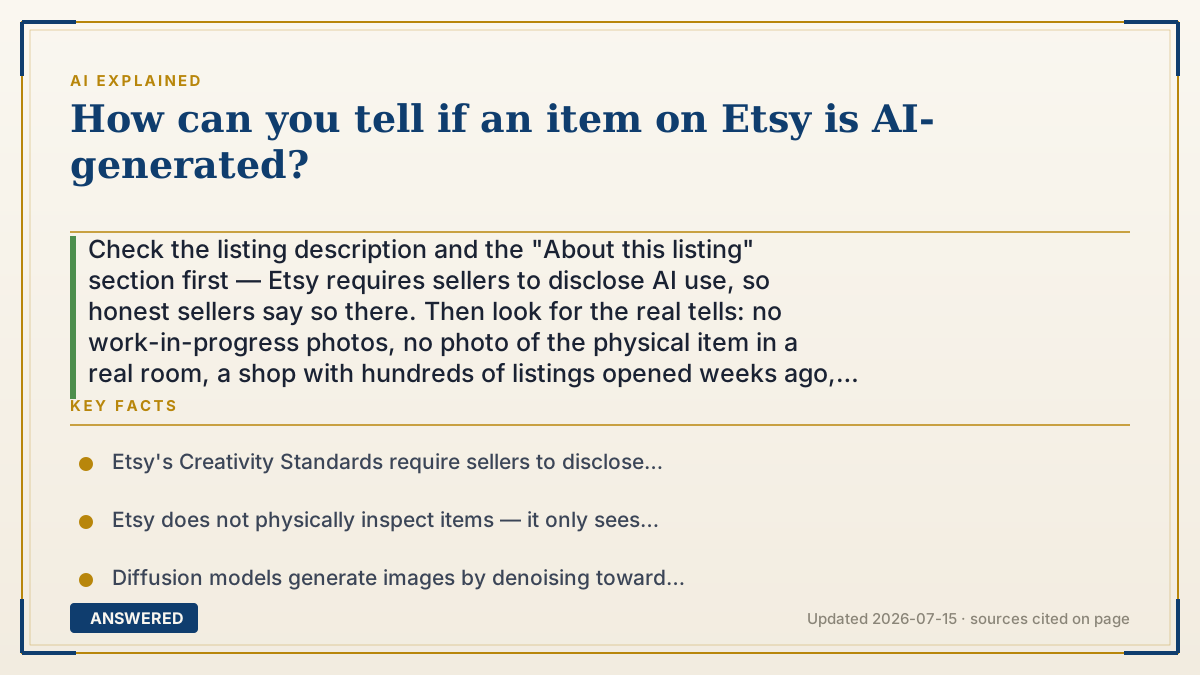
How can you tell if an item on Etsy is AI-generated?
Check the listing description and the "About this listing" section first — Etsy requires sellers to disclose AI use, so honest sellers say so there. Then look for the real tells: no work-in-progress photos, no photo of the physical item in a real room, a shop with hundreds of listings opened weeks ago, and art with smeared text or wrong finger counts.
Why — the first-principles explanation
The core problem is that Etsy is a marketplace, not an inspector. Etsy never sees your item. It sees a photo and a description the seller typed. So enforcement can only work in two ways: rules that make lying against policy, and detection after the fact. Etsy's Creativity Standards require sellers to disclose when an item was created or materially assisted by AI, and there's a place in the listing editor to declare it. That handles honest sellers. It does nothing about dishonest ones, which is precisely who you're worried about.
So you fall back on economics, and this is where the reliable signals live. Making a real thing costs hours. Generating an image costs seconds. That difference doesn't hide well. A human potter physically cannot open 400 listings in three weeks. A human illustrator has a recognizable hand — their faces resemble each other across pieces because they're drawing from the same trained instinct. A generative model has no hand; it has a style setting, so a shop can post watercolor florals, hyperreal portraits, and Art Deco posters in the same month with no development arc between them. Look at the shop, not the picture. Volume and range are harder to fake than any single image.
The visual tells still exist but are weakening fast, and you should know why. Diffusion models generate images by denoising the whole canvas toward something statistically plausible. They have no model of what a hand is — only what hands tend to look like in pixels. That's why fingers used to multiply and text turned to gibberish: local plausibility, global nonsense. Each model generation fixes more of this. Hands are largely solved. Text is mostly solved. So checking for six fingers is a test that works less every year, which is exactly why you shouldn't lean on it.
The most durable tell is different: AI images have no process and no place. A generated image can't show you the item half-finished on a workbench, or sitting on a scuffed kitchen table next to a coffee cup, or held in a hand with a specific chipped nail polish. Sellers who make things have hundreds of those photos lying around because making things generates them for free. Sellers who don't, don't.
An example that makes it click
Imagine two bakeries with identical Instagram accounts. One posts a perfect croissant every day, always in flawless golden light, always at the same angle, never a photo of the kitchen, and it has 300 posts even though the account opened last month. The other posts a slightly lopsided croissant on a flour-dusted counter, a shot of the oven at 5 a.m., a tray that came out too dark with the caption "batch two was better."
You don't need a croissant expert to tell you which one bakes. The mess is the evidence. On Etsy, ask for the mess: the workbench, the misprint, the item on a real table in a real room. Real makers have that on their phone already.
How to do it
- Read the full listing description and the "About this listing" section. Etsy requires disclosure of AI use, so honest sellers state it there. Note who it says made the item — "Designed by" rather than "Made by" is a meaningful distinction.
- Scroll the entire shop, not the one listing. Check the listing count against the shop's opening date. Hundreds of listings in a few weeks is physically impossible for handmade goods.
- Look for style drift. A human artist's work looks related across pieces. A shop jumping between watercolor, photorealism, and vector art with no development arc is running a style dial, not a hand.
- Hunt for process photos: work-in-progress shots, the workbench, packaging, the item photographed in a normal room with normal light. Their total absence is the strongest signal available.
- Zoom in on any lettering, logos, or repeated patterns. Smeared or nonsensical text and patterns that don't tile correctly are classic generative failures — though newer models increasingly avoid them.
- Message the seller and ask a specific process question: what paper stock, what glaze, what printer. Makers answer instantly and in too much detail. Resellers deflect or answer generically.
- Reverse-image search the listing photos. Stolen or stock-generated art often appears on multiple shops across several marketplaces.
- To report: use the "Report this item to Etsy" link at the bottom of the listing page, and select the option covering prohibited items or policy violation. Include specifics — undisclosed AI, listing volume, or duplicate images elsewhere.
Key facts
- Etsy's Creativity Standards require sellers to disclose when an item was created or materially assisted by AI; the listing description and the "About this listing" section are where that disclosure belongs.
- Etsy does not physically inspect items — it only sees seller-supplied photos and text, so all policy enforcement is disclosure-based plus after-the-fact detection.
- Diffusion models generate images by denoising toward statistical plausibility with no internal model of objects, which historically produced extra fingers and garbled text — errors that newer model generations increasingly eliminate.
- Shop-level signals (listing count vs. shop age, style drift, absence of process photos) are more reliable than image-level artifact hunting, because volume and workflow are far harder to fake than any single image.
- Every Etsy listing page has a "Report this item to Etsy" link at the bottom for policy violations.
- As of 2026-07, no AI image detector is accurate enough to be treated as proof; treat any detector output as one weak signal, not a verdict.
▶ The 60-second explainer (script)
How do you tell if an Etsy item is AI-generated? Start with the easy step: read the listing description and the About This Listing section. Etsy's Creativity Standards require sellers to disclose AI use, so honest sellers say so right there. That handles honest sellers — which isn't who you're worried about. So here's the thing that actually works. Etsy never sees your item. It only sees a photo and text the seller typed. So forget the picture and look at the shop. Making a real thing costs hours. Generating an image costs seconds. That gap doesn't hide. A potter physically cannot open four hundred listings in three weeks. A real illustrator has a hand — their faces look related across pieces. A model has a style dial, so a fake shop posts watercolor florals, hyperreal portraits, and Art Deco posters in the same month with no development arc. Volume and range are way harder to fake than any single image. Now, the classic tells — six fingers, garbled text — those are dying. Diffusion models denoise toward plausible pixels with no idea what a hand is. That's why fingers multiplied. Each generation fixes more of it. So don't lean on finger-counting. The durable tell: AI images have no process and no place. No half-finished item on a workbench. No shot on a scuffed kitchen table next to a coffee cup. Real makers have hundreds of those photos already, because making things produces them for free. Ask for one. Watch what happens.
What authoritative sources say
People also ask
Is selling AI-generated items on Etsy against the rules?
Not automatically. Etsy's Creativity Standards require disclosure of AI involvement rather than banning it outright. The violation is hiding it — and misrepresenting who made an item.
Can I use an AI image detector to check a listing photo?
You can, but don't trust the result. AI detectors have well-documented false-positive problems, and an image that's been printed, photographed, and compressed by Etsy is even harder for them to judge. Treat it as one weak hint.
What if a physical item was made from an AI design?
That still requires disclosure under Etsy's standards — the item was materially assisted by AI even though a human printed, cut, or assembled the final product.
How do I report a listing?
Use the "Report this item to Etsy" link at the bottom of the listing page and select the relevant policy violation. Include specifics like undisclosed AI use, implausible listing volume, or the same image appearing in other shops.
Does asking the seller actually help?
Surprisingly, yes. Ask a narrow process question — the exact glaze, paper stock, or printer model. People who make things answer immediately and at length. People who don't tend to deflect or stay generic.