How do teachers detect AI use?
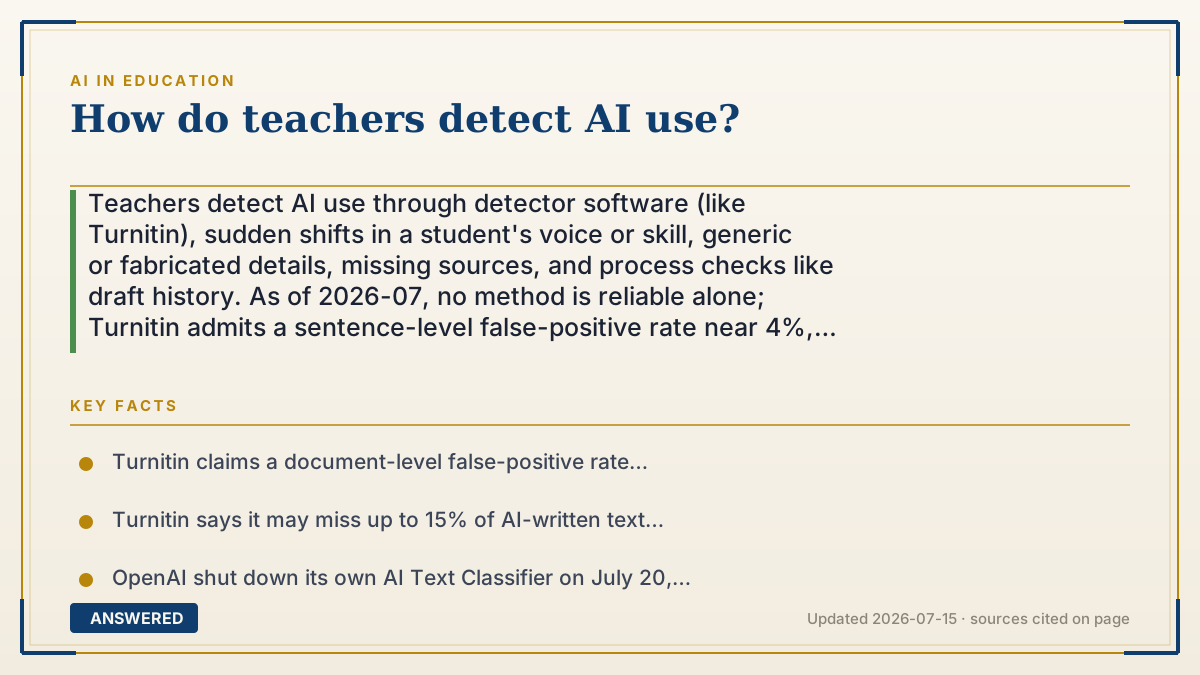
Teachers detect AI use through detector software (like Turnitin), sudden shifts in a student's voice or skill, generic or fabricated details, missing sources, and process checks like draft history. As of 2026-07, no method is reliable alone; Turnitin admits a sentence-level false-positive rate near 4%, so teachers combine signals with conversation.
Why — the first-principles explanation
AI-written text has statistical fingerprints. Language models pick words that are, on average, the most predictable next word, so the writing tends to be smooth, evenly toned, and low in surprise. Detector tools measure this predictability (often called perplexity and burstiness) and flag text that is too uniform. But human writing that is careful and plain also looks uniform, which is exactly why detectors produce false positives.
Detectors are probability estimates, not proof. Turnitin says its document-level false-positive rate is under 1%, but its own chief product officer acknowledged the sentence-level rate is around 4%, and it may miss up to 15% of AI text to keep false alarms low. It also suppresses results below a 20% threshold. Because a student can lightly edit AI output to erase the fingerprints, detectors are easy to defeat and unsafe as sole evidence.
That is why experienced teachers rely more on human signals: a paper that suddenly jumps two grade levels, citations to books that don't exist, an answer that ignores the specific prompt, or a student who can't explain their own essay. The most defensible method is process evidence — Google Docs version history, drafts, outlines, and a short oral follow-up — because it shows the learning, not just the final text.
An example that makes it click
Imagine a bakery contest where every entry is supposed to be homemade. A judge can't chemically prove a cake came from a box, but the clues add up: the frosting is suspiciously perfect, the baker can't say what temperature they used, and there are no dirty mixing bowls at home. Any one clue could be innocent, but together they justify a friendly question: "Walk me through how you made this."
AI detection works the same way. The detector score is like the too-perfect frosting: a hint, not a verdict. The teacher asking you to explain your essay is the "show me your dirty bowls" step, and it's the fairest one.
How to do it
- Read for voice shifts: compare the work to the student's past writing and in-class samples.
- Check the details: look for fake citations, invented quotes, or facts that don't match the assigned readings.
- Run a detector as one signal only, never as sole proof, given false-positive rates.
- Ask for process evidence: draft history, outlines, notes, and Google Docs version history.
- Have a brief, non-accusatory conversation: ask the student to explain or expand a point live.
- Follow the school's academic-integrity policy before making any formal accusation.
Key facts
- Turnitin claims a document-level false-positive rate under 1% but acknowledges a sentence-level rate around 4%.
- Turnitin says it may miss up to 15% of AI-written text to keep false positives low, and suppresses scores under a 20% threshold.
- OpenAI shut down its own AI Text Classifier on July 20, 2023 because it correctly flagged only 26% of AI text.
- Detectors measure text predictability (perplexity/burstiness), which lightly edited AI text can defeat.
- Process evidence (draft history, outlines, oral follow-up) is the most defensible detection method.
▶ The 60-second explainer (script)
How do teachers spot AI use? They stack up clues. First, detector tools like Turnitin measure how predictable the writing is, because AI tends to write in smooth, low-surprise patterns. But these tools are only estimates. Turnitin admits its sentence-level false-positive rate is around four percent, and OpenAI shut down its own detector back in 2023 because it caught only twenty-six percent of AI text. So teachers rely more on human signals: writing that suddenly jumps a grade level, citations to books that don't exist, or a student who can't explain their own essay. The strongest method isn't a score at all. It's process evidence, like Google Docs version history and drafts, plus a quick chat where you explain your thinking. Any single clue can be innocent, so a fair teacher treats a flag as a reason to talk, not a verdict. If you did the work, your draft history and your ability to explain it are your best defense.
What authoritative sources say
People also ask
Can teachers prove I used AI?
Rarely with certainty. Detector scores are probability estimates with real false-positive rates, so most schools require additional evidence like drafts or an explanation.
Does Turnitin catch all AI writing?
No. Turnitin says it may miss up to 15% of AI text, and lightly edited AI output often slips through.
What's the strongest evidence a teacher can use?
Process evidence: version history, outlines, and a short conversation where you explain your own reasoning.
Can a false positive get me in trouble?
It can trigger a question, but fair policies require more than a score. Keep your drafts and notes to protect yourself.