How do you get AI to make you money, according to Reddit?
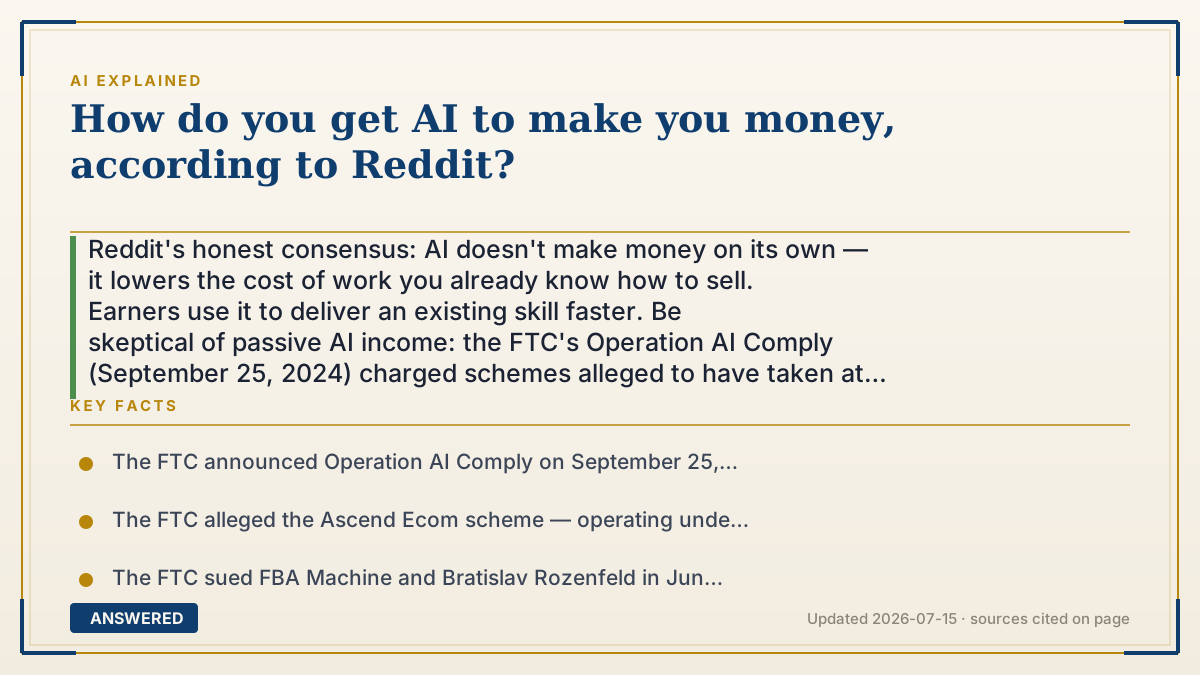
Reddit's honest consensus: AI doesn't make money on its own — it lowers the cost of work you already know how to sell. Earners use it to deliver an existing skill faster. Be skeptical of passive AI income: the FTC's Operation AI Comply (September 25, 2024) charged schemes alleged to have taken at least $25 million.
Why — the first-principles explanation
The reason "AI passive income" fails is economics, not effort. AI's defining property is that it makes a certain kind of output nearly free to produce. Anything nearly free to produce is nearly worthless to sell, because your customer can produce it too, for free, in thirty seconds. So the moment a business model is "I generate content with AI and sell it," you're selling something with a marginal cost approaching zero into a market where supply is infinite. Price goes to zero. This isn't a Reddit opinion — it's the same reason nobody sells bottled air.
What AI actually does is shift where value sits. If generation is free, then the scarce things are distribution (who sees it), trust (who believes you), judgment (knowing which output is any good), and access to the customer (who has the problem and a budget). None of those are things AI gives you. This is why Reddit threads converge on a boring answer: freelancers who already had clients now serve more of them; developers who already shipped now ship faster; consultants who already knew a niche now produce deliverables in an hour instead of a day. In every case AI multiplied something that already existed. Multiply zero and you still get zero.
This mechanism is also why the scams work. The pitch "AI will run a business for you" is attractive precisely to people who don't have the distribution, trust, or judgment — the exact people for whom it can't work. The FTC's Operation AI Comply, announced September 25, 2024, brought five enforcement actions on this theme. The Ascend Ecom case alleged consumers were charged tens of thousands of dollars to open AI-run online storefronts, plus tens of thousands more for inventory, on claims of proprietary AI maximizing their success; the FTC alleged at least $25 million in consumer losses. FBA Machine allegedly took over $15 million on similar promises of AI-powered passive income. The FTC's framing is the useful part: "AI" was a credibility label on classic get-rich-quick schemes, not a new kind of business.
The honest arithmetic on the legitimate path: the ILO's 2025 analysis found roughly one in four workers hold jobs with some generative-AI exposure, and concluded that jobs are being transformed rather than eliminated. Transformed is exactly the opportunity. The person who does their existing job 3x faster captures real value. The person with no job to transform has nothing to multiply.
An example that makes it click
Imagine someone invents a machine that prints perfect restaurant menus in one second, free, and gives one to everybody in town. Do you get rich printing menus? Obviously not — your neighbor has the same machine. Menus are now worth nothing.
Who does get rich? The chef who already had a restaurant and now updates her menu daily instead of twice a year, because she's the one with the kitchen, the customers, and the taste to know which dish belongs on it. The machine didn't give her any of that. It just removed the one bottleneck she had.
And the guy selling a $30,000 course on "passive menu-printing income"? He's not making money from menus. He's making money from you.
How to do it
- Start from a skill or an audience you already have. AI multiplies existing capability; it cannot create the customer, the credibility, or the judgment about what's good.
- Pick work where the output is verifiable and someone already pays for it — code, copy for a specific business, design, editing, research, bookkeeping. Avoid anything whose only input is 'AI generated it.'
- Use AI to compress delivery time, then either take more clients at the same rate or charge for the outcome rather than the hour. That's where the actual margin appears.
- Sell the judgment layer, not the generation layer. Clients pay you to know which of the twenty AI outputs is correct and why — that's the part they can't do themselves.
- Test demand before you build: get one paying customer for the manual version before you automate anything. If nobody pays for it slow, nobody pays for it fast.
- Screen every 'AI business opportunity' against the FTC's pattern: upfront fees in the thousands, earnings guarantees, 'proprietary AI,' passive income framing, required inventory purchases. All five appeared in the Operation AI Comply complaints.
- Never pay for an income claim. Legitimate tools charge for the tool, not for a promised return. Guaranteed earnings from a business opportunity are a documented fraud marker, not a bonus.
Key facts
- The FTC announced Operation AI Comply on September 25, 2024, bringing five enforcement actions against companies using AI claims to supercharge deceptive conduct.
- The FTC alleged the Ascend Ecom scheme — operating under names including Ascend Ecommerce, Ascend CapVentures and ACV since 2021 — defrauded consumers of at least $25 million with claims that proprietary AI would maximize their ecommerce success.
- The FTC sued FBA Machine and Bratislav Rozenfeld in June 2024, alleging false guarantees that consumers could earn money with AI-powered storefront software and over $15 million in consumer losses.
- FTC complaints describe the pattern: consumers charged tens of thousands of dollars upfront, plus tens of thousands more for inventory, on promises of AI-driven passive income.
- The ILO's 2025 update finds about one in four workers are in occupations with generative-AI exposure and concludes most jobs will be transformed rather than made redundant.
- AI-generated output has near-zero marginal cost, which means selling the generation itself competes against infinite free supply — the structural reason 'AI content business' models collapse.
▶ The 60-second explainer (script)
How do you get AI to make you money? Reddit's honest answer is one most people don't want: AI doesn't make money. It multiplies money-making you're already doing. Here's the logic. AI makes certain output nearly free to produce. Anything nearly free to produce is nearly worthless to sell — because your customer can make it too, in thirty seconds, for nothing. So 'I'll generate content with AI and sell it' is a business selling into infinite supply. The price goes to zero. What's still scarce? Distribution. Trust. Judgment about which output is any good. A customer who has a problem and a budget. AI gives you none of those. That's why the threads that survive scrutiny all say the same thing: freelancers with clients now serve more clients. Developers who shipped now ship faster. Multiply something by three and you get more. Multiply zero and you still get zero. Now the warning, with real numbers. In September 2024 the FTC launched Operation AI Comply. One case, Ascend Ecom, allegedly took at least twenty-five million dollars from people by promising proprietary AI would run their online stores. Another, FBA Machine, over fifteen million. The FTC's own framing is the lesson: AI was a credibility label on a classic get-rich-quick scheme. If it promises passive income and asks for money upfront, that's the scheme.
What authoritative sources say
People also ask
Can AI generate passive income?
No documented business does this reliably, and it's the exact claim the FTC prosecuted in Operation AI Comply — cases alleging $25 million and $15 million in consumer losses. Output AI produces for free is output your customers can also produce for free, so it can't sustain a price.
What actually works, then?
Using AI to deliver a skill you can already sell, faster. Freelancers, developers, and consultants with existing clients capture real gains because AI removes their bottleneck. The value sits in distribution, trust, and judgment — none of which AI supplies.
How do I spot an AI money-making scam?
Look for the FTC's documented pattern: thousands in upfront fees, earnings guarantees, claims of 'proprietary AI,' passive-income framing, and required inventory purchases. All five appeared in the Operation AI Comply complaints.
Is selling AI-generated content on Etsy or Amazon viable?
Structurally weak. Marginal cost near zero plus unlimited competitors means prices collapse toward the cost of production. Sellers who do earn are usually winning on distribution or niche knowledge — the AI is incidental.
Should I pay for an AI business course?
Pay for tools, never for an income claim. Legitimate software charges for the software; a guaranteed return on a business opportunity is a documented fraud marker that the FTC has repeatedly prosecuted.