How do you defend yourself against accusations of using AI?
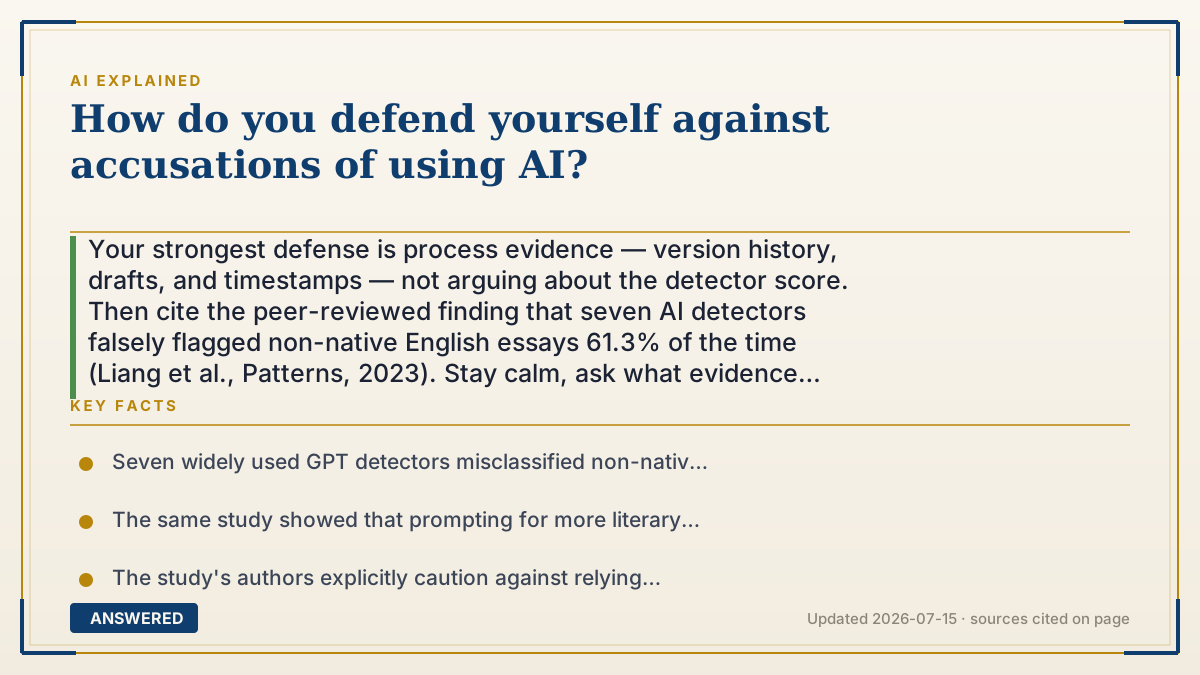
Your strongest defense is process evidence — version history, drafts, and timestamps — not arguing about the detector score. Then cite the peer-reviewed finding that seven AI detectors falsely flagged non-native English essays 61.3% of the time (Liang et al., Patterns, 2023). Stay calm, ask what evidence exists besides the score, and request the written appeals procedure.
Why — the first-principles explanation
Understand what the accusation actually rests on, because it's usually weaker than it sounds. AI detectors don't detect AI. They measure predictability — how closely your word choices match what a language model would have predicted. A model writes low-surprise text, so low-surprise text scores as "AI." But plenty of humans write low-surprise text: people writing in a second language, people writing in a formal register, people writing about a technical topic where the standard phrasing is the standard phrasing. The detector cannot tell those apart from a machine. It was never able to.
This isn't a fringe complaint. A Stanford team published in Patterns (July 2023) ran essays through seven widely used detectors. TOEFL essays by non-native English writers were flagged as AI-generated 61.3% of the time. Essays by US eighth-graders were classified nearly perfectly. The kicker is the follow-up test: when they rewrote the TOEFL essays with more literary, native-like language, the false flags dropped — and when they simplified native English writing, the false flags went up. Same authors, same honesty, different score. That's proof the tool is measuring vocabulary richness, not authorship. Even Turnitin's own published guidance notes it withholds scores in the low ranges because they aren't reliable, and says the score shouldn't be treated as proof of misconduct by itself.
So the defense strategy follows from the mechanism. Arguing "the detector is wrong" is weak because it's your word against a number. Showing your work is strong because it produces evidence the detector can't touch. Google Docs version history, Word's autosave revisions, browser research tabs, a messy draft with abandoned paragraphs, notes in your handwriting — these show a document becoming. AI-generated text has no becoming. It arrives.
One practical warning: don't try to "prove" your innocence by re-running the text through other detectors. They disagree with each other constantly, and a second bad score handed over voluntarily just hands your accuser more ammunition. And don't offer to rewrite it — that reads as an admission. Ask instead what evidence exists besides the score.
An example that makes it click
Imagine being accused of not baking a cake yourself because it looks too neat. You could argue about the frosting. Or you could open your phone and show 14 photos: flour on the counter at 2:10, a collapsed first attempt at 2:45, the trash can with the failed one in it, your grandmother's handwritten card, and the finished cake at 4:30.
The photos win, and the argument doesn't. Nobody who bought a cake has photos of the failure they threw away. That's what version history is: the pictures of your flour on the counter. This is also why the best defense starts before the accusation — you can't take those photos after the cake is done.
How to do it
- Do not reply while angry, and do not confess to something you didn't do just to end the conversation. Ask for the claim in writing and for time to respond.
- Gather process evidence immediately: Google Docs version history (File > Version history > See version history), Word autosave revisions, OneDrive/Dropbox file versions, and any dated drafts or notes.
- Collect your research trail — browser history, library records, downloaded PDFs, annotated sources, and any messages where you discussed the assignment while writing it.
- Ask one specific question: 'Besides the detector score, what evidence supports this?' Detector-only accusations are the weakest kind, and making that explicit shifts the burden.
- Cite the actual research, not a blog: Liang et al., Patterns, July 2023 — seven detectors flagged non-native English TOEFL essays 61.3% of the time versus near-perfect accuracy on native-speaker essays.
- Point to the vendor's own limits. Turnitin's published guidance withholds AI scores in the low percentage ranges as unreliable and states the score is not by itself proof of misconduct.
- Offer to discuss the content: explain your argument, your sources, and why you made specific choices. Someone who wrote it can do this; a pasted output can't.
- Request the written appeals procedure and follow it in writing. If the stakes are serious (failing grade, suspension, expulsion), ask whether you may bring an advisor and keep a record of every exchange.
- Going forward, write in a tool with version history turned on, and keep your drafts. This costs nothing and is the only defense that works before you need it.
Key facts
- Seven widely used GPT detectors misclassified non-native English TOEFL essays as AI-generated 61.3% of the time, while US eighth-grade essays were classified near-perfectly (Liang et al., Patterns, July 10, 2023).
- The same study showed that prompting for more literary language reduced false flags on non-native essays, and that simplifying native English writing increased false flags — the detector tracks vocabulary predictability, not authorship.
- The study's authors explicitly caution against relying on these detectors in evaluative and educational settings because of this bias.
- Turnitin's published guidance states no score or highlights are attributed for AI detection results in the 1%-19% range because of unreliability at low thresholds, and that its score is not by itself proof of misconduct.
- Google Docs retains version history under File > Version history, and Microsoft Word/OneDrive retain autosave revisions — both produce timestamped evidence of drafting that a detector score cannot rebut.
- Different AI detectors frequently disagree on the same document, so a second opinion from another detector is not exculpatory evidence.
▶ The 60-second explainer (script)
Accused of using AI when you didn't? Here's what actually works. First, understand the weapon pointed at you. AI detectors don't detect AI. They measure predictability — how closely your writing matches what a model would have guessed. Write plainly, or write in your second language, and you score as a machine. This is documented. A Stanford team published in the journal Patterns in July 2023 ran essays through seven detectors. Essays by non-native English writers got flagged as AI sixty-one point three percent of the time. American eighth-graders? Near perfect. And when researchers made the non-native essays fancier, the false flags dropped. Same author, same honesty, different score. Now the strategy. Do not argue about the number — that's your word against a statistic, and you lose. Instead, show process. Google Docs version history. Word autosave revisions. Your messy first draft with the paragraph you deleted. Browser tabs. Notes. AI output has no drafts. It just arrives. Then ask one question, in writing: besides the detector score, what evidence is there? Don't run it through other detectors — they disagree with each other and you'd be handing over ammunition. Don't offer to rewrite it; that reads as guilt. Ask for the appeals procedure and keep everything in writing.
What authoritative sources say
People also ask
What is the single best piece of evidence?
Version history. Google Docs and Microsoft Word both keep timestamped revisions showing a document being built over time, including the parts you deleted. Generated text has no drafting trail, so this is evidence a detector score cannot rebut.
Should I run my essay through other AI detectors to prove I'm innocent?
No. Detectors routinely disagree on the same document, so a second bad score just hands your accuser more ammunition. The tools are measuring predictability, so a clean score proves as little as a dirty one.
Can a school punish me based only on a detector score?
Policies vary by institution, but the research and the vendors both undercut score-only accusations — Turnitin's own guidance says the score isn't proof of misconduct by itself. Ask in writing what evidence exists beyond the score, and request the appeals procedure.
Why do I keep getting flagged when English is my second language?
Because non-native writing tends to use a smaller, more predictable vocabulary, which is exactly the signal detectors read as machine-generated. Seven detectors misclassified non-native TOEFL essays 61.3% of the time in peer-reviewed testing. This is a known bias in the tools.
How do I protect myself in the future?
Write in a tool with version history enabled, keep your drafts and notes, and don't compose in a blank box that saves no revisions. The defense has to exist before the accusation — you can't create a drafting trail afterward.