How does ChatGPT work?
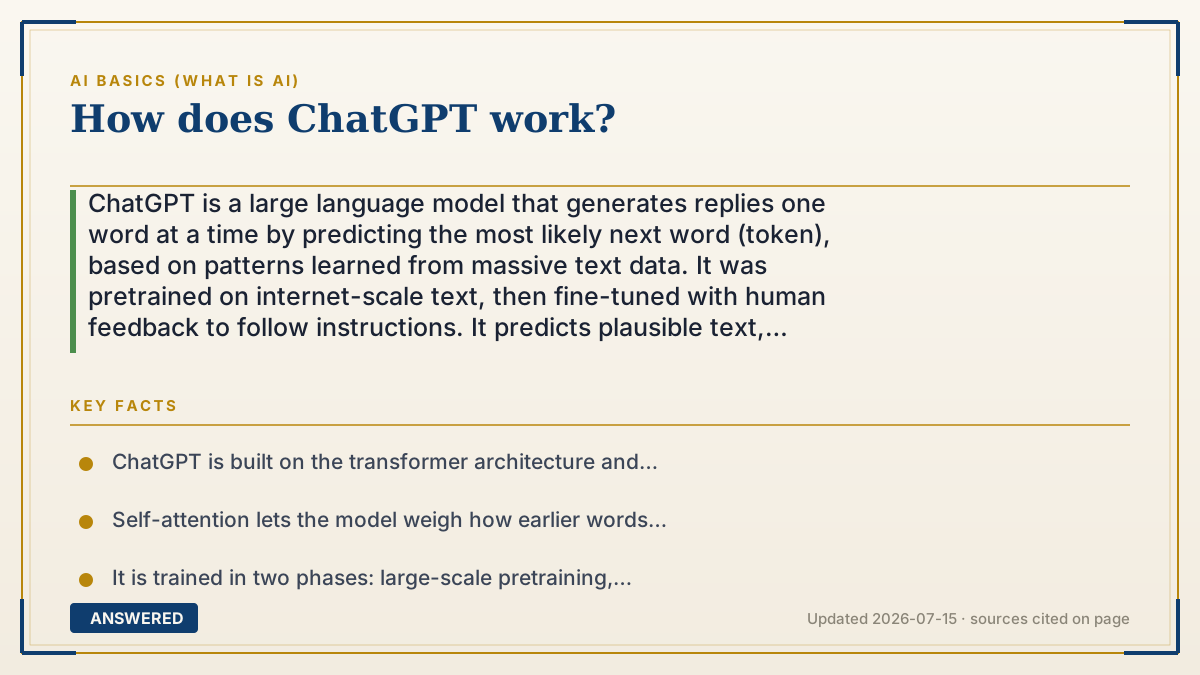
ChatGPT is a large language model that generates replies one word at a time by predicting the most likely next word (token), based on patterns learned from massive text data. It was pretrained on internet-scale text, then fine-tuned with human feedback to follow instructions. It predicts plausible text, not verified truth.
Why — the first-principles explanation
ChatGPT runs on a transformer neural network. Its whole job is deceptively simple: given the words so far, predict the next word. It does this using a mechanism called self-attention, which lets the model weigh how much every earlier word should influence the next one, so it keeps track of context across a long passage. Generate one word, add it to the sentence, predict again, and a fluent paragraph appears.
Getting there takes two big stages. First, pretraining: the model reads an enormous amount of text and adjusts billions of internal numbers to get good at next-word prediction. This gives it grammar, facts, and reasoning-like patterns, but it just autocompletes and doesn't naturally answer questions helpfully. Second, alignment: humans rate example responses and the model is fine-tuned (using reinforcement learning from human feedback, RLHF) to be helpful, honest, and to follow instructions like a chat assistant.
The key limitation follows directly from the mechanism. Because ChatGPT outputs the statistically likely continuation rather than looking up a fact, it can produce confident, well-written statements that are wrong. These are called hallucinations. It also has a knowledge cutoff and no live understanding, so for anything important you verify its output against a trusted source.
An example that makes it click
Think of your phone's autocomplete on steroids. When you type "I'm running late, I'll be there in..." your phone suggests "5 minutes." It's guessing the next word from patterns. ChatGPT is the same idea scaled up massively: it predicts the next word again and again, keeping the whole conversation in view, until it has written a full, coherent answer.
But just like autocomplete sometimes suggests a silly word, ChatGPT sometimes strings together a smooth sentence that happens to be false. It's picking likely words, not checking a fact sheet, so you stay the fact-checker.
Key facts
- ChatGPT is built on the transformer architecture and generates text by predicting the next token.
- Self-attention lets the model weigh how earlier words affect the next word, preserving context.
- It is trained in two phases: large-scale pretraining, then fine-tuning with human feedback (RLHF).
- As of 2026-07, ChatGPT's Free plan is $0, with Go at $8/month, Plus at $20/month, and Pro at $200/month.
- Because it predicts likely text rather than facts, ChatGPT can hallucinate confident but false answers.
▶ The 60-second explainer (script)
How does ChatGPT work? At its heart, it does one thing: predict the next word. It's a large language model built on something called a transformer. You give it your message, and it generates a reply one word at a time, each time asking 'what word most likely comes next?' A mechanism called self-attention lets it keep the whole conversation in mind, so the words stay on topic. But how did it get good? Two steps. First, pretraining: it read a massive amount of text and tuned billions of internal numbers until it was excellent at guessing the next word. That gave it grammar and facts. Second, human feedback: people rated its answers, and it was fine-tuned to be helpful and follow instructions, turning autocomplete into an assistant. The catch? It predicts likely words, not verified truth, so it can sound confident and still be wrong. Those are called hallucinations. Use it as a brilliant first draft, then check anything that matters.
What authoritative sources say
People also ask
Does ChatGPT search the internet for each answer?
Not by default in its base mode; it generates from learned patterns. Some paid features and modes can browse the web, but the core model predicts text.
Why does ChatGPT sometimes make things up?
It predicts statistically likely words rather than retrieving verified facts, so it can produce fluent but false statements called hallucinations.
What does GPT stand for?
Generative Pre-trained Transformer: it generates text, it was pretrained on large data, and it uses the transformer architecture.
Is ChatGPT conscious or thinking?
No. It has no awareness or understanding. It is a math model producing likely word sequences based on its training.