How does Grok AI know your location?
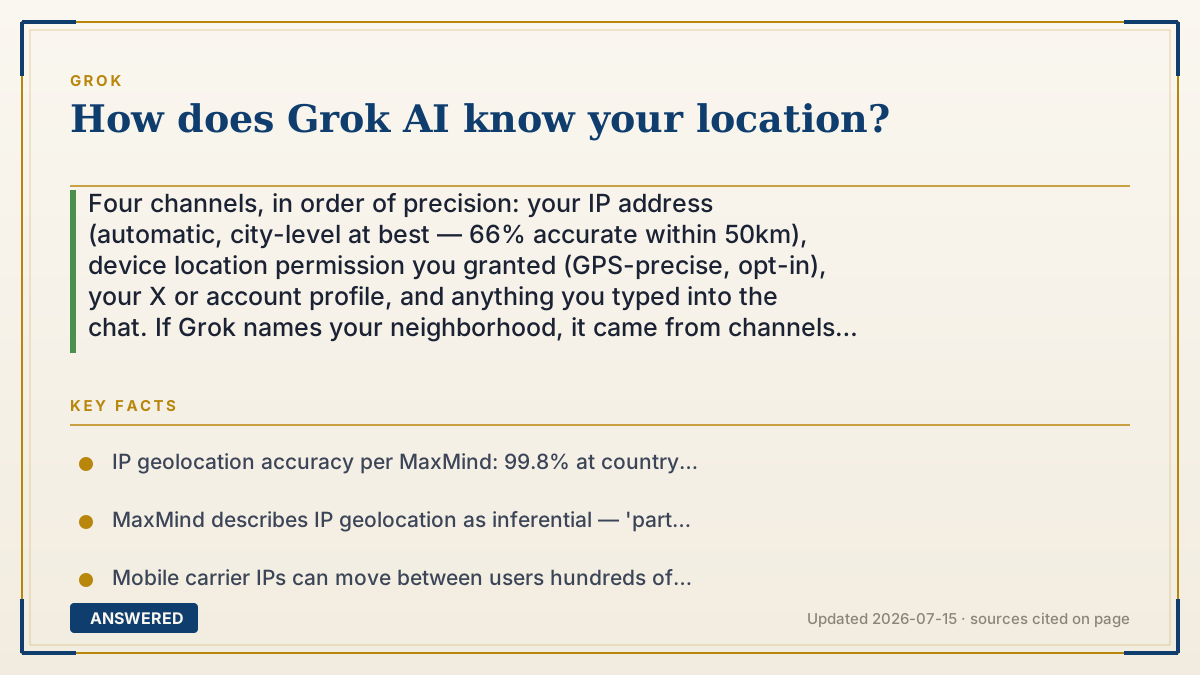
Four channels, in order of precision: your IP address (automatic, city-level at best — 66% accurate within 50km), device location permission you granted (GPS-precise, opt-in), your X or account profile, and anything you typed into the chat. If Grok names your neighborhood, it came from channels 2–4, not your IP.
Why — the first-principles explanation
People imagine one mysterious pipe. There are four, they have very different precision, and only one of them is automatic.
Channel 1 — your IP address. This arrives whether you like it or not; it's how the reply finds its way back to your device. But an IP is a routing label, not a coordinate, so turning it into a place is guesswork built on registry paperwork and ISP routing data. The industry-standard provider, MaxMind, publishes the honest numbers: 99.8% at country level, ~80% at U.S. state level, and 66% for U.S. cities — counting anything within 50 kilometers as correct. VPNs return the server's city. Mobile IPs can hop between users hundreds of kilometers apart in minutes. This channel is coarse by construction.
Channel 2 — device location permission. This is the precise one, and it only exists if you tapped "Allow." Your browser or phone combines GPS, nearby Wi-Fi networks, and cell towers into a fix good to a few meters. Nothing about the model demands this; it's an app permission like any other, and U.S. regulators treat precise geolocation as sensitive data requiring affirmative consent — which is exactly why you get a prompt instead of silent collection.
Channel 3 — your account. Grok lives next door to X. A city in your bio, your billing details, your time zone — that's all just stored data, no inference required, and it's often more accurate than any IP lookup.
Channel 4 — you. This is the one nobody counts. "What's good for dinner near me?" "Is my flight from SFO delayed?" "Traffic on the 405?" The model doesn't need to geolocate anyone who volunteers it. And it's stickier than you'd think — if memory or chat history is on, a location mentioned once can resurface sessions later, which is why Grok sometimes seems to know something you don't remember telling it today.
The practical upshot: precision tells you the source. Country or metro area? That's your IP. Your actual block, or a fact about your commute? That's permission, profile, or your own typing. Diagnosing which channel is leaking is the whole game, because each one has a different off switch.
An example that makes it click
Four people can tell a stranger where you are. The mail carrier knows which neighborhood your mail comes from — vague, and automatic. Your phone's GPS knows which room you're in — precise, but only because you handed it over. Your ID card says which city you registered in — accurate, and just sitting there. And then there's you, mentioning at dinner that you live two blocks from the stadium.
Grok has all four. People blame the mail carrier. It's almost always the fourth one.
How to do it
- Figure out which channel is talking: ask Grok what it thinks your location is. If it says a metro area or a city 30 miles off, that's IP inference. If it's precise, it's permission, profile, or memory.
- Kill the precise channel first: revoke location permission for grok.com in your browser's site settings, and for the Grok app in iOS or Android settings. This is the only channel that can be GPS-accurate.
- Blunt the IP channel: use a VPN. Lookups then return the VPN server's city. This cannot fix anything you already typed.
- Clean the account channel: remove your city from your X or xAI profile, and check the time zone in your settings.
- Stop feeding channel 4: avoid 'near me', local landmarks, your airport code, and your street in prompts — and clear stored chat history or memory, since an old mention can resurface in later sessions.
- Reduce retention: use xAI's Data Controls to opt out of model training, and use a private chat for anything you don't want kept.
Key facts
- IP geolocation accuracy per MaxMind: 99.8% at country level, roughly 80% at U.S. state level, 66% for U.S. cities within a 50km radius; city accuracy across countries ranges 20–75%.
- MaxMind describes IP geolocation as inferential — 'part art, part science' — and notes it does not require user consent, unlike GPS.
- Mobile carrier IPs can move between users hundreds of kilometers apart within minutes, so phone IPs typically resolve only to a broad region.
- VPNs and proxies intentionally mask the true IP, so geolocation returns the VPN or proxy server's location instead.
- The U.S. FTC treats precise geolocation as sensitive data requiring affirmative express consent, which is why GPS-level access requires a device permission prompt while IP inference does not.
- In August 2025, private Grok conversations were exposed to Google indexing through a misconfigured share feature — a reminder that anything typed into a chat, including your location, is stored data.
Open xAI's current consumer entry point and check plans, limits, privacy and cancellation terms before subscribing.
▶ The 60-second explainer (script)
How does Grok know where you are? There isn't one pipe — there are four, and only one of them is automatic. Number one: your IP address. It arrives the moment you connect, because that's how the answer gets back to you. But an IP is a routing label, not a coordinate. Converting it to a place is guesswork. MaxMind, the standard provider, publishes real numbers: country level, ninety-nine point eight percent. City level? Sixty-six percent — and that counts as correct if it lands within fifty kilometers. That's a whole metro area. Number two: device location permission. This one is GPS-precise, accurate to a few meters — and it only exists because you tapped Allow. That's why you get a prompt: regulators treat precise location as sensitive data. Number three: your account. Grok lives next door to X. A city in your bio, your billing info, your time zone — that's just stored, no guessing needed, and often more accurate than any IP lookup. Number four, the one nobody counts: you. Ask about traffic on the 405, or dinner near me, or your flight from SFO, and you've told it. And if memory is on, that can resurface weeks later — which is why Grok sometimes knows something you don't remember mentioning today. Here's the useful trick. Precision tells you the source. Metro area? That's your IP — use a VPN. Your actual block? That's permission, profile, or your own typing. Each has a different off switch.
What authoritative sources say
People also ask
Why does Grok know my city without me telling it?
Your IP address arrives automatically with every connection, and a lookup maps it to an approximate area. That's standard for essentially every website, not something specific to Grok.
Grok named my actual neighborhood. How?
Not from your IP — that isn't precise enough. Check three things: location permission granted to the browser or app, your account profile, and whether you mentioned a landmark or address in this or an earlier chat.
Does turning off location permission stop everything?
No. It removes the GPS-precise channel, which is the most sensitive one. Your IP still arrives, and your profile and past prompts are still stored.
Can Grok track me over time?
Not by GPS if you never granted permission. But an approximate location plus stored chat history builds a rough pattern anyway — which is why clearing history and using private chat matters more than most people think.
Is Grok worse than other chatbots for this?
The mechanics are the same for all of them — IP, permission, profile, prompts. Grok's difference is proximity to X, meaning account data and public posts sit unusually close to the chatbot.
The same question, asked other ways
- Does Grok AI know your location from your IP address?
- How does Grok know my location?
- How does Grok know my location without me telling it?