How many jobs will AI replace by 2030?
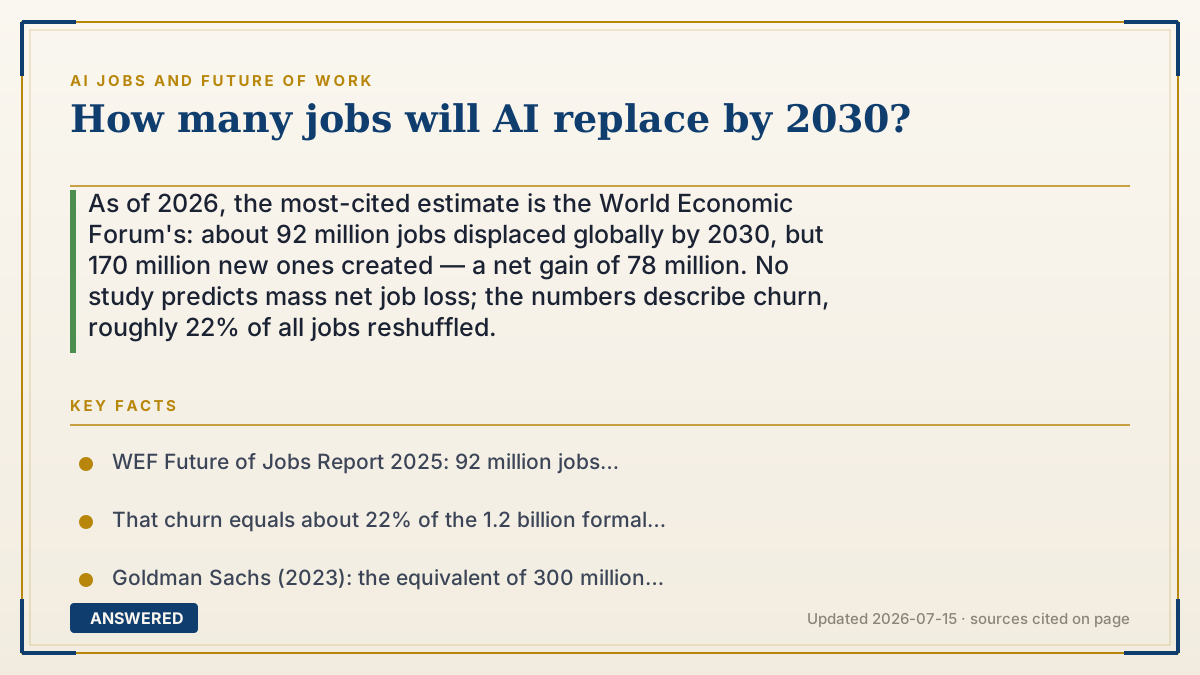
As of 2026, the most-cited estimate is the World Economic Forum's: about 92 million jobs displaced globally by 2030, but 170 million new ones created — a net gain of 78 million. No study predicts mass net job loss; the numbers describe churn, roughly 22% of all jobs reshuffled.
Why — the first-principles explanation
The word "replace" is misleading, and that is the key to the whole question. AI does not swallow a "job" the way a machine swallows a coin. A job is a bundle of tasks — a bookkeeper reconciles numbers, but also answers questions, spots odd patterns, and reassures a nervous client. AI automates specific tasks, not whole bundles. When enough tasks in a role get automated, the role either shrinks in headcount, changes shape, or splits into new roles.
That is why serious forecasts give two numbers, not one. The World Economic Forum's Future of Jobs Report 2025 surveyed over 1,000 employers covering 14 million workers and projected 92 million roles displaced and 170 million created by 2030. Goldman Sachs framed it differently: roughly 300 million full-time jobs worldwide are exposed to some automation — but "exposed" means a quarter to half of the tasks could be done by AI, not that the person is fired.
The gap between headlines comes from mixing up three things: tasks exposed, jobs displaced, and net jobs lost. Exposure is huge (Goldman: two-thirds of US occupations touched). Displacement is real but smaller. Net loss, in most models, is near zero or positive because new work appears — data specialists, AI trainers, and roles we cannot name yet. Forrester, taking the most conservative US view, sees only about 6% of US jobs (10.4 million) actually lost to automation by 2030.
An example that makes it click
Think of a big restaurant kitchen that buys a machine to peel and chop vegetables. Before, ten cooks spent two hours a day chopping. Now the machine does it. Did the machine "replace" ten cooks? No — it replaced the chopping. Two cooks might leave, but the kitchen now plates fancier dishes, so it hires a pastry chef and a delivery coordinator it never had before.
Count only the two cooks who left and you'd say "AI destroyed jobs." Count the whole kitchen and headcount actually went up, with different job titles. That's exactly what the 92-million-out, 170-million-in numbers are describing across the world economy.
Key facts
- WEF Future of Jobs Report 2025: 92 million jobs displaced and 170 million created by 2030, a net gain of 78 million.
- That churn equals about 22% of the 1.2 billion formal jobs studied by the WEF.
- Goldman Sachs (2023): the equivalent of 300 million full-time jobs globally are exposed to AI automation, with a quarter to half of tasks automatable.
- Forrester (Jan 2026): AI and automation will cut about 6.1% of US jobs — roughly 10.4 million — by 2030.
- McKinsey: up to 30% of hours worked in the US economy could be automated by 2030, driving about 12 million occupational transitions.
▶ The 60-second explainer (script)
How many jobs will AI replace by 2030? The honest answer: fewer than the scary headlines suggest. The most respected estimate, from the World Economic Forum, projects about 92 million jobs displaced worldwide by 2030 — but 170 million new jobs created, for a net gain of 78 million. Here's the trick most articles miss. AI doesn't eat whole jobs; it eats tasks. Goldman Sachs says 300 million jobs are exposed to AI, but exposed means a chunk of the work could be automated, not that the person is fired. Some roles shrink, some change, and brand-new roles appear. The most cautious forecast, from Forrester, sees only about six percent of US jobs actually lost by 2030. So the real story isn't replacement — it's reshuffling. Roughly one in five jobs will change shape. The smart move is to ask which of your tasks are exposed, and build skills around the parts AI can't do.
What authoritative sources say
People also ask
Will AI cause mass unemployment by 2030?
No major forecast predicts that. Most, including the WEF, project net job growth because new roles are created faster than old ones disappear, even as many jobs change shape.
Why do the numbers differ so much between studies?
They measure different things. Goldman's 300 million counts jobs exposed to some automation; the WEF's 92 million counts actual displacement; Forrester's 6% counts net US losses.
Which jobs are displaced most?
Clerical and secretarial roles — cashiers, data entry clerks, and administrative assistants — top the WEF's list of fastest-declining jobs through 2030.
Is a net gain of 78 million guaranteed?
No. It is a survey-based projection, not a promise. It assumes employers reskill workers; without that, displacement could outpace creation in specific regions and sectors.