How to future proof your career against AI?
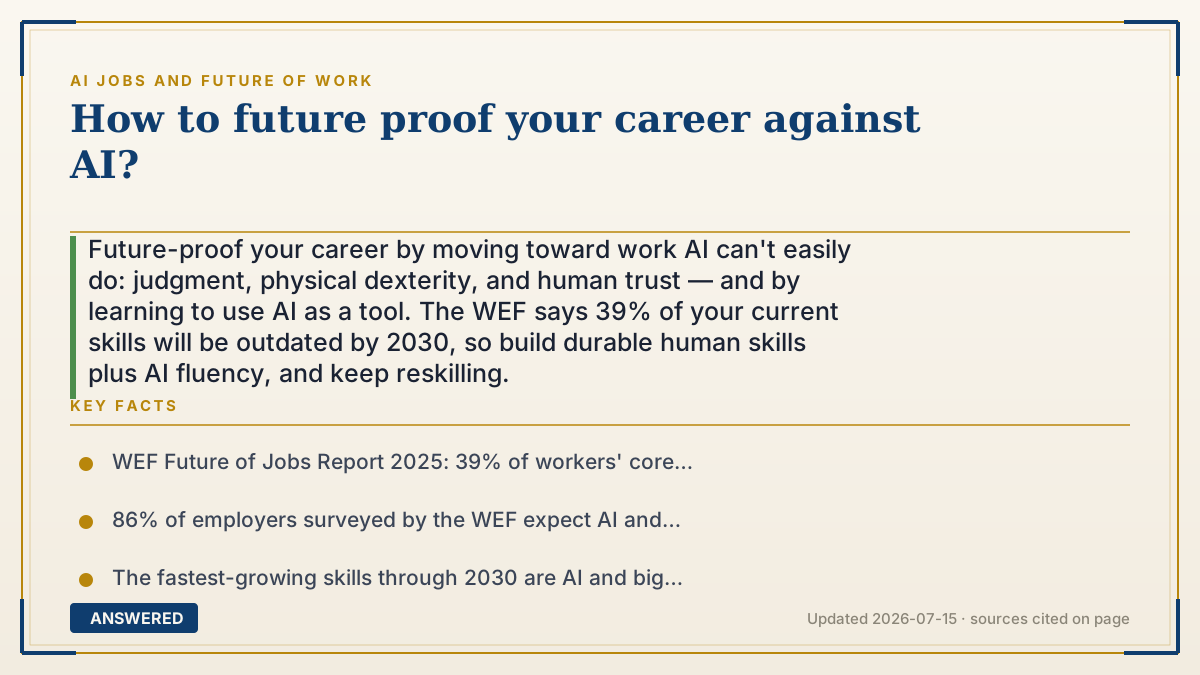
Future-proof your career by moving toward work AI can't easily do: judgment, physical dexterity, and human trust — and by learning to use AI as a tool. The WEF says 39% of your current skills will be outdated by 2030, so build durable human skills plus AI fluency, and keep reskilling.
Why — the first-principles explanation
AI is strong where work is predictable and pattern-based, and weak where work needs a body, real accountability, or human trust. That single split tells you which way to steer. Today's AI predicts the next likely word, pixel, or action from patterns in training data. It has no fingers, takes no legal responsibility, and cannot truly care about a customer. So tasks that are repetitive and screen-based are the most exposed; tasks that need hands, presence, or a person willing to be blamed are the safest.
The second principle is that skills decay faster than they used to. The World Economic Forum estimates 39% of workers' core skills will be transformed or outdated between 2025 and 2030. "Future-proof" therefore can't mean picking one safe skill and coasting. It means becoming someone who reskills on purpose — the durable meta-skill is the ability to learn new tools quickly.
Third, the people who thrive are usually not the ones who avoid AI but the ones who command it. In most fields the near-term threat is not "a robot takes my job" but "a colleague who uses AI well does my job in half the time." So the winning position is a stack: deep human judgment in a domain, plus fluency directing AI tools, plus at least one skill that lives off-screen. That combination is hard for software to copy and hard for a cheaper worker to undercut.
An example that makes it click
Picture two accountants. One spends the day manually typing numbers into spreadsheets — exactly the task AI does fastest and cheapest. The other learns to let AI draft the spreadsheet in seconds, then spends her time sitting with clients, catching a fraud pattern the software missed, and signing off with her professional name on the line.
When AI arrives, the first accountant's core task evaporates. The second one just got a super-fast assistant and became more valuable, because the parts of her job that matter — trust, judgment, responsibility — are the parts AI can't hold. Future-proofing is simply choosing to be the second accountant on purpose.
How to do it
- Audit your job: list your weekly tasks and mark each as 'repetitive/screen-based' (high AI exposure) or 'judgment/physical/relationship' (low exposure).
- Shift your time toward the low-exposure tasks and volunteer for work that needs client trust, negotiation, or hands-on problem-solving.
- Become fluent with AI tools in your field — learn to prompt, verify, and edit AI output so you're the one directing it, not competing with it.
- Build one durable human skill: leadership, complex communication, sales, or a hands-on craft that doesn't live on a screen.
- Treat learning as continuous: budget a few hours weekly for new tools, since about 39% of your skills will shift by 2030.
- Grow your network and reputation — referrals and trust are assets AI cannot generate for you.
Key facts
- WEF Future of Jobs Report 2025: 39% of workers' core skills are expected to be transformed or outdated between 2025 and 2030.
- 86% of employers surveyed by the WEF expect AI and information processing to transform their business by 2030.
- The fastest-growing skills through 2030 are AI and big data, networks and cybersecurity, and technology literacy — alongside human skills like creative thinking and resilience.
- The IMF estimates about 60% of jobs in advanced economies are exposed to AI, but roughly half of those could be enhanced rather than replaced.
- WEF's fastest-growing roles include AI and machine learning specialists, big data specialists, and software developers.
▶ The 60-second explainer (script)
Want to future-proof your career against AI? Start with one rule: AI is strong where work is predictable and screen-based, and weak where work needs a body, real judgment, or human trust. So steer toward the second kind. Three moves. First, audit your job — list your tasks and mark which are repetitive and which need judgment, hands, or relationships. Shift your time toward the second group. Second, learn to command AI tools in your field, because the near-term threat isn't a robot taking your job — it's a coworker who uses AI doing your job in half the time. Third, keep learning, because the World Economic Forum says thirty-nine percent of your skills will be outdated by 2030. The safest career isn't one AI can't touch — it's being the person who blends deep human judgment with AI fluency. That combination is hard to automate and hard to undercut.
What authoritative sources say
People also ask
What's the single best skill to future-proof my career?
The ability to learn continuously. Specific tools change fast, so being someone who reskills quickly and directs AI beats mastering any one tool that may soon be outdated.
Should I avoid AI or embrace it?
Embrace it. The people most at risk aren't those who use AI — they're those replaced by colleagues who use AI well. Learn to command the tools in your field.
Are hands-on trades safer than office jobs?
Often, yes. Jobs needing physical dexterity in unpredictable settings — electricians, nurses, plumbers — are among the least exposed to current AI, which has no body.
How often should I update my skills?
Treat it as ongoing. With about 39% of skills shifting by 2030, budgeting a few hours a week for new tools and knowledge keeps you ahead of the churn.
The same question, asked other ways
- What skills should I learn to stay relevant with AI?
- How can employees future proof their careers against AI?
- How can people stay competitive in an AI-driven future?
- How can we prepare for the future of work in an AI-driven world?
- How can I make sure AI doesn't replace my job?