How many jobs will AI take over?
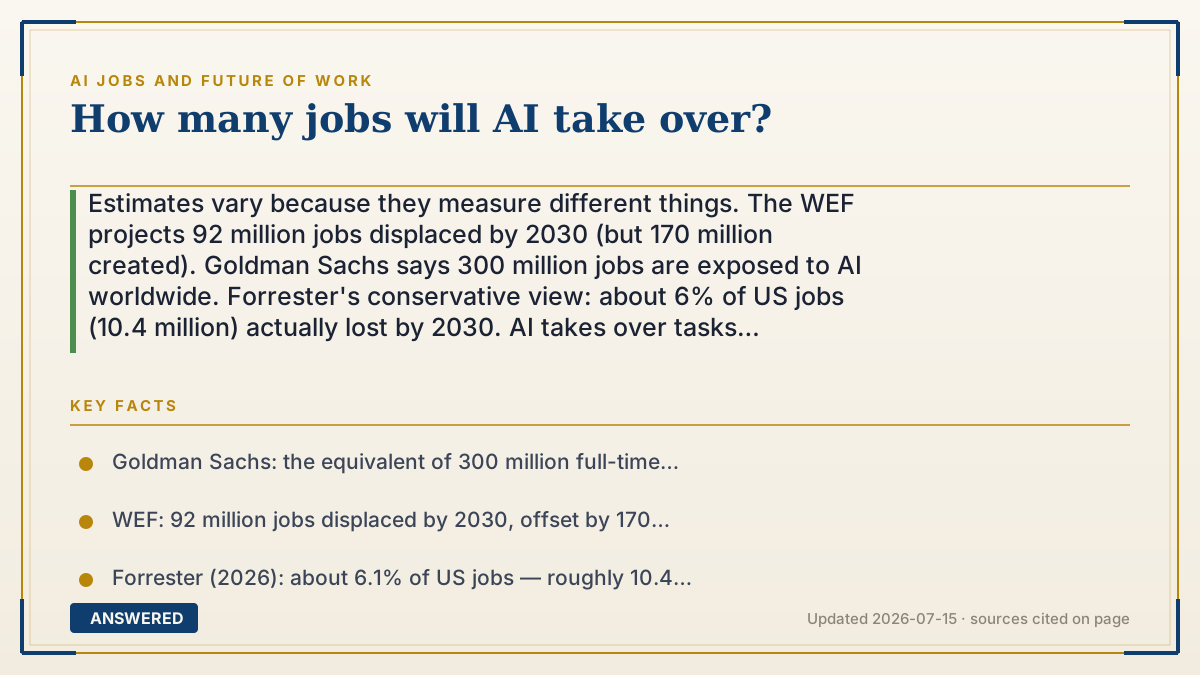
Estimates vary because they measure different things. The WEF projects 92 million jobs displaced by 2030 (but 170 million created). Goldman Sachs says 300 million jobs are exposed to AI worldwide. Forrester's conservative view: about 6% of US jobs (10.4 million) actually lost by 2030. AI takes over tasks first, whole jobs far less often.
Why — the first-principles explanation
The reason "how many jobs will AI take over" has wildly different answers — from 6% to 300 million — is that each study measures a different stage of impact. There are three distinct things being counted, and headlines blur them together.
The first is exposure: how many jobs have at least some tasks AI could do. This number is huge. Goldman Sachs found the equivalent of 300 million full-time jobs exposed globally, and two-thirds of US occupations touched to some degree. But exposed means "part of the work could be automated," not "the worker is gone." The second is displacement: jobs that actually shrink away. The WEF's employer survey puts this at 92 million by 2030 — real, but far smaller than exposure, and paired with 170 million new jobs. The third is net loss: displacement minus creation. Here Forrester's conservative US model lands on about 6% of jobs (10.4 million) net lost by 2030.
So "taken over" depends entirely on your definition. If you mean touched by AI, it's most jobs. If you mean displaced, it's tens of millions globally but offset by more new roles. If you mean net gone, it's a single-digit percentage in most models. The honest headline: AI will take over a large share of tasks, a modest share of jobs, and — in the leading forecasts — fewer jobs than it creates.
An example that makes it click
Think of it like a flood warning with three numbers. "Houses in the flood zone" (exposure) might be 10,000 — a scary, big number. "Houses that actually take on water" (displacement) might be 2,000. "Houses damaged beyond repair after repairs and rebuilding" (net loss) might be 500. All three are true; they just answer different questions.
AI job numbers work the same way. Goldman's 300 million is the flood zone. The WEF's 92 million is the houses that flood. Forrester's 6% is the ones that don't recover. When someone says "AI will take X jobs," always ask which number they mean — otherwise you'll panic at the flood-zone figure when the real net loss is far smaller.
Key facts
- Goldman Sachs: the equivalent of 300 million full-time jobs globally are exposed to AI automation.
- WEF: 92 million jobs displaced by 2030, offset by 170 million created — net gain of 78 million.
- Forrester (2026): about 6.1% of US jobs — roughly 10.4 million — net lost to AI and automation by 2030.
- McKinsey: up to 30% of US work hours automatable by 2030, driving about 12 million occupational transitions.
- Goldman: of exposed occupations, roughly a quarter to half of the workload could be automated, not the whole job.
▶ The 60-second explainer (script)
How many jobs will AI take over? You'll see numbers from six percent to three hundred million, and they're all technically true — because each measures a different thing. There are three stages. First, exposure: how many jobs have some tasks AI could do. That's the huge number — Goldman Sachs says three hundred million jobs worldwide are exposed. But exposed means part of the work could be automated, not that the worker is gone. Second, displacement: jobs that actually shrink away. The World Economic Forum puts that at ninety-two million by 2030 — but paired with a hundred and seventy million new jobs. Third, net loss: displacement minus creation. Forrester's conservative US model lands on about six percent, or ten point four million jobs. So the honest answer is: AI takes over a large share of tasks, a modest share of jobs, and in the leading forecasts, fewer jobs than it creates. Next time you see a scary number, ask which of the three it actually measures.
What authoritative sources say
People also ask
Why do AI job estimates differ so much?
Because they measure different stages: exposure (tasks touched), displacement (jobs shrunk), and net loss (jobs gone after new ones are created). Exposure is always the biggest number.
What's the most realistic 'net jobs lost' figure?
Forrester's conservative US estimate is about 6% (10.4 million) by 2030. Globally, the WEF sees net job growth because creation outpaces displacement.
Does 300 million jobs mean 300 million people fired?
No. Goldman's figure counts full-time-job-equivalents exposed to some automation, where a quarter to half of tasks could be done by AI — not 300 million layoffs.
Will AI take over more jobs than it creates?
The leading global forecast says no. The WEF projects 170 million created versus 92 million displaced, a net gain — contingent on workers reskilling.
The same question, asked other ways
- How many jobs will AI replace?