How old is Snorkel AI, and how big is the company?
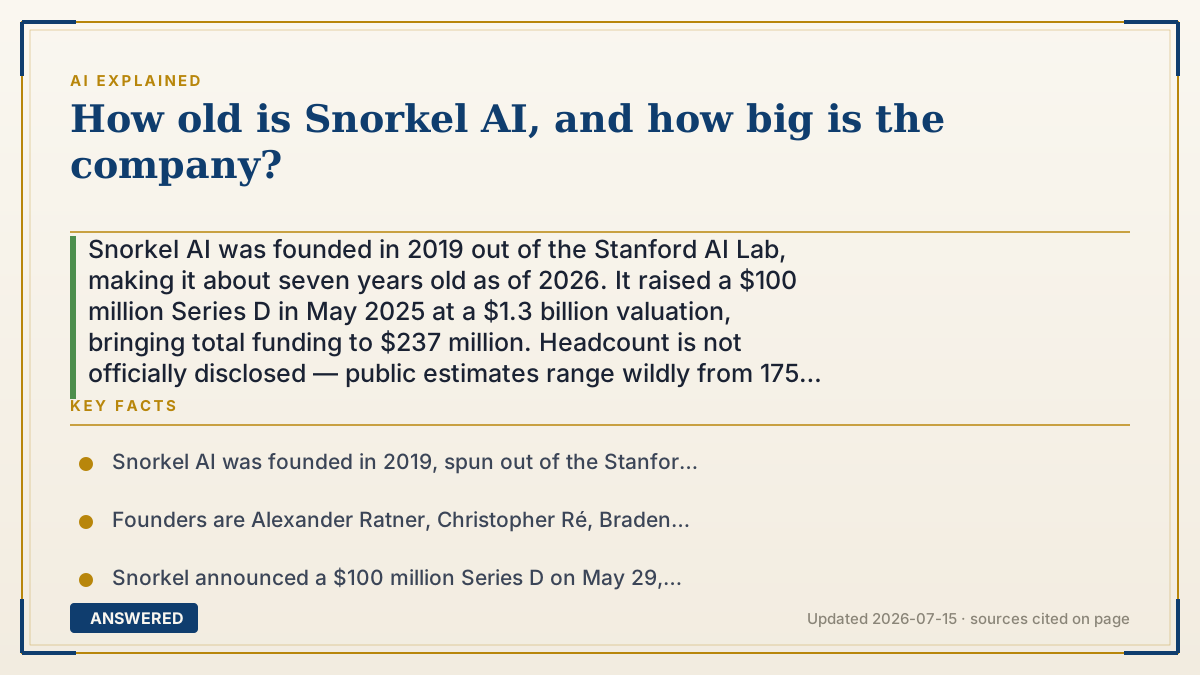
Snorkel AI was founded in 2019 out of the Stanford AI Lab, making it about seven years old as of 2026. It raised a $100 million Series D in May 2025 at a $1.3 billion valuation, bringing total funding to $237 million. Headcount is not officially disclosed — public estimates range wildly from 175 to 1,000.
Why — the first-principles explanation
Snorkel exists because of a bottleneck that sounds boring and is actually the whole game: AI needs labeled data, and labeling is done by humans, and humans are slow. If you want a model to flag fraudulent insurance claims, someone has to first mark thousands of claims as fraudulent or not. At enterprise scale, with lawyers and doctors doing the marking, that is brutally expensive and takes months.
The Stanford research behind Snorkel proposed inverting this. Instead of labeling examples one by one, you write labeling functions — small rules that encode what an expert knows. A doctor doesn't hand-label 50,000 records; she writes rules like "if the note mentions this drug alongside this symptom, it's probably this condition." Each rule is noisy and imperfect on its own. The system then models how the rules agree and disagree, and statistically combines them into probabilistic labels better than any single rule. This is called programmatic labeling or weak supervision. The move is treating expertise as code you write once rather than clicks you repeat forever.
That origin explains the age and the shape of the company. Snorkel began as an academic project in the Stanford AI Lab and was founded as a company in 2019 by Alexander Ratner, Christopher Ré, Braden Hancock, Henry Ehrenberg, and Paroma Varma. It predates the ChatGPT era by three years — it was solving the data problem before the generative boom made everyone care. It then repositioned as the Snorkel AI Data Development Platform, covering datasets for LLMs, RAG pipelines, and agents, used in production by firms including BNY, Wayfair, and Chubb.
On size, honesty requires naming the uncertainty. Funding is well documented: $100 million Series D announced May 29, 2025, led by Addition, with Prosperity 7 Ventures, existing investors Greylock and Lightspeed, and strategic investors BNY and QBE Ventures, at a $1.3 billion valuation, bringing total funding to $237 million. Headcount is not. Snorkel is private and has no obligation to publish it. Third-party trackers disagree enormously — one reports roughly 1,000 employees, another about 175, another 352 for 2024. Those cannot all be right. They differ because some count contractors and annotators, some count only full-time staff, and some are stale scrapes of LinkedIn. The credible read is a few hundred employees, with no verified figure available. Anyone giving you a confident precise number is quoting one tracker and not telling you.
An example that makes it click
Imagine teaching a new assistant to sort your mail. The slow way: you sit with her and hand-sort 10,000 letters together, saying "bill... junk... bill... personal." Weeks of your life, and if you change your mind about what counts as junk, you start over.
The Snorkel way: you write down eight rules. "If it has a window envelope, probably a bill." "If my name is misspelled, probably junk." "If it's handwritten, probably personal." Each rule is imperfect — plenty of bills come in plain envelopes. But the system checks where your rules agree and where they clash, figures out which ones to trust more, and sorts all 10,000 in an afternoon. You spent an hour writing rules instead of three weeks pointing at envelopes. And when your mind changes, you edit a rule, not 10,000 letters.
Key facts
- Snorkel AI was founded in 2019, spun out of the Stanford AI Lab — roughly seven years old as of 2026.
- Founders are Alexander Ratner, Christopher Ré, Braden Hancock, Henry Ehrenberg, and Paroma Varma, all Stanford AI Lab alumni.
- Snorkel announced a $100 million Series D on May 29, 2025, led by Addition, at a $1.3 billion valuation.
- Total funding since founding reached $237 million as of the Series D.
- Headcount is not officially disclosed; third-party estimates range from about 175 to roughly 1,000, with 352 reported for 2024 — the wide spread reflects inconsistent counting methods, not real growth swings.
- Named production customers include BNY, Wayfair, and Chubb.
▶ The 60-second explainer (script)
How old is Snorkel AI, and how big is it? Founded 2019, out of the Stanford AI Lab. So about seven years old — which means it predates the ChatGPT boom by three years. It was solving the data problem before everyone cared about the data problem. On size, here's the part other pages get wrong. The funding is solid, documented fact: a hundred million dollar Series D announced May 29th, 2025, led by Addition, at a 1.3 billion dollar valuation. That brought total funding to 237 million. Investors included Greylock, Lightspeed, and strategic backers like BNY and QBE. Headcount? Nobody actually knows publicly. Snorkel is private and doesn't publish it. And the trackers wildly disagree — one says a thousand employees, another says 175, another says 352. Those can't all be true. They differ because some count contractors and annotators, some count only full-time staff, and some are just old LinkedIn scrapes. Best honest answer: a few hundred people, no verified number. If a site gives you a confident exact figure, they're quoting one tracker and not telling you. What does Snorkel actually do? It fixes a boring, enormous bottleneck: AI needs labeled data, and labeling is done by humans, and humans are slow. Instead of a doctor hand-labeling fifty thousand records, she writes a handful of rules capturing what she knows. Each rule is noisy. But the system models where the rules agree and disagree, and combines them into labels better than any single rule. That's called programmatic labeling. The trick is turning expertise into code you write once, instead of clicks you repeat forever. Customers include BNY, Wayfair, and Chubb.
What authoritative sources say
People also ask
When exactly was Snorkel AI founded?
2019, as a spinout from the Stanford AI Lab, by Alexander Ratner, Christopher Ré, Braden Hancock, Henry Ehrenberg, and Paroma Varma. The underlying research project ran at Stanford before that.
How many employees does Snorkel AI have?
There is no official figure. Third-party estimates range from about 175 to roughly 1,000, which is too wide to treat as reliable. A few hundred is the reasonable read, but nobody outside the company has a verified number.
Is Snorkel AI a unicorn?
Yes. Its May 2025 Series D was priced at a $1.3 billion valuation, above the $1 billion unicorn threshold. Note that private valuations reflect a negotiated round price, not a market price.
What does Snorkel AI actually sell?
The Snorkel AI Data Development Platform, which helps enterprises build high-quality training datasets programmatically for LLMs, RAG pipelines, and AI agents — rather than labeling every example by hand.
Is Snorkel AI public? Can I buy shares?
No. It is a private company, so shares are not available on public exchanges. Its $1.3 billion valuation comes from a private funding round, not from public trading.