How to ask AI a question?
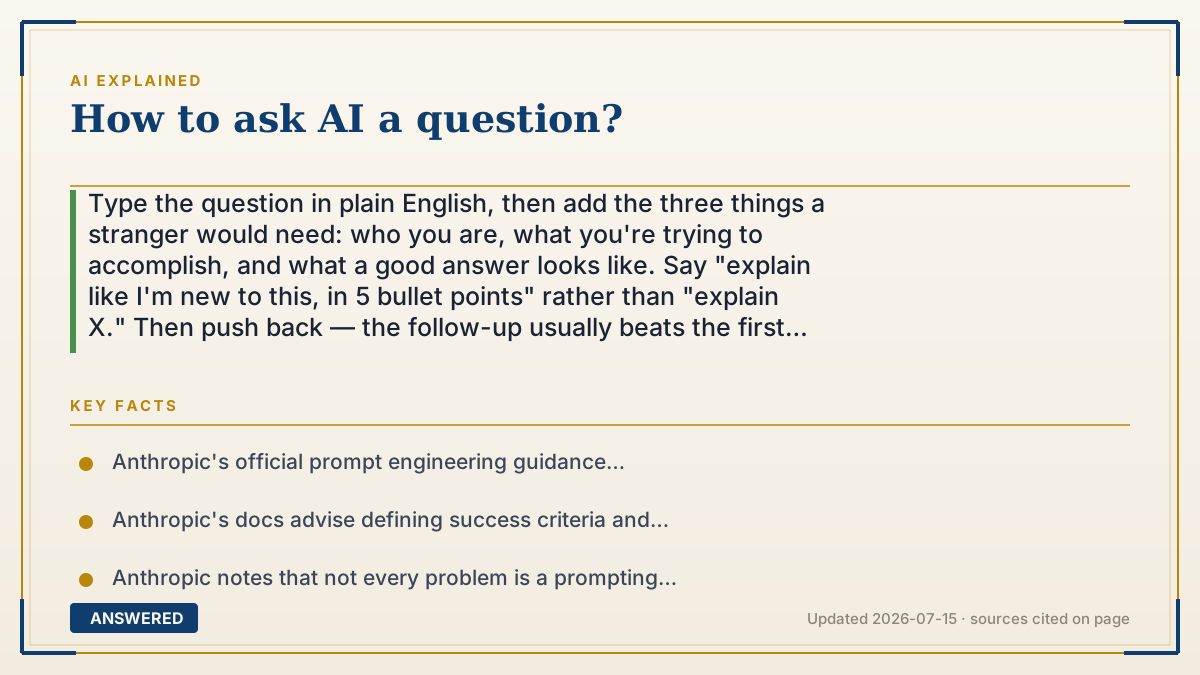
Type the question in plain English, then add the three things a stranger would need: who you are, what you're trying to accomplish, and what a good answer looks like. Say "explain like I'm new to this, in 5 bullet points" rather than "explain X." Then push back — the follow-up usually beats the first reply.
Why — the first-principles explanation
A chatbot isn't a search engine and isn't a person. It's a machine that continues text plausibly. It has read an enormous amount of writing and, given your words, produces what would most plausibly come next. That single fact explains every rule of thumb about prompting.
Because it continues plausibly, it needs to know which kind of document it's inside. "Explain inflation" is ambiguous — is the plausible continuation a textbook chapter, a tweet, or a bedtime story? The model has to guess, and it guesses average. If you write "Explain inflation to a 14-year-old in 5 bullet points, no jargon," you've told it which document it's writing, and the guessing stops. This is why context beats cleverness: you don't need magic words, you need to remove ambiguity. Anthropic's own guidance puts being clear and direct first, before any advanced technique, and then adds examples of the output you want (multishot) and asking the model to think step by step.
Because it continues text, it has no idea what you actually want unless it's in the text. It cannot see your screen, your job, your deadline, or the fact that this is for your boss. A stranger emailing you that question cold would ask three things — who's it for, what's it for, what does done look like. Put those in the first message and you skip three rounds.
And because plausible is not the same as true, the model will sometimes produce a confident, well-formed, wrong answer. That's a feature of the mechanism, not a bug you can prompt away. So for anything that matters — a dose, a law, a number, a name — treat the answer as a draft to verify, and ask for sources you can check yourself.
An example that makes it click
Imagine texting a brilliant new assistant who started this morning, has read every book in the library, and has never met you.
"Fix my resume" gets you a generic resume. "I'm a nurse with 6 years in the ER applying for a hospital IT role — rewrite my resume summary to bridge those two worlds, in 3 sentences, no buzzwords" gets you something usable. Same assistant, same intelligence. The only difference is you told them who you are, where you're going, and what done looks like. They're not being coy — they genuinely just met you.
How to do it
- Write the question in plain language first. Don't try to sound technical.
- Add who it's for: "I'm a beginner," "I'm a lawyer," "this is for my 8-year-old."
- Add the goal: not "explain SEO" but "explain SEO so I can decide whether to hire someone."
- Specify the shape of the answer: length, format, tone. "Five bullets." "A table." "Under 100 words."
- Paste in the actual material — the email, the code, the error message. The model can't see anything you don't paste.
- Show an example of what good looks like if you have one. One example beats a paragraph of description.
- For hard reasoning, ask it to work through the steps before answering.
- Follow up. "Too generic — give me the version for someone who already knows the basics" is the highest-return prompt there is.
- Verify anything that matters: numbers, laws, medicine, money. Ask for sources and check them yourself.
Key facts
- Anthropic's official prompt engineering guidance recommends starting with clarity and directness before advanced techniques, then examples, XML structuring, role prompting, thinking, and prompt chaining.
- Anthropic's docs advise defining success criteria and building evaluations before investing in prompt engineering.
- Anthropic notes that not every problem is a prompting problem — latency and cost are often better solved by choosing a different model.
- Language models generate the most plausible continuation of your text, which is why they can produce fluent answers that are factually wrong.
- Chatbots cannot see your files, screen, or history unless you paste or upload the content into the conversation.
▶ The 60-second explainer (script)
Here's the one-sentence version: ask in plain English, then tell it who you are, what you're trying to do, and what a good answer looks like. That's it. But here's why that works, because once you get this, you'll never need a prompt template again. A chatbot is not a search engine and it's not a person. It's a machine that continues text plausibly. It read an enormous pile of writing, and given your words, it produces what would plausibly come next. So when you type 'explain inflation,' it has to guess which document it's inside. A textbook? A tweet? A bedtime story? It guesses average, and average is boring. When you type 'explain inflation to a fourteen-year-old in five bullets, no jargon,' the guessing stops. You didn't use a magic word. You removed ambiguity. Anthropic's own official guidance puts 'be clear and direct' first, before every advanced trick. Think of texting a brilliant assistant who started this morning and has never met you. 'Fix my resume' gets a generic resume. 'I'm an ER nurse of six years applying to hospital IT — bridge those worlds in three sentences' gets something usable. Same brain. You just introduced yourself. Two last things. Paste the actual material — it can't see your screen. And because plausible isn't the same as true, verify anything that matters.
What authoritative sources say
People also ask
Do I need special prompt words to get better answers?
No. Anthropic's own guidance puts clarity and directness first. Specific context beats clever phrasing almost every time.
Why does it give me generic answers?
Because your question was answerable in a generic way. Add who you are, what you're trying to accomplish, and the format you want, and the generic version stops being the most plausible continuation.
Should I be polite to the AI?
It doesn't have feelings, but polite phrasing tends to be clearer and fuller phrasing, which helps. The gain comes from the extra words, not the courtesy.
Can it see my files or my last conversation?
Only what you paste, upload, or what the product explicitly stores. If you didn't put it in the window, assume it doesn't exist.
Can I trust the answer?
Treat it as a confident draft. For anything involving health, money, law, or safety, ask for sources and verify them yourself before acting.
The same question, asked other ways
- How do I ask AI a question?