How to use AI for SEO?
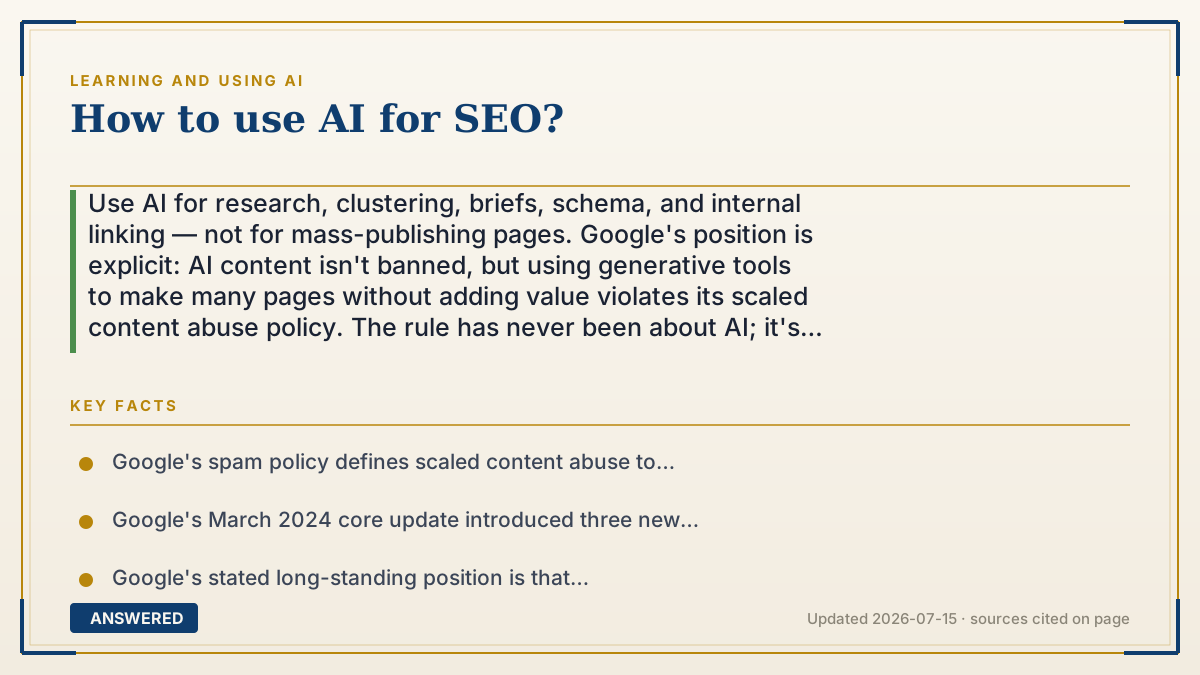
Use AI for research, clustering, briefs, schema, and internal linking — not for mass-publishing pages. Google's position is explicit: AI content isn't banned, but using generative tools to make many pages without adding value violates its scaled content abuse policy. The rule has never been about AI; it's about whether the primary purpose is manipulating rankings.
Why — the first-principles explanation
Everything about AI and SEO makes sense once you see the incentive. Google's product is useful results. AI made producing plausible pages nearly free, which means the supply of pages that look like answers exploded. If Google let that supply rank, its results get worse and its product dies. So Google is structurally forced to devalue mass-produced content — not because AI is morally bad, but because a search engine that surfaces infinite generated filler is a broken search engine. That pressure exists regardless of any policy announcement.
And Google says exactly this out loud. Its guidance is that automation isn't inherently spam — automation has generated sports scores, weather forecasts, and transcripts helpfully for years. The line it draws is purpose: automation is spam if the primary purpose is manipulating ranking. Its March 2024 scaled content abuse policy names "using generative AI tools to generate many pages without adding value for users" as a violation, and pointedly states it applies whether content is produced by automation, humans, or a combination. That last clause is the tell. Google isn't detecting AI. It's detecting valueless content at scale, and human-written filler was always in scope too.
So the strategy follows directly. AI is a leverage tool on the parts of SEO that were always bottlenecked by labor, not judgment. Clustering a thousand keywords by intent used to take a day; now it takes a minute. Writing schema markup, drafting outlines from actual SERP analysis, finding internal linking gaps, auditing title tags across 500 URLs, translating pages, summarizing what competitors cover that you don't — all genuine wins, all invisible to any spam policy, because none of them create valueless pages.
The second shift matters more than most SEO advice admits. Search results now include AI-generated summaries, and people increasingly ask chatbots directly. Those systems quote and synthesize rather than send clicks. Optimizing for them isn't a new trick — it's an old one intensified: answer the question directly, early, with specific facts and real citations, so a machine can extract a quotable claim. Pages that bury an answer under 800 words of preamble were always bad; now they're also unquotable.
An example that makes it click
Imagine a town where everyone suddenly gets a printing press. The newspaper's job was never printing — it was knowing what's true and what matters. When printing becomes free, the town floods with pamphlets. Does the newspaper start pumping out pamphlets? No. That's a race it can't win and doesn't want to. It leans harder on the thing presses can't copy: reporters who went to the meeting, checked the record, and put their name on it.
Google is the reader in that town, drowning in pamphlets, trying to find the one thing worth reading. It's not scanning for "which of these came off a press" — it can't, and it says so. It's asking "which of these knows something?" Use your press for speed. Just don't compete on volume, because everyone has a press now, and the pamphlet pile has no floor.
How to do it
- Use AI where the bottleneck was labor, not judgment: clustering keywords by intent, grouping a crawl by issue, auditing 500 title tags, generating schema/JSON-LD, spotting internal-linking gaps, and translating pages.
- Do research synthesis: paste the top 10 ranking pages for a query and ask what subtopics all of them cover, what none cover, and what questions go unanswered. That gap is your brief.
- Mine real language from real customers — paste support tickets, reviews, and sales-call transcripts and ask for recurring questions in the customers' own words. Better than any keyword tool at finding intent.
- Draft with AI, but supply what only you have: original data, firsthand testing, prices you verified, screenshots, a real opinion. That's the 'adds value' half of Google's rule, and no model can generate it.
- Never mass-publish. 'Generate 500 pages targeting long-tail keywords' is the textbook definition of scaled content abuse in Google's own policy, and it applies to human-written filler too.
- Answer the question in the first two sentences, with a specific number or fact. This serves both readers and the AI systems that now summarize results — a buried answer can't be quoted.
- Fact-check every statistic, date, and citation before publishing. Models invent sources fluently, and a fake citation is the fastest way to destroy the E-E-A-T signals you're trying to build.
- Add what a machine can't: author identity and credentials, publication and update dates, primary sources you actually read, and a clear stance. These are the surviving differentiators.
- Measure honestly. If AI-assisted pages don't outperform your pre-AI pages on rankings and conversions, you bought speed and paid in quality.
Key facts
- Google's spam policy defines scaled content abuse to include 'using generative AI tools to generate many pages without adding value for users,' along with scraping feeds to generate pages and stitching content without adding value (Google Search Central).
- Google's March 2024 core update introduced three new spam policies — expired domain abuse, scaled content abuse, and site reputation abuse — and the scaled content abuse policy applies whether content is produced through automation, human effort, or a combination (Google Search Central).
- Google's stated long-standing position is that automation, including generative AI, is spam if the primary purpose is manipulating rankings; automation itself is not spam, and has long produced helpful content like sports scores, weather forecasts, and transcripts (Google Search Central).
- Google states that AI-generated content that is useful, helpful, original, and satisfies aspects of E-E-A-T might do well in Search — meaning quality, not authorship, is the ranking question (Google Search Central, February 2023 guidance).
- Google updated its site reputation abuse policy in November 2024, extending enforcement against third-party content published on established domains to exploit their ranking signals (Google Search Central).
- 49% of US adults now use AI chatbots and 42% of chatbot users use them to search for information — evidence that search demand is partially shifting to systems that summarize rather than link (Pew Research Center, February 2026, n=5,119).
Choosing an AI tool for work?
The answer above explains the concept; this next step helps you choose by job, limits and current terms.
▶ The 60-second explainer (script)
How do you use AI for SEO? Research, clustering, briefs, schema, internal linking — yes. Mass-publishing pages — absolutely not. And the reason isn't moral. It's structural. Google's product is useful results. AI made producing plausible pages nearly free, so the supply of things that LOOK like answers exploded. If Google let that rank, its results get worse and its product dies. So Google is forced to devalue mass-produced content. That pressure exists whether or not anyone writes a policy. And Google says this out loud, very precisely. Its guidance is that automation is NOT inherently spam — automation has produced sports scores and weather forecasts helpfully for years. The line is purpose. Automation is spam if the primary purpose is manipulating rankings. Its scaled content abuse policy specifically names 'using generative AI tools to generate many pages without adding value.' But here's the sentence people miss: it applies whether the content is made by automation, by humans, or a combination. That's the tell. Google isn't detecting AI. It's detecting valueless content at scale — and human-written filler was always in scope. Picture a town where everyone suddenly gets a printing press. The newspaper's job was never printing. It was knowing what's true. When printing goes free, the town floods with pamphlets. Does the paper start pumping out pamphlets? No — that race has no floor. It leans on what a press can't copy: reporters who went to the meeting and put their name on it. So use AI on the parts that were bottlenecked by labor, not judgment. Cluster a thousand keywords in a minute. Write your schema. Audit five hundred title tags. Paste the top ten results and ask what none of them cover — that gap is your brief. Then supply what only you have: original data, real testing, verified prices, an actual opinion. One more shift. Search now summarizes, and people ask chatbots directly. Those systems quote — they don't browse. So answer the question in the first two sentences with a specific number. Pages that bury the answer under eight hundred words of preamble were always bad. Now they're also unquotable.
What authoritative sources say
People also ask
Does Google penalize AI-generated content?
Not for being AI-generated. Google's stated rule is that automation is spam only when the primary purpose is manipulating rankings. Its scaled content abuse policy explicitly applies to content made by automation, humans, or a combination — quality is the test, not authorship.
Can I publish AI-written blog posts?
Yes, if they're genuinely useful, original, and add something — your data, your testing, your expertise — and a human verified every fact. What violates policy is generating many pages without adding value, which is Google's definition of scaled content abuse.
What is AI best at in SEO?
Work that was bottlenecked by labor rather than judgment: clustering keywords by intent, generating schema markup, auditing hundreds of title tags, finding internal linking gaps, translating pages, and synthesizing what competitors do and don't cover.
How do I get cited by AI search and chatbots?
Answer the question directly in the first two sentences with a specific number or fact, cite primary sources, and show author identity and dates. AI systems extract quotable claims — an answer buried under 800 words of preamble can't be extracted.
Can Google actually detect AI writing?
That's the wrong question — Google's policy is deliberately written to sidestep detection, applying to valueless content at scale regardless of how it was produced. Betting on evading detection misreads the rule you're actually subject to.