How to use AI in sales?
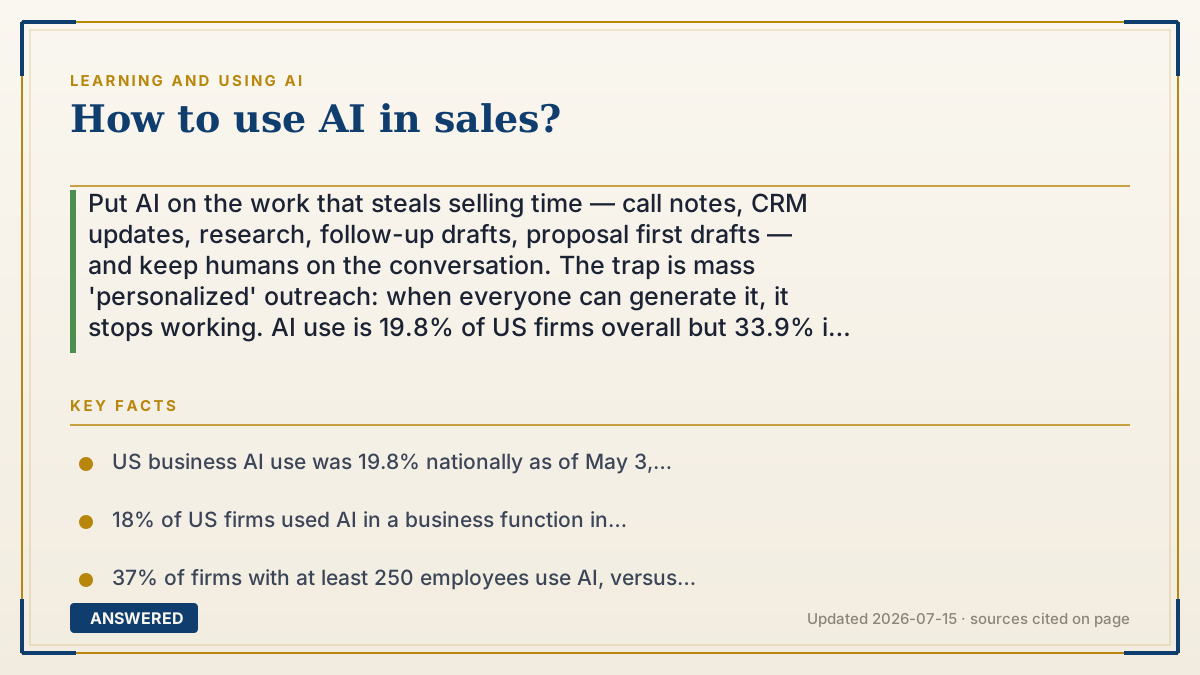
Put AI on the work that steals selling time — call notes, CRM updates, research, follow-up drafts, proposal first drafts — and keep humans on the conversation. The trap is mass 'personalized' outreach: when everyone can generate it, it stops working. AI use is 19.8% of US firms overall but 33.9% in Finance and Insurance (Census, May 2026).
Why — the first-principles explanation
Sales has a brutal arithmetic problem. A rep's day is finite, and most of it isn't spent selling — it's spent on research, note-taking, CRM hygiene, scheduling, and writing follow-ups. That admin isn't optional; it's the tax you pay to have conversations. So the highest-value thing AI does in sales is unglamorous: it gives hours back. Auto-summarize the call, extract the action items, draft the follow-up, update the record. Nothing about that is impressive to demo, and it's where nearly all the real return lives.
The glamorous use is where teams destroy themselves. Personalized outreach used to work because it was expensive. When a prospect saw that you'd read their annual report, that email carried a signal: this person spent twenty minutes on me, so it's probably worth two of mine. The value was never in the words — it was in the cost the words proved. AI drives that cost to zero. And the moment personalization is free, it stops proving anything. Everyone's inbox fills with fluent, well-researched, individually-tailored messages, and the whole channel deflates. This is why teams that 10x their outreach volume routinely watch response rates fall by more than 10x. They didn't get a bigger lever. They burned the thing that made the lever work.
Which points at the correct question: what is now scarce? Not words, not research, not personalization — all free. What stays scarce is being genuinely relevant (knowing this prospect actually has this problem right now), being trusted (a referral, a reputation, a prior relationship), and being accountable (a human who'll own it when it goes wrong). AI can help you find relevance by chewing through signals you'd never have time to read. It cannot manufacture trust, and anything that fakes trust at scale destroys it.
One more mechanism worth knowing: the model predicts likely text, which means it will invent your product's features, your pricing, and your integration list without hesitation, in a confident tone, inside an email to a customer. In sales that's not a typo — it's a promise your company now has to either honor or walk back. Every customer-facing sentence needs a human read.
An example that makes it click
Think about a handwritten letter. It works not because handwriting is beautiful, but because the recipient knows it took you forty minutes. The effort is the message. Now imagine a machine that produces perfect handwritten letters — personal details, the right pen, everything — for a tenth of a cent each. For about a month, they'd work brilliantly. Then everyone would have one, and everyone's mailbox would fill with warm handwritten letters from strangers. Within a year, a handwritten envelope would mean exactly what junk mail means today.
That's AI sales outreach, running at high speed right now. The machine didn't make you more persuasive. It removed the cost that made the gesture persuasive. So the useful move isn't sending 10,000 warm letters — it's using the machine to figure out which forty people genuinely need what you sell this quarter, and then actually calling them.
How to do it
- Start with time recovery, not outreach: record and auto-summarize calls, extract action items, update CRM fields, draft follow-ups. This is where the measurable return is, and it doesn't degrade with use.
- Use AI for pre-call prep — paste the prospect's earnings call, recent news, job postings, and product pages, and ask for what changed and what pain that implies. Fifteen minutes of prep in ninety seconds.
- Mine your own data: paste lost-deal notes and call transcripts and ask which objections recur and where deals die. Most teams already have this answer sitting in their CRM and have never read it.
- Draft with AI, send with judgment. Every customer-facing sentence gets a human read — the model will confidently invent features, prices, and integrations, and in sales an invented claim becomes a commitment.
- Resist volume. Personalization worked because it was expensive; free personalization signals nothing. Sending 10x more will usually cut your response rate by more than 10x and burn your domain reputation.
- Aim AI at relevance instead of at volume: use it to read hiring pages, funding news, tech-stack changes, and earnings calls across your list, and surface the few accounts with a live trigger. Then contact those few like a human.
- Use it as a practice partner. Have it roleplay a skeptical CFO with your real objections. Reps get reps without burning real pipeline.
- Keep customer data out of consumer chatbots. Contact records, deal terms, and call recordings need an enterprise tier with contractual data controls — not a free tab.
- Measure the honest metric. Meetings booked and win rate, not emails sent. Activity is the metric AI inflates most and the one that matters least.
Key facts
- US business AI use was 19.8% nationally as of May 3, 2026, but 33.9% in Finance and Insurance and 39.7% in Information — with very large firms in Information, Professional Services, and Finance reaching 50-60% (Census Bureau BTOS).
- 18% of US firms used AI in a business function in November 2025-January 2026, rising to 32% on an employment-weighted basis; adoption was expected to reach 22% within six months (Census Bureau BTOS).
- 37% of firms with at least 250 employees use AI, versus under 20% of firms with four or fewer employees — meaning enterprise sales teams are far more likely to face AI-equipped counterparts than small ones (Census Bureau BTOS).
- 38% of employed US adults who use chatbots use them for work tasks (Pew Research Center, n=5,119, February 17-23, 2026).
- Business AI use held between 17% and 20% from December 2025 to May 2026, with 20-23% expecting to adopt within six months — steady growth, not a step change (Census Bureau BTOS).
Choosing an AI tool for work?
The answer above explains the concept; this next step helps you choose by job, limits and current terms.
▶ The 60-second explainer (script)
How do you use AI in sales? Put it on everything that steals your selling time — call notes, CRM updates, research, follow-up drafts — and keep humans on the actual conversation. Here's the arithmetic. A rep's day is finite, and most of it isn't selling. It's research, note-taking, CRM hygiene, scheduling. That admin is the tax you pay to have conversations. So the highest-value use of AI in sales is boring: it gives hours back. Nothing to demo. That's where almost all the return is. Now the trap — because this is where teams hurt themselves. Personalized outreach used to work BECAUSE it was expensive. When a prospect saw you'd read their annual report, that email carried a signal: this person spent twenty minutes on me, so maybe it's worth two of mine. The value was never the words. It was the cost the words proved. AI drives that cost to zero. And the second personalization is free, it stops proving anything. Think of a handwritten letter. It works because the recipient knows it took forty minutes. The effort IS the message. Now imagine a machine that makes perfect handwritten letters for a tenth of a cent. For a month, magic. Then everyone has one, and a handwritten envelope means exactly what junk mail means today. That's happening right now, fast. It's why teams that 10x their outreach watch response rates fall by more than 10x. They didn't get a bigger lever — they burned the thing that made the lever work. So ask what's actually scarce now. Not words. Not research. Not personalization. What's scarce is real relevance — knowing this prospect has this problem right now — plus trust, and a human who owns it when it breaks. AI can help you FIND relevance by reading signals you'd never have time for: hiring pages, funding news, earnings calls across your whole list. Use it to find the forty accounts with a live trigger. Then call them like a person. And one hard rule: every customer-facing sentence gets a human read. The model will invent your features and your pricing in a confident voice. In sales, that's not a typo. That's a promise your company has to honor or walk back.
What authoritative sources say
People also ask
What's the highest-return use of AI in sales?
Time recovery — call summaries, action-item extraction, CRM updates, and follow-up drafts. It's unglamorous and it doesn't degrade with use, unlike outreach volume. Most reps spend the majority of their day on admin, not selling.
Does AI-personalized cold outreach work?
Less every month. Personalization worked because it was costly, which proved effort. Once it's free it proves nothing, and inboxes fill with fluent tailored messages from strangers. Teams that 10x volume usually see response rates fall by more than 10x.
Will AI replace salespeople?
It replaces the admin around selling, not the selling. What stays scarce is real relevance, trust, and a human who's accountable when something goes wrong — none of which a model can manufacture.
What's the biggest risk of using AI in sales?
Invented claims. Models will confidently state features, prices, and integrations that don't exist — inside an email to a customer. In sales that becomes a commitment your company must honor or retract, so every outbound sentence needs a human read.
Can I put my CRM data into ChatGPT?
Not a consumer tier. Contact records, deal terms, and call recordings require an enterprise plan with contractual data controls. Assume anything typed into a free tool could be retained or reviewed.