How will AI affect jobs by 2030?
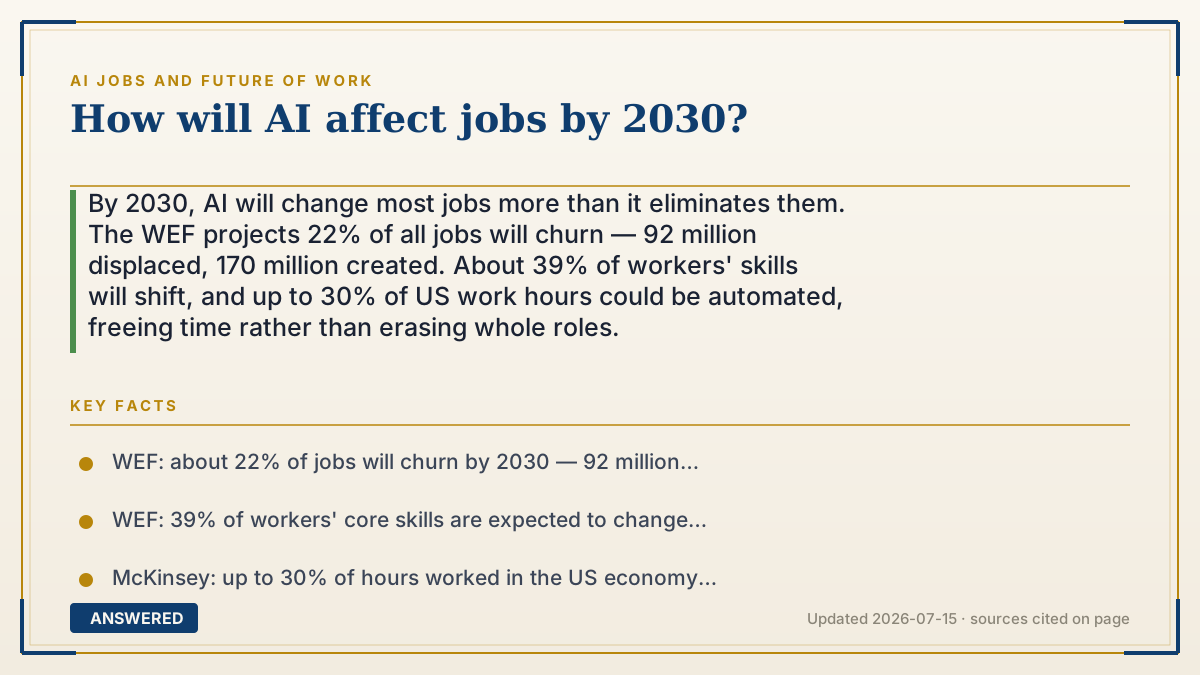
By 2030, AI will change most jobs more than it eliminates them. The WEF projects 22% of all jobs will churn — 92 million displaced, 170 million created. About 39% of workers' skills will shift, and up to 30% of US work hours could be automated, freeing time rather than erasing whole roles.
Why — the first-principles explanation
To see how AI affects jobs, split every job into tasks and ask which tasks AI can do. AI today excels at predictable, information-based work: drafting text, summarizing documents, writing routine code, answering standard questions, sorting data. It struggles with physical work in messy environments, genuine judgment calls, and anything where a human must be accountable. So AI doesn't hit jobs evenly — it hits the office, screen-based tasks hardest and leaves hands-on, relationship, and judgment work largely intact.
The effect by 2030 comes in three flavors. Augmentation is the biggest: AI does part of your work so you do more, faster. McKinsey estimates up to 30% of hours worked in the US economy could be automated — but that mostly means time freed inside existing jobs, not jobs deleted. Displacement is smaller and concentrated in clerical roles. Creation is real and large: entirely new roles in AI, data, and oversight appear.
The net picture depends on reskilling. The World Economic Forum's survey of over 1,000 employers projects a net gain of 78 million jobs by 2030, but only if workers move into new roles. Where reskilling fails, individual workers in shrinking roles get hurt even as the total count rises. That's why "how will AI affect jobs" has no single number — it's a story of transformation, unevenly distributed.
An example that makes it click
Imagine a newsroom in 2030. AI drafts the first version of routine stories — sports scores, earnings summaries — in seconds. Ten years ago that was junior reporters' work. But the newsroom doesn't shrink to nothing. Reporters now spend their hours on interviews, investigations, and judgment calls AI can't make, and the paper hires new people to manage the AI tools, fact-check outputs, and build data visualizations.
Some routine writing jobs vanish; new editing, verification, and AI-management jobs appear; and the surviving reporters do more ambitious work. That mix — some gone, some new, most transformed — is what "AI affecting jobs by 2030" actually looks like across nearly every industry.
Key facts
- WEF: about 22% of jobs will churn by 2030 — 92 million displaced, 170 million created, net +78 million.
- WEF: 39% of workers' core skills are expected to change between 2025 and 2030.
- McKinsey: up to 30% of hours worked in the US economy could be automated by 2030, accelerated by generative AI.
- IMF: about 40% of jobs globally — and 60% in advanced economies — are exposed to AI, with roughly half likely enhanced rather than replaced.
- WEF: fastest-growing roles are technology-related (AI/ML specialists, big data, software), while clerical and secretarial roles decline fastest.
▶ The 60-second explainer (script)
How will AI affect jobs by 2030? The short version: it'll change far more jobs than it destroys. Here's the mechanism. Every job is really a bundle of tasks, and AI is good at the predictable, screen-based ones — drafting, summarizing, routine coding — while it's weak at physical work, judgment, and anything needing human accountability. So by 2030, most jobs get transformed, not deleted. McKinsey says up to thirty percent of US work hours could be automated, but that's mostly time freed inside jobs, not jobs erased. The World Economic Forum projects ninety-two million roles displaced worldwide, but a hundred and seventy million created — a net gain of seventy-eight million. The catch is reskilling: thirty-nine percent of workers' skills will shift by 2030. Workers who adapt come out ahead; those in shrinking clerical roles who don't retrain are the ones who get hurt. Transformation, unevenly shared.
What authoritative sources say
People also ask
Will AI take more jobs than it makes by 2030?
The leading forecast says no. The WEF projects 170 million new roles versus 92 million displaced — a net gain — though the benefit depends heavily on workers reskilling into new roles.
Which jobs change the most?
Office and knowledge work change most, because AI handles text, data, and routine analysis well. Physical, hands-on, and relationship-heavy jobs change least.
Does automating 30% of hours mean 30% of jobs are gone?
No. It means about 30% of tasks within jobs could be automated, freeing time. Most of that lands as augmentation inside existing roles, not mass layoffs.
What should I do to prepare?
Learn to use AI tools in your field, shift toward judgment and relationship work, and keep reskilling — nearly 40% of today's skills will change by 2030.