How will AI affect my job in the future?
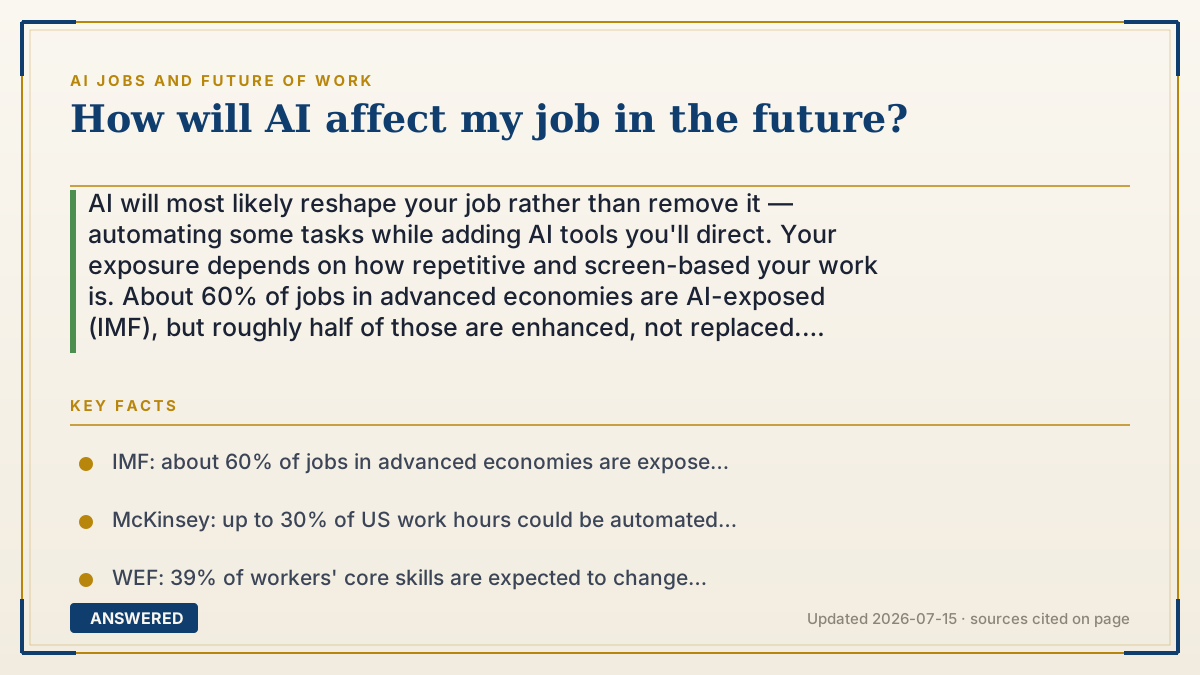
AI will most likely reshape your job rather than remove it — automating some tasks while adding AI tools you'll direct. Your exposure depends on how repetitive and screen-based your work is. About 60% of jobs in advanced economies are AI-exposed (IMF), but roughly half of those are enhanced, not replaced. Audit your tasks to see where you stand.
Why — the first-principles explanation
To predict AI's effect on your job, ignore your title and analyze your task mix. Every job is a collection of tasks, and AI affects each task differently. The IMF's framework is useful here: it sorts exposed jobs into two buckets — high complementarity (AI helps you do the task better) and low complementarity (AI can do the task instead of you). Your future depends on which bucket most of your tasks fall into.
AI is strong on tasks that are repetitive, rule-based, and mediated by a screen: drafting standard documents, entering and sorting data, answering routine questions, producing first-draft content. It's weak on tasks needing physical presence, genuine judgment, emotional connection, or accountability. So if your day is mostly the first kind, expect significant automation of those tasks — and pressure on your role. If it's mostly the second kind, expect AI to become a helpful assistant that makes you faster.
The most likely near-term outcome for most people is augmentation with rising expectations. AI handles the routine 30% (McKinsey's estimate of automatable US hours), freeing time — but employers then expect more output, and the skills that matter shift toward directing AI and doing the judgment-heavy work it can't. The WEF projects 39% of workers' skills changing by 2030. The practical upshot: your job probably survives, but the version of it that survives rewards people who use AI well and lean into the human parts. You have real agency in which side of that line you end up on.
An example that makes it click
Imagine you're a loan officer. Today you spend hours pulling documents, checking figures, and filling forms — then a smaller slice of time actually talking to borrowers and making the judgment call on tricky cases. AI is about to eat the first part: it can gather documents and run the numbers in minutes.
So what happens to you? If you defined your job as "the person who fills the forms," that job shrinks. If you define it as "the person who understands borrowers and makes the call," AI just handed you back hours and made you more valuable. Same starting job, two futures — and the difference is whether you move toward the tasks AI can't do and learn to run the AI that does the rest.
How to do it
- Write down your regular tasks and label each 'AI can do it' (repetitive, screen-based) or 'AI can only assist' (judgment, physical, relationship).
- Estimate the rough percentage in each bucket — that's your personal exposure snapshot.
- For high-exposure tasks, learn the AI tools that do them so you become the operator, not the casualty.
- For low-exposure tasks, deepen them — they're your durable value.
- Reskill continuously; nearly 40% of job skills are expected to change by 2030, so keep updating.
Key facts
- IMF: about 60% of jobs in advanced economies are exposed to AI, but roughly half are complementary (enhanced) rather than substitutable.
- McKinsey: up to 30% of US work hours could be automated by 2030, mostly freeing time inside existing jobs.
- WEF: 39% of workers' core skills are expected to change between 2025 and 2030.
- Forrester: AI will influence about 20% of US jobs but replace only about 6% by 2030.
- Task mix, not job title, best predicts individual AI exposure — repetitive, screen-based work is most affected.
▶ The 60-second explainer (script)
How will AI affect your job in the future? The best way to answer is to ignore your job title and look at your tasks. Every job is a bundle of tasks, and AI hits each one differently. The IMF splits exposed work into two types: tasks where AI helps you do better, and tasks where AI can do it instead of you. Your future depends on which type fills your day. AI is strong on repetitive, screen-based work — drafting documents, entering data, answering routine questions. It's weak on physical work, judgment, emotional connection, and accountability. So here's your homework: list your tasks, mark which AI can do and which it can only assist. If most are the first kind, your role faces pressure — so learn to run the AI and shift toward the human parts. The likely outcome for most people isn't unemployment; it's augmentation with higher expectations. About sixty percent of jobs in rich countries are AI-exposed, but half of those get enhanced, not replaced. You have real say in which half you land in.
What authoritative sources say
People also ask
How do I figure out my personal AI risk?
Audit your tasks. The larger the share that's repetitive and screen-based, the higher your exposure. Judgment, physical, and relationship-heavy work lowers it.
Will AI make my job easier or harder?
Usually easier at first — it automates routine tasks — but employers then expect more output, so the job's demands shift toward AI-directed and judgment-heavy work.
Should I be worried about my job?
Caution, not panic. Most jobs are reshaped rather than removed. The people at real risk are those whose tasks are mostly automatable and who don't adapt.
What single step best protects my future?
Learn to use the AI tools in your field. Becoming the operator of AI, rather than competing with it, is the strongest hedge for almost any role.