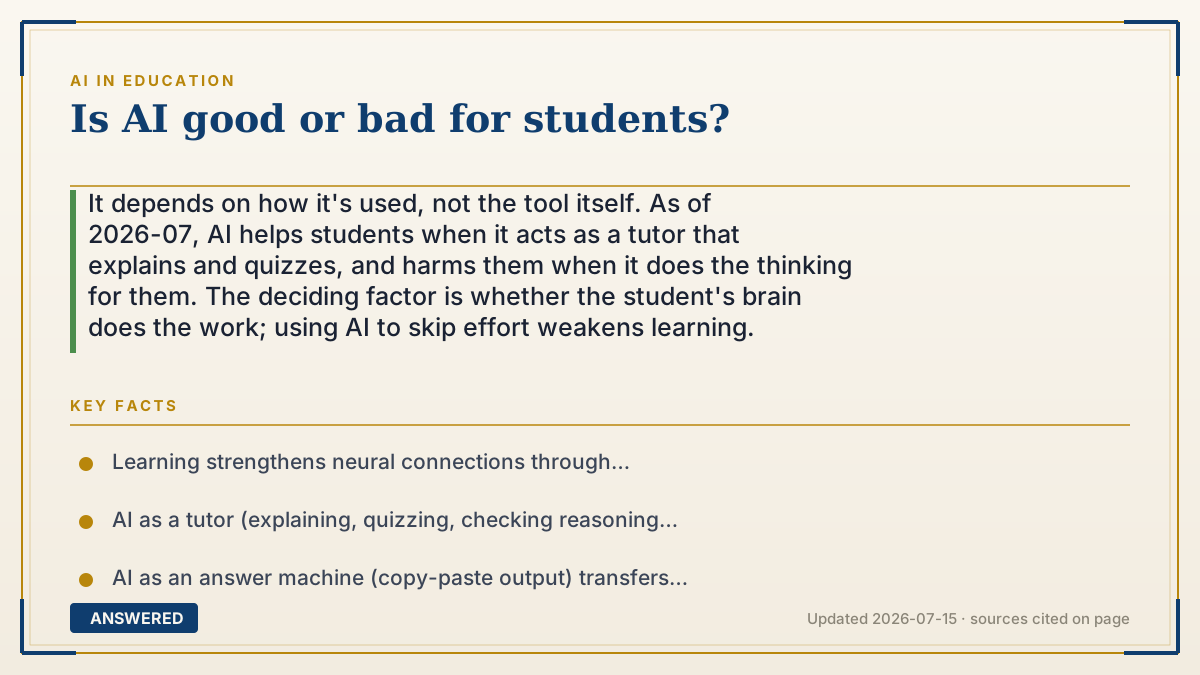
Is AI good or bad for students?
It depends on how it's used, not the tool itself. As of 2026-07, AI helps students when it acts as a tutor that explains and quizzes, and harms them when it does the thinking for them. The deciding factor is whether the student's brain does the work; using AI to skip effort weakens learning.
Why — the first-principles explanation
Learning is a physical change in the brain that only happens through effort. When you struggle to recall a fact or work through a hard problem, you strengthen the neural connections that store that skill. Psychologists call the useful struggle "desirable difficulty." This is the core reason AI can cut both ways: the same tool can create productive struggle or remove it entirely.
Used as a tutor, AI adds effort. If it asks you questions, checks your reasoning, explains a concept a second way, or quizzes you until you get it, your brain is still doing the retrieval and problem-solving. That's genuinely helpful, and it's available 24/7 at low cost. Used as an answer machine, AI removes effort. If you paste the prompt and copy the output, the model did the thinking and your brain recorded nothing, which is why students who over-rely on it often can't reproduce the work on a test.
There are two other real risks worth naming plainly. AI can be confidently wrong (hallucinations), so a student who can't yet judge the subject may absorb errors. And AI trained on internet text can carry bias. So the honest answer is that AI is a powerful amplifier: it makes a curious, effortful student faster and a shortcut-seeking student weaker. The tool doesn't decide which; the habit does.
An example that makes it click
Think of AI like a bicycle with a motor. If you pedal and let the motor help on the hills, you still get exercise and you go farther than you could alone. That's AI as a tutor. But if you sit on the seat and let the motor do 100% of the work, you arrive without having exercised at all. That's AI as an answer machine.
A 12-year-old who asks AI "quiz me on these vocab words and tell me which I keep missing" is pedaling. A 12-year-old who asks AI to "write my vocab sentences" is just coasting. Same bike, opposite result for the legs, or in this case, the brain.
Key facts
- Learning strengthens neural connections through effortful practice ("desirable difficulty"); skipping the effort skips the learning.
- AI as a tutor (explaining, quizzing, checking reasoning) keeps the student's brain doing the work.
- AI as an answer machine (copy-paste output) transfers the thinking to the model, weakening retention.
- AI can state false information confidently (hallucinations), a risk for learners who can't yet judge the topic.
- The U.S. Department of Education's 2023 report supports AI that assists learning while keeping teachers in the loop.
Choosing an AI tool for study?
The answer above explains the concept; this next step helps you choose by job, limits and current terms.
▶ The 60-second explainer (script)
Is AI good or bad for students? Honest answer: it depends entirely on how you use it. Here's the science. Learning is a physical change in your brain that only happens when your brain does the work. Struggling to recall a fact or solve a hard problem is what builds the skill. So the same AI can help or hurt. Use it as a tutor, asking it to explain a concept a second way or quiz you until you get it, and your brain is still doing the work. That's genuinely great, and it's available any time for cheap. But use it as an answer machine, pasting the prompt and copying the output, and the AI did the thinking while your brain recorded nothing. That's why heavy shortcut users often freeze on tests. Two extra warnings: AI can be confidently wrong, and it can carry bias. Think of it like a motorized bike. Pedal with help and you get stronger. Let the motor do everything and you get nowhere. The habit decides, not the tool.
What authoritative sources say
People also ask
Does AI make students lazy?
It can, if used to skip effort. Used to quiz and explain, it can actually increase practice. The usage habit determines the outcome.
Is AI safe for a student's learning?
It's safe for learning when the student still does the thinking and a teacher checks accuracy, since AI can be confidently wrong.
What's the healthiest way for a student to use AI?
Ask it to explain, quiz you, or critique your draft, rather than to produce the finished work you'll turn in.
Can AI hurt grades?
Over-reliance can, because skills you didn't build yourself won't be there on tests and in-class work.