Is AI improving education or making students too dependent?
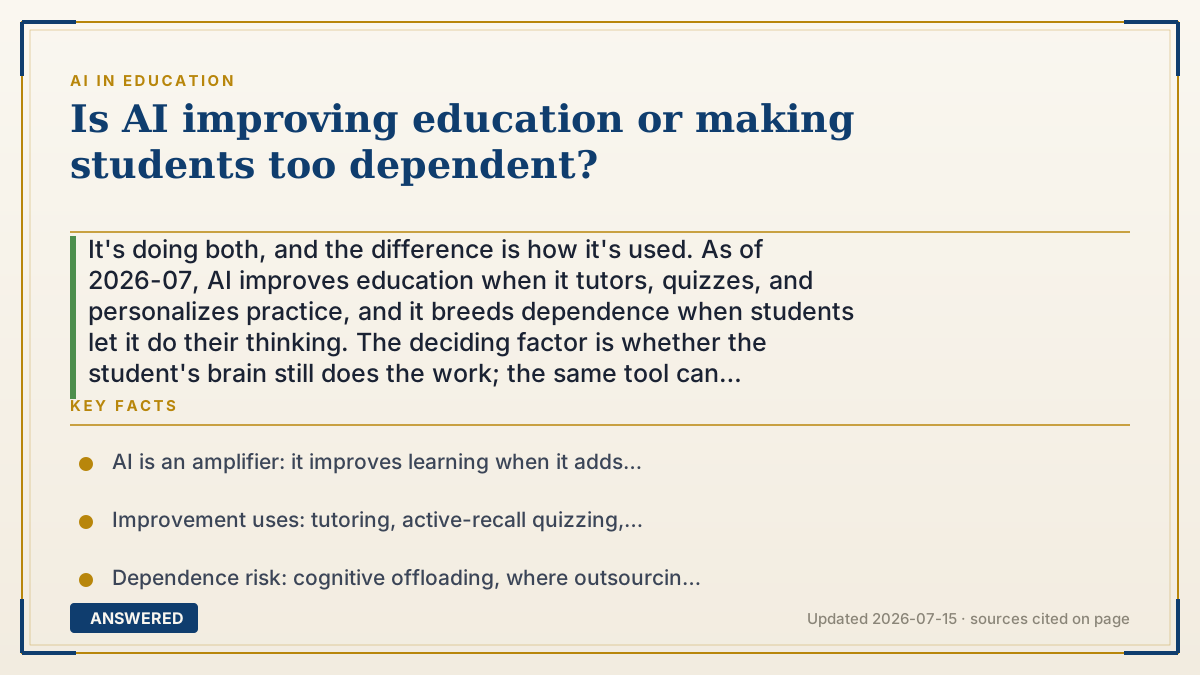
It's doing both, and the difference is how it's used. As of 2026-07, AI improves education when it tutors, quizzes, and personalizes practice, and it breeds dependence when students let it do their thinking. The deciding factor is whether the student's brain still does the work; the same tool can strengthen or weaken a learner.
Why — the first-principles explanation
This isn't really an either/or question, because AI is an amplifier, not a fixed force. The outcome depends entirely on whether the tool adds effort or removes it. Learning is built by effortful practice, retrieving facts, wrestling with problems, organizing your own ideas. Anything that makes a student do more of that improves education; anything that lets them skip it builds dependence. The same AI does both, depending on the habit.
On the improvement side, AI gives every student a patient tutor that explains a concept ten different ways, quizzes them for active recall, adapts difficulty, and offers instant feedback. That's genuine value, especially for students who'd otherwise get no one-on-one help. On the dependence side, if students outsource the thinking, pasting prompts and copying answers, they practice nothing, which is the mechanism behind worries about weakened writing and reasoning ("cognitive offloading").
So the honest verdict is that AI is improving education for students who use it to think harder and creating dependence in students who use it to think less. The evidence is still early and mixed, not a settled scoreboard. What tips the balance is design and habit: teachers who require students to show reasoning, assignments that ask for hints rather than answers, and students who treat AI as a sparring partner rather than a ghostwriter. The tool won't decide which future you get; the way it's used will.
An example that makes it click
Think of AI like an escalator next to a staircase. If you're carrying heavy luggage, the escalator is a real help, and you still walk plenty elsewhere. But if you take the escalator every single time, even for one floor, your legs slowly weaken and one day the stairs feel exhausting.
AI in learning is that escalator. Use it to get past the truly stuck moments and you go further with less wasted struggle. Ride it for everything and your mental legs, your writing and reasoning, quietly lose their strength. Same machine, opposite result, depending on how often you choose to walk.
Key facts
- AI is an amplifier: it improves learning when it adds effort and creates dependence when it removes effort.
- Improvement uses: tutoring, active-recall quizzing, adaptive practice, and instant feedback.
- Dependence risk: cognitive offloading, where outsourcing thinking means the student practices nothing.
- Evidence as of 2026-07 is early and mixed, not a settled conclusion.
- Design and habit (hints not answers, showing reasoning) determine which outcome dominates.
Choosing an AI tool for study?
The answer above explains the concept; this next step helps you choose by job, limits and current terms.
▶ The 60-second explainer (script)
Is AI improving education or making students too dependent? The honest answer is both, and it comes down to how it's used. AI is an amplifier, not a fixed force. Learning is built by effort, retrieving facts, wrestling with problems, organizing your own ideas. Anything that makes a student do more of that improves education. Anything that lets them skip it builds dependence. And the same AI does both. On the good side, it gives every student a patient tutor that explains a concept ten ways, quizzes them, and gives instant feedback, real value, especially for kids who'd otherwise get no help. On the risky side, if students paste the prompt and copy the answer, they practice nothing, which is exactly the worry behind weakened writing and thinking. The evidence so far is early and mixed, not a final scoreboard. What tips the balance is habit: ask AI for hints, not answers; use it to test your reasoning, not replace it. Think of an escalator next to stairs. Great for heavy luggage, bad if you never walk again.
What authoritative sources say
People also ask
Does AI make students smarter or lazier?
Either, depending on use. Using it to quiz and challenge yourself builds skill; using it to skip the work builds dependence.
Is there proof AI makes students dependent?
As of 2026-07 the evidence is early and mixed. The concern is real, but it's about habits, not the tool itself.
How can students avoid over-dependence on AI?
Ask for hints instead of answers, do the reasoning first, and use AI to critique your work rather than produce it.
What can teachers do to keep AI a positive?
Design assignments that require showing reasoning and drafts, so students must think even when AI is available.
The same question, asked other ways
- Is AI making students lazy?
- Does AI undermine student learning?
- Will AI enhance the way we learn?