Is AI the antichrist?
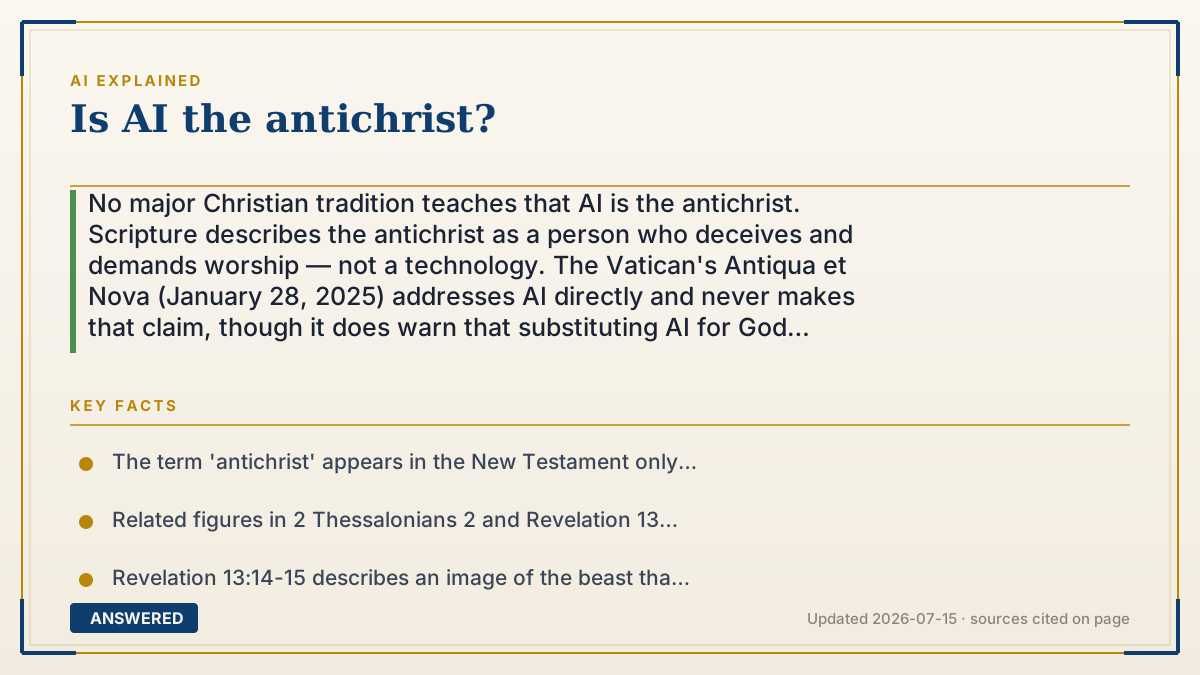
No major Christian tradition teaches that AI is the antichrist. Scripture describes the antichrist as a person who deceives and demands worship — not a technology. The Vatican's Antiqua et Nova (January 28, 2025) addresses AI directly and never makes that claim, though it does warn that substituting AI for God would be idolatry. The concern is human use, not the machine.
Why — the first-principles explanation
Start with what the texts actually say, because the answer hinges on it. The word antichrist appears in the New Testament only in the letters of John, where it describes people — those who deny the Father and the Son — and John notes that many such figures already existed in his own time. The related figures in 2 Thessalonians and Revelation are likewise portrayed as persons who deceive, claim divine honors, and demand worship. Across the tradition, the defining marks are personal: intent, deception, a will to be worshipped. A system without desires cannot want to be worshipped.
That matters mechanically. A language model has no intentions and no self. It predicts likely next tokens from patterns in text. It doesn't want anything — not your allegiance, not your soul, not your Tuesday. Whatever theological category it belongs to, "a being that deceives in order to be adored" isn't a description it can satisfy, any more than a printing press could.
The verse that drives most of this search is Revelation 13:14-15, describing an image of the beast that is given breath and speaks, and that people are compelled to worship. A talking image is genuinely striking to read in an age of synthetic voices and video, and that resonance is why the question spikes. But note the grammar even there: the image is made by people and animated by another actor. It is an instrument in someone's hands. Interpreters across the spectrum — futurist, historicist, preterist — differ enormously on what it refers to, and none of the major traditions has identified it with computing technology.
The most serious institutional treatment says something more useful. The Vatican's Antiqua et Nova (January 28, 2025) argues AI cannot truly think — that human intelligence involves embodiment, relationship, and moral discernment that AI lacks — and warns that treating AI as genuinely intelligent "risks overlooking what is most precious in the human person." It names real dangers: idolatry (substituting AI for God), autonomous weapons, surveillance, labor displacement, and deepfakes eroding trust. Read carefully, that's the theologically coherent version of the worry — and it's the reverse of the question. The danger isn't that the machine is evil. It's that people might treat a tool as if it were a god, or use it to deceive at scale. Both of those are old human failures wearing new hardware.
An example that makes it click
Think about the golden calf. In the story, the calf isn't the villain — it's metal. It has no plans. Aaron melts down jewelry and shapes it, and the people bow to it. The calf never asked for anything; it couldn't. The failure is entirely on the side of the people who decided to kneel.
AI is far more useful than a metal cow, but the structure of the concern is identical. A chatbot can't want your worship. It can't want anything. But a person can start trusting it more than their own judgment, more than their community, more than God — and someone else can use it to deceive millions cheaply.
So the traditional question isn't "is this object evil?" It's "what are people doing in front of it?" That question was answerable long before anyone built a computer, and it hasn't changed.
Key facts
- The term 'antichrist' appears in the New Testament only in the letters of John (1 John 2:18, 2:22, 4:3; 2 John 1:7), where it describes people who deny the Father and the Son — John states many antichrists already existed in his time.
- Related figures in 2 Thessalonians 2 and Revelation 13 are described as persons who deceive, claim divine honors, and demand worship — attributes requiring intent, which a predictive model does not have.
- Revelation 13:14-15 describes an image of the beast that is made by people, given breath, and speaks — the passage most often linked to AI, though the image is depicted as an instrument made and animated by other actors.
- The Vatican's Antiqua et Nova, a Note on the Relationship Between Artificial Intelligence and Human Intelligence, was issued January 28, 2025 and does not identify AI with the antichrist.
- Antiqua et Nova argues AI cannot truly think, holding that human intelligence involves intuition, embodiment, emotional depth and moral discernment that AI lacks, and that treating AI as genuinely intelligent 'risks overlooking what is most precious in the human person.'
- The document names idolatry — substituting AI for God — as a genuine risk, alongside autonomous weapons ('no machine should ever choose to take human life'), surveillance, labor displacement, and deepfakes undermining trust.
- No major Christian denomination has issued teaching identifying artificial intelligence as the antichrist.
▶ The 60-second explainer (script)
Is AI the antichrist? No major Christian tradition teaches that — and the reason is in the text itself. The word antichrist shows up in the New Testament only in the letters of John, and there it describes people. Specifically, people who deny the Father and the Son. John even says many antichrists already existed in his own time. The related figures in Second Thessalonians and Revelation are the same: persons who deceive, claim divine honors, and demand worship. Every defining mark is personal. Intent. Deception. A will to be worshipped. And that's where it breaks down mechanically. A language model has no intentions and no self. It predicts likely next words from patterns in text. It doesn't want anything — not your allegiance, not your soul. A system with no wants cannot want to be worshipped. Now, the verse driving this question is Revelation thirteen: an image of the beast that's given breath and speaks, and people are made to worship it. A talking image is genuinely striking to read in an age of synthetic voices. I get why it lands. But look at the grammar even there — the image is made by people, and animated by someone else. It's an instrument in human hands. And interpreters across every tradition disagree wildly about what it means. None of the major ones say 'computers.' The most serious treatment is the Vatican's Antiqua et Nova, January 2025. It argues AI can't truly think, and it warns about real dangers — idolatry, autonomous weapons, surveillance, deepfakes. But read it closely and it's the reverse of the question. The danger isn't that the machine is evil. It's that people might treat a tool like a god, or use it to deceive at scale. Think of the golden calf. The calf isn't the villain. It's metal. It has no plans. It never asked for anything — it couldn't. The failure belongs entirely to the people who decided to kneel. So the traditional question was never 'is this object evil.' It's 'what are people doing in front of it?' That question is a lot older than computers, and it hasn't changed.
What authoritative sources say
People also ask
Does the Bible mention artificial intelligence?
No. The texts were written roughly 1,900+ years before computers existed. Any connection to AI is interpretation applied afterward, not a subject the writers addressed.
What about the image of the beast that speaks in Revelation 13?
That's the passage most often linked to AI, and the resonance is understandable. But in the text the image is made by people and animated by another actor — an instrument, not an agent. Interpretations of it vary widely across traditions.
What does the Catholic Church say about AI?
Antiqua et Nova (January 28, 2025) says AI cannot truly think and must serve human dignity. It warns about idolatry, autonomous weapons, surveillance, and deepfakes — but never calls AI the antichrist.
Could an AI ever want to be worshipped?
Current systems have no desires — they predict likely next words. Wanting worship requires a self that wants things. That's a claim about agency no current architecture supports.
So is there any legitimate religious concern about AI?
Yes, but it points at people. Antiqua et Nova frames the risk as humans substituting AI for God, deceiving each other at scale, or building weapons that choose targets — old human failures with new tools.