Is Alexa an AI?
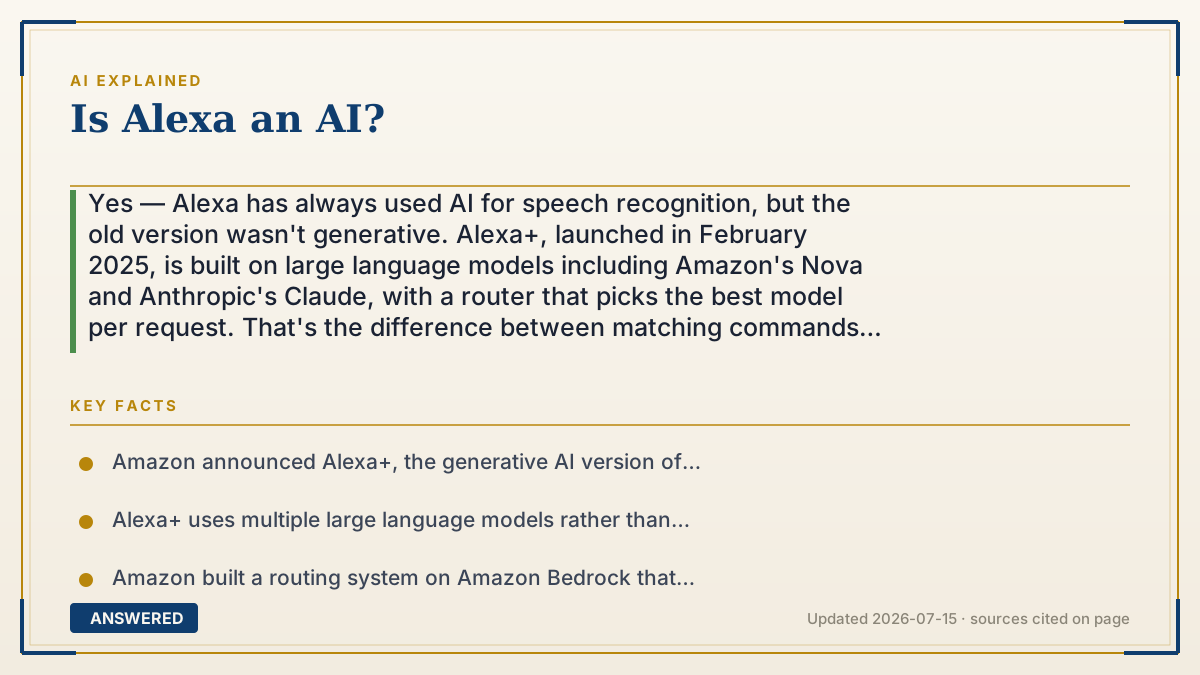
Yes — Alexa has always used AI for speech recognition, but the old version wasn't generative. Alexa+, launched in February 2025, is built on large language models including Amazon's Nova and Anthropic's Claude, with a router that picks the best model per request. That's the difference between matching commands and actually understanding you.
Why — the first-principles explanation
Both answers you've heard are right, because Alexa is two different machines wearing the same name.
Classic Alexa used AI in a narrow, unglamorous way. Turning "set a timer for ten minutes" into text is automatic speech recognition — a genuine machine learning problem, and a hard one. But once it had the text, the old Alexa did something much dumber: it matched your words against a list of known intents. SetTimerIntent, PlayMusicIntent, WeatherIntent. Each intent had a fixed handler. This is why classic Alexa was maddening in a specific way — it could nail "set a timer for ten minutes" and be totally defeated by "hey, buzz me when the pasta's done." Same meaning. Wrong phrasing. No matching intent, no response. It never understood you; it recognized you.
Alexa+ works differently at the core. Announced in February 2025, it's built on large language models, and rather than one model, Amazon built a router on Amazon Bedrock that matches each request to whichever model handles it best — including Amazon's own Nova models and Anthropic's Claude. Amazon also built a concept it calls "experts": bundles of systems, APIs, and instructions that handle specific task types. So the LLM doesn't just chat; it decides which expert to hand the job to.
The deeper change is agentic capability. Old Alexa could only call APIs that developers had pre-wired. Alexa+ was taught to navigate the digital world roughly the way a person does — it can go to a business's website and complete a task. And it can chain multiple calls: ask it to book a lunch reservation and text a friend the plan, and it does both, in order, as one request. That chaining is the thing intent-matching architecture fundamentally could not do, no matter how many intents you added.
So the reason classic Alexa felt like a voice remote and Alexa+ feels like an assistant isn't polish. It's that one was a lookup table with a good microphone, and the other is a language model with hands.
An example that makes it click
Think of classic Alexa as a hotel phone with buttons: Housekeeping, Room Service, Front Desk. Press the right button and it works perfectly. But there's no button for "my shower's cold and I have a 7 a.m. flight." You can press buttons all night — nothing on that panel understands your problem.
Alexa+ is a concierge. You describe the situation in whatever words come out, she works out what you actually need, and then she picks up the phone and calls maintenance and books your car. Same lobby, completely different machine.
Key facts
- Amazon announced Alexa+, the generative AI version of Alexa, in February 2025.
- Alexa+ uses multiple large language models rather than one, including Amazon's proprietary Nova models and Anthropic's Claude.
- Amazon built a routing system on Amazon Bedrock that matches each customer request to the model it determines is best for that task.
- Amazon created "experts" — groups of systems, capabilities, APIs, and instructions that handle specific types of tasks — which the LLM delegates to.
- Alexa+ has agentic capabilities: it can navigate to a developer's website and complete a task on the user's behalf, and chain multiple API calls in sequence from one request.
- Classic Alexa used automatic speech recognition (a machine learning system) but routed the resulting text through fixed intent matching, which is why it failed on unfamiliar phrasings of familiar requests.
- Alexa+ was launched at $19.99 per month, and is included at no extra cost for Amazon Prime members.
▶ The 60-second explainer (script)
Is Alexa an AI? Yes — but the interesting part is that Alexa is two different machines wearing the same name. Classic Alexa used AI in a narrow way. Turning "set a timer for ten minutes" into text is speech recognition — real machine learning, genuinely hard. But then it did something much dumber. It matched your words against a list of known intents: SetTimerIntent, PlayMusicIntent, WeatherIntent. Each intent had a fixed handler. That's why old Alexa was maddening in one specific way. It nails "set a timer for ten minutes" and is completely defeated by "hey, buzz me when the pasta's done." Same meaning. Wrong phrasing. No matching intent, no response. It never understood you — it recognized you. Alexa+, announced February 2025, is different at the core. It's built on large language models — and not one model. Amazon built a router on Amazon Bedrock that sends each request to whichever model handles it best, including Amazon's own Nova and Anthropic's Claude. They also built things they call experts: bundles of APIs and instructions for specific task types, which the language model delegates to. The biggest change is agentic capability. Old Alexa could only call APIs developers pre-wired. Alexa+ can navigate the web like a person and complete a task. And it can chain calls — ask it to book a lunch reservation and text your friend the plan, and it does both, in order, from one request. Intent-matching could never do that, no matter how many intents you added. So classic Alexa was a lookup table with a great microphone. Alexa+ is a language model with hands.
What authoritative sources say
People also ask
Was the old Alexa AI too?
Partly. Its speech recognition was genuine machine learning. But understanding was fake — it matched your words to a fixed list of intents with canned handlers, which is why unfamiliar phrasings of familiar requests failed.
Does Alexa+ use ChatGPT?
No. Alexa+ routes requests across multiple models including Amazon's own Nova family and Anthropic's Claude, using a router built on Amazon Bedrock to pick the best model per task.
How much does Alexa+ cost?
It launched at $19.99 per month, and is included at no additional cost for Amazon Prime members. Verify current pricing with Amazon, as of 2026-07.
Is Alexa always listening?
The device processes audio locally listening for the wake word, and only streams to Amazon's servers after it detects one. Whether that satisfies your privacy standard is a separate question from how it technically works.
Is Alexa AGI?
No. Alexa+ is a strong applied AI system — routing between models, delegating to experts, chaining tasks. It has no general reasoning about arbitrary domains and no autonomy beyond what it's wired to do.