Is coding still worth learning after AI?
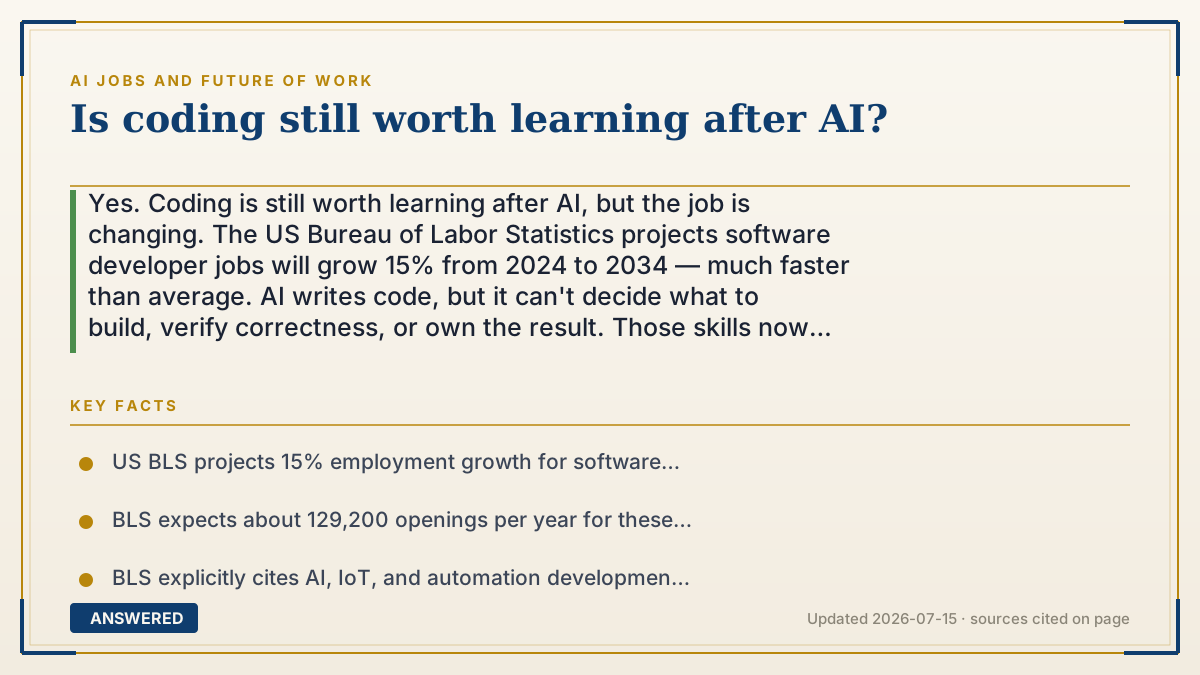
Yes. Coding is still worth learning after AI, but the job is changing. The US Bureau of Labor Statistics projects software developer jobs will grow 15% from 2024 to 2034 — much faster than average. AI writes code, but it can't decide what to build, verify correctness, or own the result. Those skills now matter more.
Why — the first-principles explanation
AI coding tools generate code by predicting likely patterns from billions of lines they were trained on. That makes them fast at the typing part of programming — boilerplate, common functions, routine fixes. But typing was never the hard part. The hard parts are deciding what to build, breaking a fuzzy human need into precise logic, spotting when the AI's confident-looking code is subtly wrong, and taking responsibility when it ships. AI does none of those reliably.
This shifts what "knowing how to code" is worth. If your only skill was cranking out simple scripts, AI is now cheaper and faster than you — that value is falling. But if you understand systems, can architect a solution, read code critically, and debug what the AI got wrong, AI makes you dramatically more productive. You need to understand code to safely use an AI that writes code. A person who can't code can't tell whether the AI's output is brilliant or broken.
The labor data backs this up. The US Bureau of Labor Statistics still projects 15% growth for software developers from 2024 to 2034, with about 129,200 openings a year, explicitly citing AI development as a demand driver. Coding literacy is also spreading into other jobs — analysts, scientists, and marketers who can script now outcompete those who can't. Coding is becoming less a niche career and more a base literacy, like writing or spreadsheets.
An example that makes it click
Think of a calculator and math. Calculators do arithmetic instantly, yet we still teach kids math — because someone who doesn't understand numbers can't tell when the calculator's answer is nonsense, can't set up the right equation, and can't catch a typo that turns 5 into 500.
AI is a calculator for code. It does the arithmetic of programming fast. But you still need to understand what's happening to give it the right problem, check its answer, and fix it when it's confidently wrong. The person who understands code and uses AI runs circles around both the coder who refuses AI and the non-coder who trusts it blindly.
How to do it
- Learn programming fundamentals — variables, logic, data structures — so you can read and judge code, not just generate it.
- Use AI coding assistants from day one, but always trace and test what they produce instead of pasting it blindly.
- Focus on the durable skills AI can't do: system design, debugging, security, and translating vague requirements into precise specs.
- Build real projects end to end so you understand how pieces fit, deploy, and break.
- Pick a domain (data, web, hardware, finance) so your coding skill combines with subject knowledge AI lacks.
Key facts
- US BLS projects 15% employment growth for software developers, QA analysts, and testers from 2024 to 2034 — much faster than the average occupation.
- BLS expects about 129,200 openings per year for these roles over the decade.
- BLS explicitly cites AI, IoT, and automation development as drivers of strong software developer demand.
- WEF ranks software and application developers among the fastest-growing roles through 2030.
- Computer programmer roles (routine coding) are projected to decline, showing the shift from typing code to designing and verifying it.
Choosing an AI tool for work?
The answer above explains the concept; this next step helps you choose by job, limits and current terms.
▶ The 60-second explainer (script)
Is coding still worth learning after AI? Yes — but here's the nuance. AI is fast at the typing part of programming: boilerplate, routine functions, quick fixes. Trouble is, typing was never the hard part. The hard parts are deciding what to build, turning a fuzzy human need into exact logic, catching when the AI's confident code is subtly broken, and owning the result. AI can't do those reliably. And here's the key insight: you need to understand code to safely use an AI that writes code. Someone who can't program can't tell if the output is genius or garbage. The data agrees — the US Bureau of Labor Statistics still projects fifteen percent growth for software developers through 2034, faster than average, and names AI itself as a demand driver. So coding is shifting from a niche skill to a base literacy. Learn the fundamentals, use AI as your assistant, and you'll be far ahead.
What authoritative sources say
People also ask
Will AI replace programmers entirely?
No credible forecast says so. AI automates routine coding tasks, but designing systems, verifying correctness, and owning outcomes still require human developers — and BLS still projects job growth.
Do I still need to learn fundamentals if AI writes the code?
Yes, more than ever. Without fundamentals you can't tell whether AI's output is correct, secure, or nonsense — which makes you dependent instead of productive.
Is it too late to start learning to code in 2026?
No. Demand for developers is still growing faster than average, and coding is becoming a base literacy useful across many jobs, not just software engineering.
What should coders focus on now?
System design, debugging, security, and translating vague needs into precise specs — the judgment-heavy work AI can't do — plus fluency with AI coding tools.
The same question, asked other ways
- Will learning to code be worth it in the future?