Is coding still worth learning in 2026?
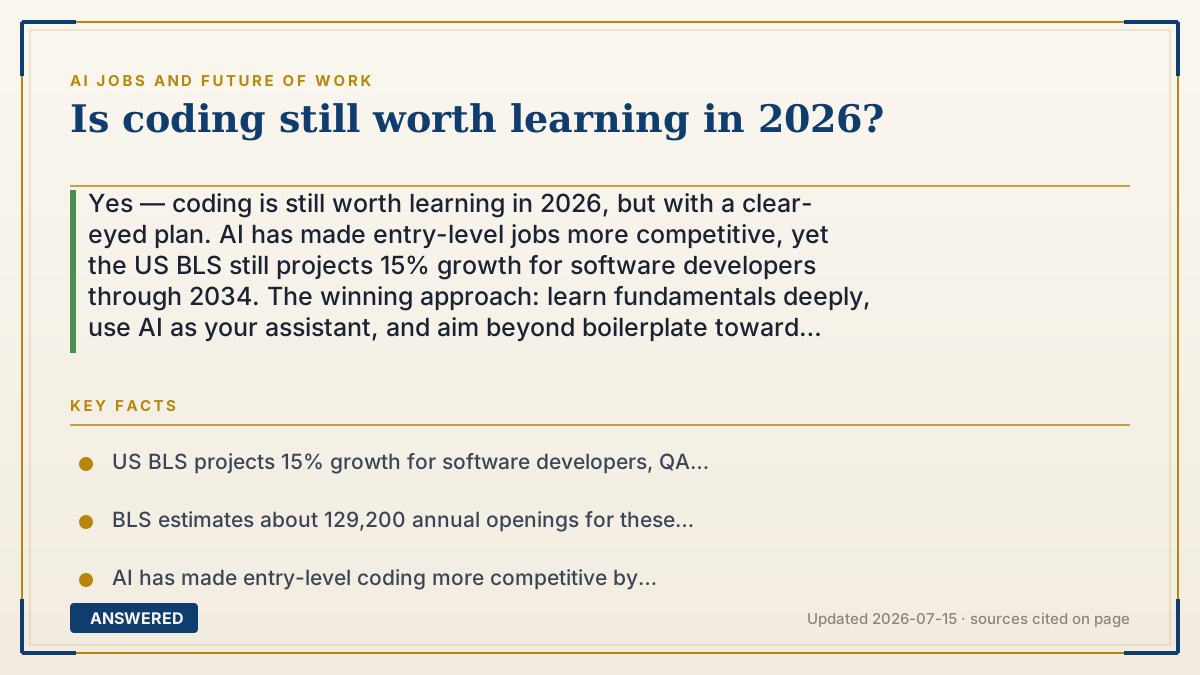
Yes — coding is still worth learning in 2026, but with a clear-eyed plan. AI has made entry-level jobs more competitive, yet the US BLS still projects 15% growth for software developers through 2034. The winning approach: learn fundamentals deeply, use AI as your assistant, and aim beyond boilerplate toward design and problem-solving.
Why — the first-principles explanation
In 2026 the coding question has two layers, and mixing them causes confusion. Layer one: is coding a useful skill? Unquestionably yes — and arguably more than ever, because AI writes code, and you need to understand code to use an AI that writes code. Layer two: is a coding job easy to get right now? Here the answer is more mixed, because AI has automated the simplest tasks that beginners used to be hired for, making the entry level more competitive.
The underlying mechanism: AI is fast at generating routine code from patterns, but it cannot decide what to build, guarantee correctness, design a system, or take responsibility when code ships. Those judgment-heavy skills are exactly what separate a valuable developer from a code-typing bot. So the value of coding is shifting upward — away from cranking out simple scripts (now cheap) and toward architecture, debugging, security, and verification (now scarce and prized).
The 2026 data supports learning it. The US Bureau of Labor Statistics projects 15% growth for software developers from 2024 to 2034, much faster than average, with about 129,200 annual openings — and it names AI as a demand driver. Meanwhile, coding literacy is spreading into non-developer jobs: analysts, scientists, and operators who can script outperform those who can't. The honest 2026 verdict: worth learning, but don't expect the easy junior job of a decade ago. Learn fundamentals so you can command AI, build real projects, and target the higher-value work — that path is still very much open.
An example that makes it click
Imagine two people learning to drive in 2026, when cars have advanced assist features. One says, "the car parks itself, why bother learning?" and never really learns — so when the assist gets confused on a tight street, they're stuck. The other learns to drive well and uses the assist features, so they're faster, safer, and can handle anything.
Coding in 2026 is the same. AI is a powerful driving assist for code. The person who refuses to learn because "AI does it" gets stranded the moment the AI's output is subtly wrong. The person who learns the fundamentals and uses AI to move faster is exactly who employers want. The tool didn't make the skill pointless — it made shallow skill pointless and deep skill more powerful.
How to do it
- Learn core fundamentals — logic, data structures, how programs actually run — not just how to prompt an AI.
- Use AI coding assistants from the start, but trace, test, and understand every line they produce.
- Build complete projects end to end so you learn design, deployment, and debugging, not just snippets.
- Aim past boilerplate: practice system design, security, and turning vague needs into precise specs.
- Pair coding with a domain (data, web, finance, hardware) so your skills combine with knowledge AI lacks.
Key facts
- US BLS projects 15% growth for software developers, QA analysts, and testers from 2024 to 2034 — much faster than average.
- BLS estimates about 129,200 annual openings for these roles and names AI as a demand driver.
- AI has made entry-level coding more competitive by automating boilerplate and simple bug fixes.
- WEF ranks software and application developers among the fastest-growing roles through 2030.
- Coding literacy increasingly benefits non-developer roles like data analysts and scientists.
Choosing an AI tool for work?
The answer above explains the concept; this next step helps you choose by job, limits and current terms.
▶ The 60-second explainer (script)
Is coding still worth learning in 2026? Yes — but let's separate two questions people keep blending. First: is coding a useful skill? Absolutely, maybe more than ever, because AI writes code and you need to understand code to safely use an AI that writes code. Second: is a coding job easy to land right now? That's more mixed, because AI has automated the simplest tasks beginners used to be hired for, so the entry level is more competitive. Here's the key shift: the value of coding is moving upward. Cranking out simple scripts is now cheap, but designing systems, debugging, securing, and verifying code is scarce and prized — and AI can't do those reliably. The data backs learning it: the US Bureau of Labor Statistics projects fifteen percent growth for software developers through 2034, faster than average, and names AI as a demand driver. So learn the fundamentals deeply, use AI as your assistant, aim beyond boilerplate — and yes, in 2026 coding is still very much worth it.
What authoritative sources say
People also ask
Is it too late to learn coding in 2026?
No. Developer demand is still growing faster than average through 2034, and coding is becoming a base literacy useful across many jobs beyond software engineering.
Will AI make coding skills obsolete?
No. AI automates routine coding but can't design systems, verify correctness, or own outcomes. Understanding code is what lets you use AI effectively.
Is the coding job market harder now?
The entry level is more competitive because AI handles simple tasks. But overall demand keeps rising, and candidates who use AI and show real skills still get hired.
What should I focus on when learning to code in 2026?
Fundamentals, complete projects, and higher-value skills like system design, debugging, and security — plus fluency with AI coding assistants.