Is it still worth learning to code in the age of AI?
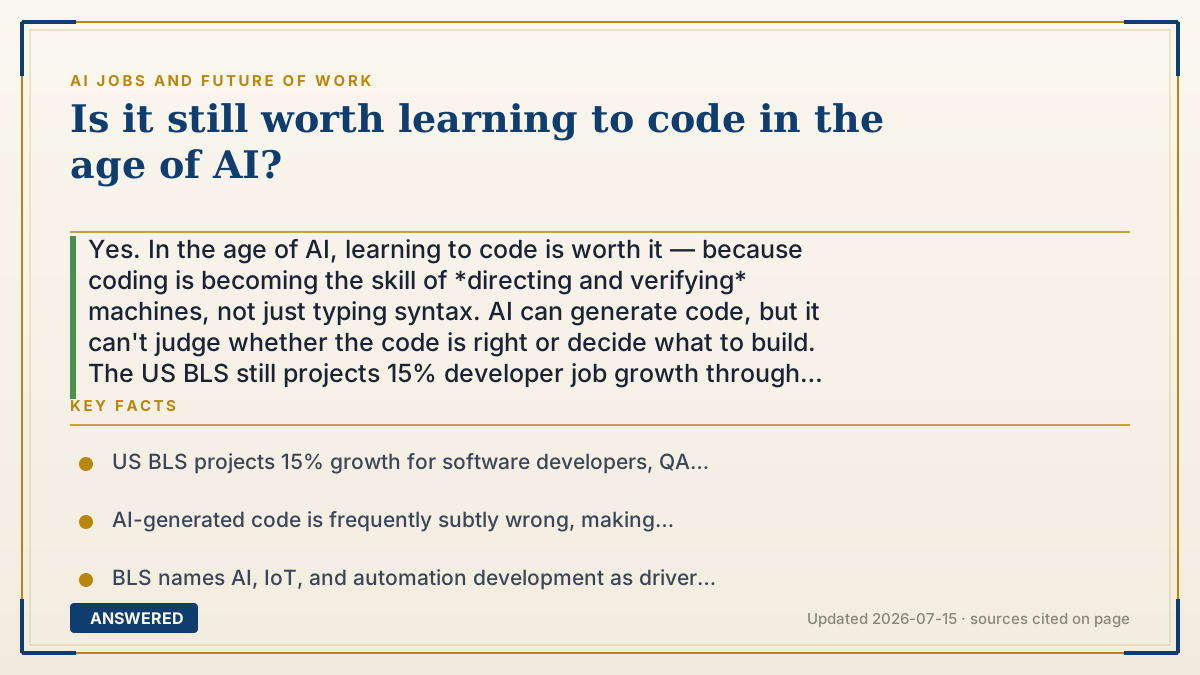
Yes. In the age of AI, learning to code is worth it — because coding is becoming the skill of *directing and verifying* machines, not just typing syntax. AI can generate code, but it can't judge whether the code is right or decide what to build. The US BLS still projects 15% developer job growth through 2034.
Why — the first-principles explanation
The deepest way to answer this is to notice that "learning to code" was never really about memorizing syntax — it was about learning to think in precise, logical steps and translate messy human goals into instructions a machine follows exactly. AI changes the typing, but it makes that underlying way of thinking more valuable, not less. Someone who can decompose a problem, reason about edge cases, and verify a result is exactly the person who can wield an AI that writes code.
Here's the mechanism that matters. AI generates plausible code by predicting patterns, and it is often subtly wrong — a security hole, a wrong assumption, a bug that only shows up with real data. It states these mistakes with total confidence. To catch them, you need to understand what the code does. So in the age of AI, coding knowledge becomes a verification and steering skill: you're the pilot, AI is the autopilot, and autopilots need pilots who can fly. A person who can't code can't tell whether the AI just saved them a day or planted a landmine.
There's also a leverage argument. AI makes each competent coder far more productive, which historically increases demand for the skill rather than killing it — cheaper software means people build more of it. The US Bureau of Labor Statistics projects 15% growth for software developers through 2034, citing AI as a driver. And coding literacy now leaks into every field: the analyst, scientist, or founder who can script and direct AI outbuilds the one who can't. So "is it worth it?" — yes, but redefine the goal: learn to think in code and command AI, not to out-type it.
An example that makes it click
Think about learning to read and write in a world of audiobooks and dictation software. You could say, "machines read aloud and take dictation, why learn to write?" But writing was never just moving a pen — it's the skill of organizing thought clearly. Someone who can't write can't tell whether the dictation software garbled their meaning, can't structure a real argument, and is at the mercy of whatever the machine produces.
Coding in the age of AI is the same. The AI is a very fast dictation machine for logic. Learning to code is learning to think clearly enough to know what to tell it and whether it got it right. The person who can do that turns AI into a superpower. The person who can't just hopes the machine didn't make a mistake — and it often does.
How to do it
- Learn to think in code: focus on logic, problem decomposition, and edge cases, not just syntax.
- Practice reading and reviewing code — including AI-generated code — to build verification instincts.
- Use AI assistants deliberately, then test and trace their output so you understand every result.
- Build real, complete projects to learn design, deployment, and debugging.
- Combine coding with a domain you know so your judgment adds value AI can't supply.
Key facts
- US BLS projects 15% growth for software developers, QA analysts, and testers from 2024 to 2034 — much faster than average.
- AI-generated code is frequently subtly wrong, making human verification and understanding essential.
- BLS names AI, IoT, and automation development as drivers of strong developer demand.
- WEF lists software and application developers among the fastest-growing roles through 2030.
- Coding literacy increasingly boosts non-developer roles, from data analysts to founders directing AI tools.
▶ The 60-second explainer (script)
Is it still worth learning to code in the age of AI? Yes — but here's the reframe that makes it obvious. Learning to code was never really about memorizing syntax. It was about learning to think in precise, logical steps and turn messy human goals into exact instructions. AI changes the typing part, but it makes that way of thinking more valuable, not less. Why? Because AI generates code by predicting patterns, and it's often subtly wrong — a security hole, a bad assumption, a bug that only appears with real data — and it says these mistakes with total confidence. To catch them, you have to understand the code. So coding becomes a steering and verification skill: you're the pilot, AI is the autopilot, and autopilots need pilots who can actually fly. Someone who can't code can't tell if the AI just saved them a day or planted a landmine. And the demand is real — the US Bureau of Labor Statistics still projects fifteen percent developer growth through 2034. So learn to think in code and command AI. That skill is more powerful now, not less.
What authoritative sources say
People also ask
If AI writes code, why learn to code at all?
Because AI's code is often subtly wrong, and you need to understand code to catch mistakes, decide what to build, and steer the AI effectively.
Has AI reduced the demand for coding skills?
Not overall. Demand for developers is still growing faster than average through 2034, and coding literacy is spreading into many non-developer roles.
What does 'learning to code' mean now?
Less about typing syntax, more about thinking in logic, verifying results, and directing AI tools — the skills AI can't replace.
Is coding a good long-term skill in the AI era?
Yes. It teaches precise problem-solving that transfers across fields and makes you the person who can command AI rather than depend on it blindly.