Is the AI bubble bursting?
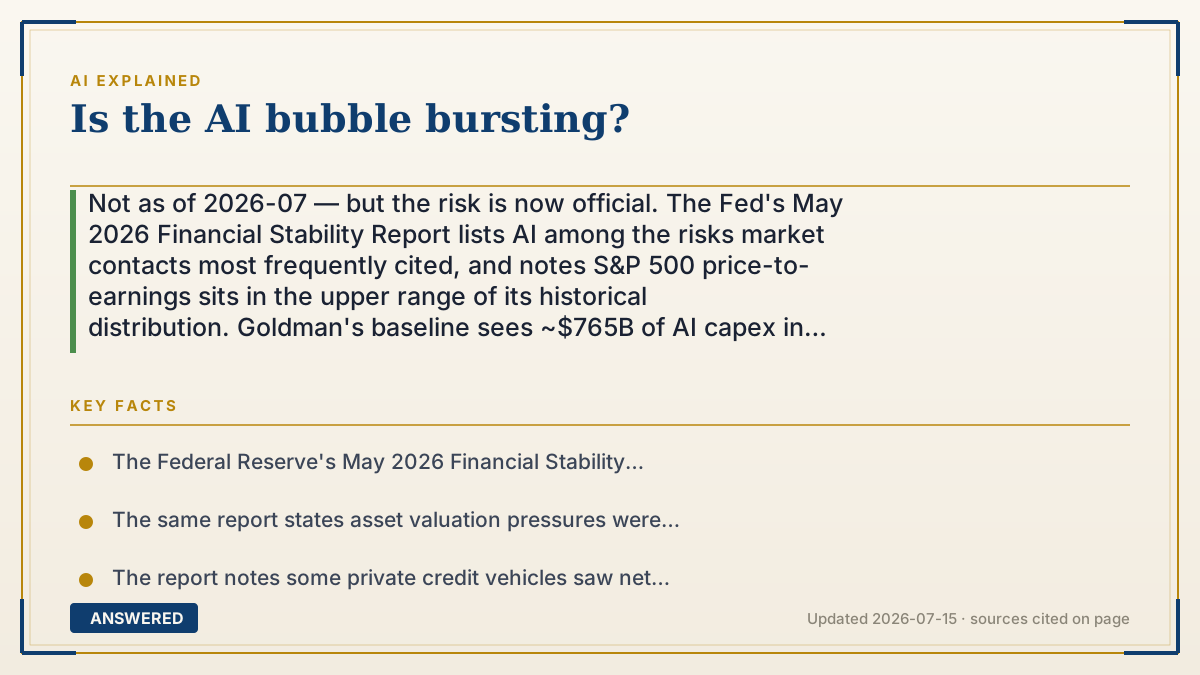
Not as of 2026-07 — but the risk is now official. The Fed's May 2026 Financial Stability Report lists AI among the risks market contacts most frequently cited, and notes S&P 500 price-to-earnings sits in the upper range of its historical distribution. Goldman's baseline sees ~$765B of AI capex in 2026. Nobody credible knows the timing.
Why — the first-principles explanation
A bubble bursts when spending outruns the cash flow that has to service it. So the honest way to think about this isn't sentiment — it's a race between two curves: the capital going in, and the revenue coming back.
The capital side is enormous and reasonably well measured. Goldman Sachs Global Institute's baseline (George Lee and Lucas Greenbaum, May 1, 2026) implies about $765 billion of AI capex in 2026, rising to ~$1.6 trillion annually by 2031 — roughly $7.6 trillion cumulative from 2026 to 2031 across compute, data centers, and power. But read Goldman's own caveat, because it's the most useful sentence in the debate: the framework does not attempt to forecast AI adoption or end-market demand, and the authors call the estimates scenario-based and "far more conditional than they appear." They name four assumptions that swing the answer by hundreds of billions: silicon useful life (3-7 years), data center cost per megawatt ($11M-$19M), the GPU-versus-ASIC mix, and how long the build-out stretches. Change the depreciation schedule alone and the economics move dramatically. That's why credible estimates diverge so wildly — they're not arguing about facts, they're picking different assumptions.
The revenue side is where the disagreement actually lives, and it's genuinely unresolved. Bears note that AI revenue is far below AI spending at several major players, that hyperscaler capex is consuming an extraordinary share of operating cash flow, and that circular arrangements — vendor equity stakes, take-or-pay compute contracts, debt-funded GPU purchases among a handful of interlocked firms — can make end demand look larger and more independent than it is. That pattern rhymes with vendor financing in telecom around 1999-2001. Bulls note the buyers are the most cash-generative companies in history, the constraint is physical (power, transformers, land) rather than speculative, and that unlike dot-com, the revenue is real and growing even if it lags.
What's not in dispute is the official temperature. The Fed's Financial Stability Report of May 2026 (data as of April 23, 2026) reports that market contacts most frequently cited geopolitical risks, an oil shock, AI, private credit, and persistent inflation. It states asset valuation pressures were elevated, with S&P 500 P/E in the upper range of its historical distribution, and notes some private credit vehicles saw net outflows partly on concerns AI could disrupt business models, notably in software.
So: elevated valuations, an acknowledged systemic risk, a capex curve dependent on assumptions nobody can pin down. That describes a fragile expansion, not a burst. And anyone telling you the date is guessing — bubbles are only unambiguous in the rearview mirror.
An example that makes it click
Imagine a town where everyone starts building hotels because a rumor says a million tourists are coming.
The hotels are real. The concrete is real. The construction jobs are real. The question isn't whether the hotels exist — it's whether the tourists show up before the mortgage payments do.
Now add the strange part. Some hotels are being paid for by the cement company, which took shares in the hotels, and the hotels signed contracts to buy cement for ten years. Cement sales look fantastic. But if you squint, some of that demand is the town selling to itself. That doesn't mean no tourists are coming. It means you can't read the cement numbers to find out.
Key facts
- The Federal Reserve's May 2026 Financial Stability Report (data as of April 23, 2026) reports that market contacts most frequently cited geopolitical risks, an oil shock, AI, private credit, and persistent inflation as salient risks.
- The same report states asset valuation pressures were elevated and that the S&P 500 price-to-earnings ratio remained in the upper range of its historical distribution.
- The report notes some private credit vehicles saw net outflows in Q1 2026 partly on credit quality concerns tied to AI's potential to disrupt business models, notably in software.
- Goldman Sachs Global Institute's baseline (May 1, 2026) implies ~$765 billion in annual AI capex in 2026, growing to ~$1.6 trillion annually by 2031, and ~$7.6 trillion cumulatively from 2026 to 2031.
- Goldman explicitly states its framework does not forecast AI adoption or end-market demand, and calls the estimates scenario-based and 'far more conditional than they appear.'
- Goldman identifies four swing assumptions: silicon useful life (3-7 years), data center cost of $11M-$19M per megawatt, GPU versus ASIC mix, and build-out elongation.
▶ The 60-second explainer (script)
Is the AI bubble bursting? As of July 2026 — no. But the risk is now officially on the record, and that's new. Here's the only framing that helps: a bubble bursts when spending outruns the cash flow that has to service it. So it's a race between two curves. Money going in, money coming back. The money going in is enormous and pretty well measured. Goldman Sachs' baseline, published May 2026, implies about seven hundred sixty-five billion dollars of AI capex this year, growing to roughly one point six trillion a year by 2031. But read their own caveat, because it's the most useful sentence in this whole debate: their framework does not attempt to forecast demand, and they call the estimates far more conditional than they appear. Four assumptions swing it by hundreds of billions — how long the chips last, cost per megawatt, GPUs versus custom chips, and how long the build takes. That's why the estimates you see disagree so violently. They're not arguing about facts. They're picking different assumptions. The money coming back is where the real fight is. Bears point at revenue far below spending, and at circular deals — vendors taking equity in their customers, customers signing take-or-pay contracts — which makes demand look bigger and more independent than it is. That rhymes with telecom in 1999. Bulls point out the buyers are the most cash-rich companies in history and the bottleneck is physical: power, transformers, land. What's not in dispute: the Fed's May 2026 Financial Stability Report lists AI among the risks market contacts cite most, and says S&P 500 valuations sit in the upper range of their historical distribution. It's a town building hotels on a rumor of tourists. The concrete is real. The question is whether the tourists arrive before the mortgage does. Anyone giving you a date is guessing.
What authoritative sources say
People also ask
Is AI definitely a bubble?
There's no consensus. Valuations are officially described as elevated and AI is a named systemic risk, but the underlying spending is buying physical assets with real revenue behind them. Bubbles are only unambiguous afterward.
Why do the estimates differ so much?
Because they rest on assumptions, not measurements. Goldman names four that swing the answer by hundreds of billions: how long chips stay useful (3-7 years), cost per megawatt ($11M-$19M), chip mix, and build-out timing.
What would an actual burst look like?
Capex guidance cut sharply, data center leases canceled or left uncommenced, GPU depreciation schedules extended to flatter earnings, and credit spreads widening for AI-linked borrowers. Watch financing, not headlines.
What does the Fed actually say?
Its May 2026 report says market contacts cite AI among the most salient risks, and that equity valuation pressures are elevated with S&P 500 P/E in the upper range of its historical distribution. That's a caution flag, not a prediction.
Isn't this just like the dot-com bubble?
Partly. The echo is vendor financing and circular deals, as with telecom in 1999-2001. The difference is that today's buyers generate enormous cash and the binding constraint is physical — power and land — not pure speculation.