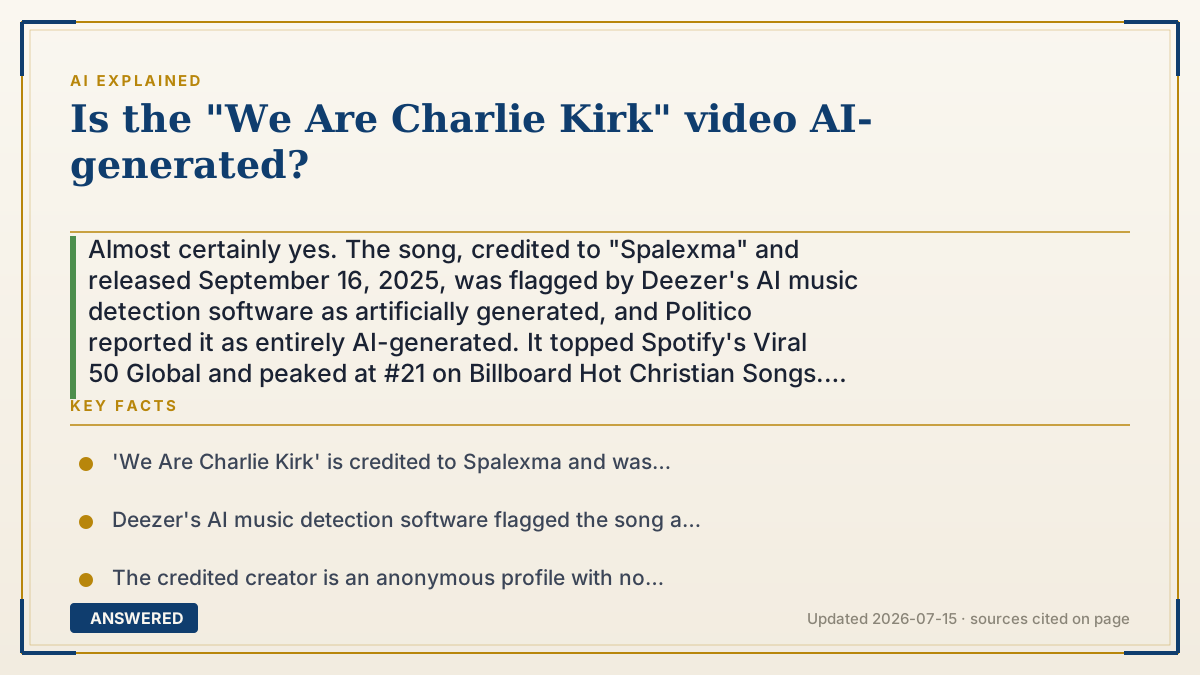
Is the "We Are Charlie Kirk" video AI-generated?
Almost certainly yes. The song, credited to "Spalexma" and released September 16, 2025, was flagged by Deezer's AI music detection software as artificially generated, and Politico reported it as entirely AI-generated. It topped Spotify's Viral 50 Global and peaked at #21 on Billboard Hot Christian Songs. The creator is anonymous with no social presence and 18 similar albums.
Why — the first-principles explanation
This case is worth understanding because it shows how AI content actually spreads — not through deception about the music, but through real grief moving faster than verification.
The evidence pattern is what matters. No one has produced a confession, so the honest word is "presumably." But the signals stack. Deezer's AI music detection software flagged it as artificially generated — and unlike text detectors, music detectors have a firmer footing, because AI audio generators leave characteristic spectral artifacts in the waveform rather than merely producing predictable choices. Politico reported it as entirely AI-generated. Listeners described a "robotic" vocal accent. The credited artist, Spalexma, is an anonymous profile with no social media presence, associated only with "SP Music Project" — and linked to eighteen Christian-themed albums, all presumably AI-generated. That last fact is the tell. A grieving human writes one song. A content operation ships eighteen albums.
Which exposes the actual mechanism: economics, not artistry. Generating a track costs cents and minutes. Streaming pays per play. So the rational strategy is volume — flood every emotionally charged moment with plausible material and let the algorithm find the one that catches. You aren't betting on a hit; you're buying lottery tickets at scale. Charlie Kirk was assassinated on September 10, 2025. The song appeared six days later. That is not the timeline of grief. It's the timeline of a pipeline.
And it worked, which is the uncomfortable part. It topped Spotify's Viral 50 – Global, reached nearly 100,000 monthly Spotify listeners, appeared in 58,000+ TikTok videos, drew 750,000+ YouTube views, and charted at #26 then #21 on Billboard Hot Christian Songs in December 2025. Real people cried to it. The feeling in the comments wasn't manufactured; only the song was. Note too that this sits inside a broader pattern. PolitiFact, via Poynter, analyzed 24 YouTube videos of AI tribute songs falsely attributed to real artists — Adele, Ed Sheeran, Eminem, Taylor Swift, Celine Dion, Lady Gaga, Rihanna and others — which together drew over 4.6 million views. Most carried synthetic-content disclaimers buried in the video description where nobody reads them, and comments showed viewers believed they were real. Those are straightforwardly deceptive: they lied about who made them. "We Are Charlie Kirk" is subtler. It never claimed to be by anyone real. It only claimed to be sincere.
An example that makes it click
Think about a sympathy card.
A handwritten note from a friend took her twenty minutes and it's about you specifically. A store-bought card cost $4.99 and was written by a stranger who has never met you — and yet you're still moved reading it, because the words are right and the person handing it to you means them.
Now imagine a company that generates ten thousand sympathy cards an hour, scans the obituaries, and has one on every doorstep within a day. Each card is fine. Some are beautiful. People cry.
Nothing about the sadness is fake. The sadness is completely real. What's synthetic is the supply — the fact that the card arrived not because someone thought of you, but because a machine noticed a death and had inventory. That's this song. Six days after an assassination, from an anonymous account with eighteen albums.
Key facts
- 'We Are Charlie Kirk' is credited to Spalexma and was released September 16, 2025 — six days after Charlie Kirk was assassinated on September 10, 2025.
- Deezer's AI music detection software flagged the song as artificially generated, and Politico reported it as 'entirely AI-generated.'
- The credited creator is an anonymous profile with no social media presence, associated only with 'SP Music Project' and linked to eighteen Christian-themed albums, all presumably AI-generated.
- The song topped Spotify's 'Viral 50 – Global' playlist and reached nearly 100,000 monthly Spotify listeners.
- It appeared in more than 58,000 TikTok videos and its YouTube upload drew over 750,000 views.
- It debuted at #26 on Billboard Hot Christian Songs for the week of December 6, 2025 and peaked at #21 the following week.
- Listeners and reviewers described a 'robotic' vocal accent characteristic of AI music; media outlets widely labeled the track 'AI slop.'
- Separately, PolitiFact analyzed 24 YouTube AI tribute videos falsely attributed to artists including Adele, Ed Sheeran, Eminem, Taylor Swift, Celine Dion, Lady Gaga and Rihanna, which together drew more than 4.6 million views; most buried their synthetic-content disclaimers in video descriptions.
▶ The 60-second explainer (script)
Is the 'We Are Charlie Kirk' song AI-generated? Almost certainly yes. Nobody's confessed, so the honest word is presumably — but the signals stack up hard. Deezer's AI music detection software flagged it as artificially generated. Politico reported it as entirely AI-generated. Listeners described a robotic vocal accent. And the credited artist, Spalexma, is an anonymous profile with no social media presence — linked to eighteen Christian-themed albums, all presumably AI-made. That last one is the tell. A grieving person writes one song. A content operation ships eighteen albums. Which reveals what this actually is: economics, not artistry. Generating a track costs cents and minutes. Streaming pays per play. So the rational move is volume — flood every emotionally charged moment with plausible material and let the algorithm find the one that catches. You're not betting on a hit. You're buying lottery tickets at scale. Charlie Kirk was assassinated on September tenth, 2025. The song appeared on the sixteenth. Six days. That is not the timeline of grief. That's the timeline of a pipeline. And here's the uncomfortable part: it worked. Number one on Spotify's Viral 50 Global. Nearly a hundred thousand monthly listeners. Fifty-eight thousand TikTok videos. Seven hundred fifty thousand YouTube views. It charted at twenty-one on Billboard Hot Christian Songs. Real people cried to it. Think about a sympathy card. A handwritten note from a friend took twenty minutes and it's about you. A store-bought card cost five bucks and was written by a stranger — and it still moves you, because the person handing it to you means it. Now imagine a company generating ten thousand cards an hour, scanning obituaries, one on every doorstep by morning. Each card is fine. Some are beautiful. People cry. Nothing about the sadness is fake. What's synthetic is the supply — the card arrived because a machine noticed a death and had inventory. And note the wider pattern. PolitiFact analyzed twenty-four YouTube tribute songs falsely credited to real artists — Adele, Ed Sheeran, Eminem, Taylor Swift, Celine Dion — over four point six million views combined. Most had a synthetic-content disclaimer buried in the description where nobody reads it, and the comments show people believed them. Those lied about who made them. This song never did. It only claimed to be sincere.
What authoritative sources say
People also ask
Has anyone confirmed the song is AI?
No creator has confirmed it, which is why coverage says 'presumably.' But Deezer's AI music detection flagged it, Politico reported it as entirely AI-generated, and the anonymous account is linked to 18 similar albums.
Who is Spalexma?
An anonymous artist profile with no social media presence, associated only with 'SP Music Project.' The account is connected to eighteen Christian-themed albums, all presumably AI-generated.
How popular did it actually get?
Very. It topped Spotify's Viral 50 – Global, reached nearly 100,000 monthly listeners, featured in 58,000+ TikTok videos, drew 750,000+ YouTube views, and peaked at #21 on Billboard Hot Christian Songs.
Are music AI detectors more reliable than text detectors?
Generally yes. AI audio generators leave characteristic spectral artifacts in the waveform, which is firmer evidence than text detectors' perplexity guessing — though no detector is conclusive on its own.
Were there other AI fakes about Charlie Kirk?
Yes. PolitiFact analyzed 24 YouTube tribute songs falsely credited to real artists — Adele, Ed Sheeran, Eminem, Taylor Swift and others — totaling over 4.6 million views. Those impersonated real people; this song didn't.
The same question, asked other ways
- Is the we are charlie kirk song AI?