Is Turnitin AI detector accurate?
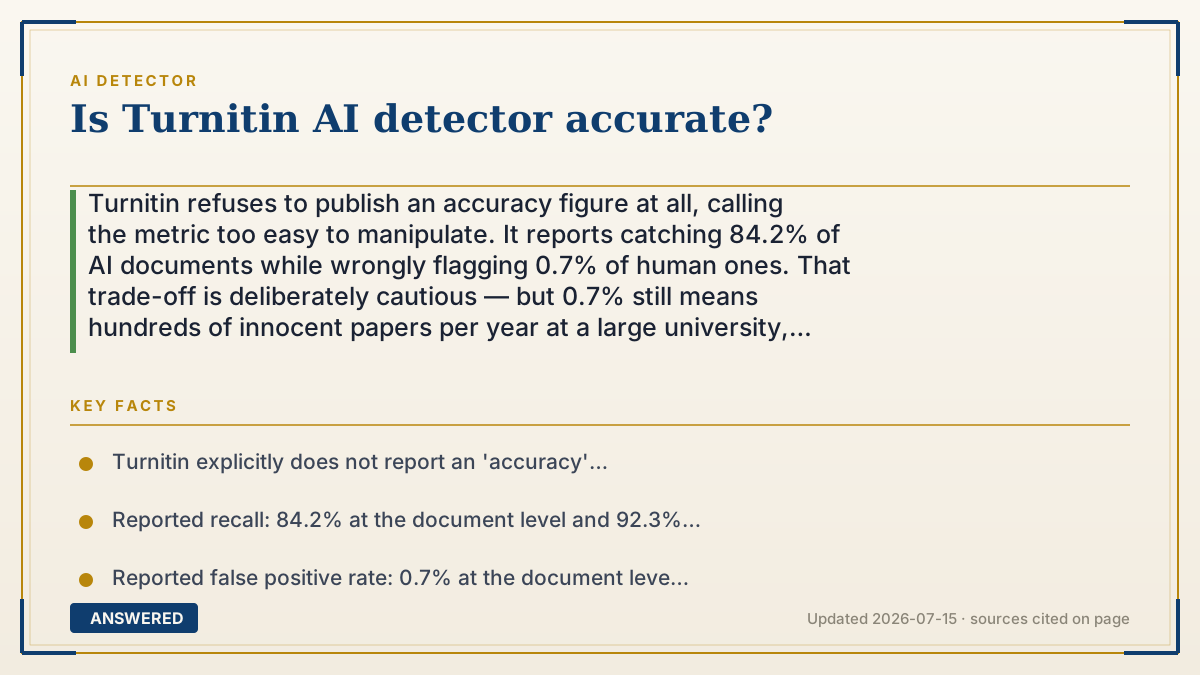
Turnitin refuses to publish an accuracy figure at all, calling the metric too easy to manipulate. It reports catching 84.2% of AI documents while wrongly flagging 0.7% of human ones. That trade-off is deliberately cautious — but 0.7% still means hundreds of innocent papers per year at a large university, which is why Vanderbilt disabled it.
Why — the first-principles explanation
"Accurate" is the wrong question, and Turnitin says so itself. Its whitepaper explains the trap with arithmetic: if only 1% of papers were AI-written, a detector that labeled everything human-written would be 99% accurate and completely worthless. So Turnitin reports two numbers instead, and you need both.
Recall is how much AI it catches: 84.2% at the document level, 92.3% at the sentence level, measured on a held-out set of roughly 7,000 documents mixing pure human, pure AI, and blended text. False positive rate is how often it accuses innocent writing: 0.7% at the document level, measured by running the production system across 800,000 papers submitted before 2019, when GPT-3 did not exist and every paper was necessarily human.
These two numbers trade against each other, and Turnitin chose its side. Every design decision pushes toward fewer false accusations: the 300-word minimum, the sentence threshold set high (typically 0.8 to 1), and the rule that a document is only labeled AI-written if more than 20% of its sentences clear that threshold — because below 20%, Turnitin found false positives spike. The cost is admitted openly: to keep the false positive rate low, the system misses real AI writing. Roughly one AI-written document in six goes unflagged.
Now the part that decides whether "accurate" is good enough: base rates and scale. Vanderbilt did the multiplication that Turnitin's percentage hides. It processed 75,000 papers in 2022. At a 1% error rate, that is about 750 students wrongly flagged in a single year — and it disabled the detector in August 2023.
There is also a gap between the test and the world. That 0.7% was measured on pre-2019 papers. Independent peer-reviewed testing of 14 systems, including Turnitin, found the tools "neither accurate nor reliable" once obfuscation entered the picture — light paraphrasing significantly degrades performance. Notably, that same study is cited in Turnitin's own whitepaper, because Turnitin recorded zero false accusations in it. Both findings are true: Turnitin is the cautious one, and cautious is not the same as reliable.
An example that makes it click
A metal detector at an airport is set very conservatively so it almost never beeps at a belt buckle. Sounds great. But the airport screens 75,000 people a year, so "almost never" still means it beeps at 500 innocent travelers — each of whom gets pulled aside and asked to explain themselves. Meanwhile, to stay that quiet, it's been tuned down enough that it misses about one in six actual knives.
That's Turnitin. The engineering is genuinely careful. The problem is that a percentage that sounds tiny becomes a crowd of real people once you multiply it by a real school — and the innocent travelers it stops aren't random. They cluster among students writing in a second language, whose plainer vocabulary looks machine-like to the math.
Key facts
- Turnitin explicitly does not report an 'accuracy' metric, stating it is too easily manipulated and too dependent on the dataset — a detector labeling everything human would score 99% accurate on a realistic dataset (whitepaper, August 2023).
- Reported recall: 84.2% at the document level and 92.3% at the sentence level, measured on a held-out evaluation set of approximately 7,000 documents mixing human, AI, and blended writing.
- Reported false positive rate: 0.7% at the document level and 0.2% at the sentence level, measured by running the production system across 800,000 papers submitted before 2019 (pre-GPT-3).
- A document is only labeled AI-written when more than 20% of sentence-level scores clear the threshold; Turnitin found a higher incidence of false positives below 20%.
- Vanderbilt University disabled Turnitin's AI detector on August 16, 2023, noting a 1% false positive rate against its 75,000 annual submissions implies roughly 750 wrongly flagged papers.
- Peer-reviewed testing of 14 detection systems including Turnitin (International Journal for Educational Integrity, December 2023) concluded the tools are neither accurate nor reliable; Turnitin's whitepaper cites that same study as showing its system produced zero false accusations.
▶ The 60-second explainer (script)
Is Turnitin's AI detector accurate? Here's the twist: Turnitin won't tell you, and that's actually the honest move. Their own whitepaper explains why. Imagine only one percent of papers are AI-written. A detector that just says 'human' to everything would be ninety-nine percent accurate — and completely useless. So accuracy is a garbage metric. Turnitin publishes two real numbers instead. Recall: it catches eighty-four point two percent of AI-written documents. False positive rate: it wrongly flags zero point seven percent of human ones. They measured that second number the smart way, by running the detector across eight hundred thousand papers submitted before 2019 — before GPT-3 existed, so guaranteed human. Every design choice they made pushes toward not accusing innocent people. Three hundred word minimum. High threshold. And a document only gets labeled AI-written if more than twenty percent of its sentences get flagged, because below that, false positives spike. The price? About one AI document in six slips through. So is zero point seven percent good? Vanderbilt did the math nobody likes doing. They process seventy-five thousand papers a year. One percent means seven hundred and fifty students wrongly flagged — annually. They shut the detector off in August 2023. Careful engineering. Still not proof.
What authoritative sources say
People also ask
Is Turnitin more accurate than free detectors?
On false positives, its published testing is far more rigorous — 800,000 real pre-GPT papers is a stronger stress test than anything free tools publish. But independent researchers still concluded no tool in the category is reliable enough to stand alone as evidence.
Can Turnitin be wrong about my paper?
Yes. Turnitin's own measured false positive rate is 0.7%, not zero, and errors concentrate on plain, formulaic prose — including writing by non-native English speakers. Turnitin tells instructors the score requires professional judgment.
Why does my score say under 20% with an asterisk?
Turnitin found false positives rise sharply below 20%, so it does not treat low scores as findings. It marks them as less reliable rather than reporting them as AI writing.
Does the detector catch paraphrased AI text?
Much less well. Independent testing found obfuscation techniques significantly worsen performance across all tools, and Turnitin's 2023 whitepaper lists AI paraphrasing tools as future work rather than solved.
The same question, asked other ways
- How accurate is Turnitin AI detector?