Is undetectable AI legit?
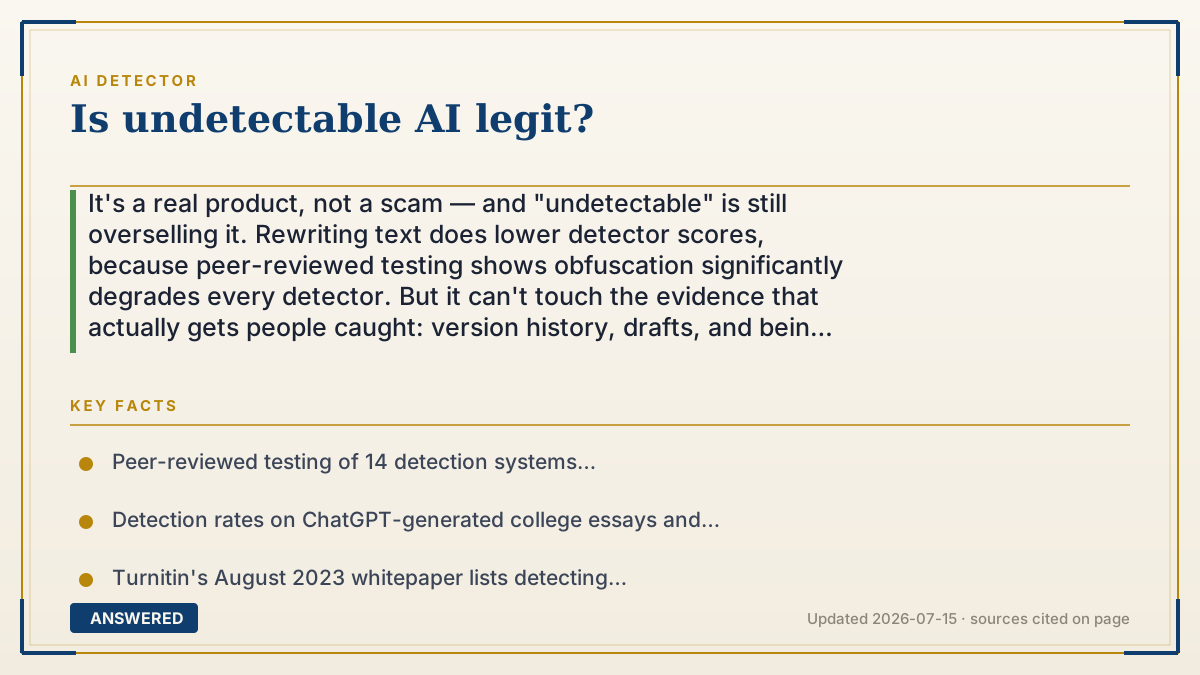
It's a real product, not a scam — and "undetectable" is still overselling it. Rewriting text does lower detector scores, because peer-reviewed testing shows obfuscation significantly degrades every detector. But it can't touch the evidence that actually gets people caught: version history, drafts, and being asked to explain your own paper.
Why — the first-principles explanation
Split "legit" into three questions, because they have three different answers.
Does it do the mechanical thing it claims? Largely yes, and the science says why. Detectors measure how statistically predictable your word sequence is. That signal lives entirely in surface phrasing, which makes it the most fragile thing in the pipeline. Independent testing of 14 detection systems found content obfuscation techniques significantly worsen performance across the board. Stanford's team got detection rates on AI-written essays to drop significantly with nothing more than a prompt asking the model to self-edit using literary language. Humanizer tools automate exactly that. Turnitin's own 2023 whitepaper listed generative AI paraphrasing and rewriting tools as a future problem to solve, not a solved one. So the category works because the thing it attacks is weak — not because these companies invented anything exotic.
Does "undetectable" mean undetectable? No, and this is the load-bearing lie in the name. It means "scores lower on statistical detectors," which is a narrow claim about one weak instrument. It does nothing about Google Docs version history showing an essay appearing in one paste at 2 a.m. It does nothing about Grammarly Authorship tagging text as pasted. It does nothing when an instructor asks why your paper cites a study that doesn't exist, or asks you to explain your third paragraph out loud. Vanderbilt's published guidance already tells faculty to use exactly these methods instead of detectors — so the tool is optimized against the defense schools are actively abandoning.
Is it safe to use? Two hard risks, stated flatly. First, rewriting for statistical camouflage means deliberately degrading word choice away from what fits — text often comes back vaguer, and vagueness is itself a tell a human reader notices instantly. Second, and much larger: no school's policy says "AI is prohibited unless the detector misses it." If you're caught by other means, the humanizer is not a defense — it's evidence of intent, which is the difference between a bad grade and a misconduct finding.
So: real company, real mechanism, real risk, wildly overclaiming name.
An example that makes it click
It's a radar detector for your car. It genuinely works — the physics is real, it really does beep before the speed trap. Nobody's scamming you.
But notice what it doesn't do. It doesn't help with the unmarked car, the traffic camera, or the officer who watched you weave through three lanes. And if you get pulled over anyway, the radar detector sitting on your dash isn't neutral — it's now the most interesting thing in the car. "I didn't know the limit" stops being available the moment you're holding a machine whose only purpose is not getting caught. Same structure exactly: the tool defeats one narrow instrument, and converts a maybe-accident into a clearly-on-purpose.
Key facts
- Peer-reviewed testing of 14 detection systems (International Journal for Educational Integrity, December 2023) found that content obfuscation techniques significantly worsen detector performance — the mechanism humanizers exploit.
- Detection rates on ChatGPT-generated college essays and scientific abstracts dropped significantly after a simple self-edit prompt using literary language (Liang et al., Patterns, July 10, 2023).
- Turnitin's August 2023 whitepaper lists detecting generative AI paraphrasing and rewriting tools as future work, not a solved capability.
- Statistical detectors are only one form of evidence: Grammarly Authorship records whether text was typed, pasted, or accepted from an AI suggestion, in Google Docs and Microsoft Word.
- Vanderbilt University's faculty guidance recommends comparing work to a student's previous writing, checking for hallucinated sources, and discussing suspicions directly — methods a text rewriter does not affect.
- Turnitin's detector reports nothing below a 20% document threshold and requires 300+ words, so low scores are common even without any rewriting tool.
▶ The 60-second explainer (script)
Is Undetectable AI legit? Split that into three questions, because they have three different answers. One: does it do the mechanical thing it says? Mostly yes — and the research explains why. Detectors measure how statistically predictable your word sequence is. That signal lives entirely in surface phrasing, which makes it the most fragile part of the whole system. Researchers tested fourteen detectors and found light obfuscation significantly degrades all of them. Stanford got detection to collapse just by asking the AI to rewrite with more literary language. Humanizers automate that. So the category works because the thing it attacks is weak. Two: does 'undetectable' mean undetectable? No. That's the load-bearing lie in the name. It means 'scores lower on one weak instrument.' It does nothing about Google Docs version history showing your essay materialize in a single paste at 2am. Nothing about paste telemetry. Nothing when your instructor asks why you cited a study that doesn't exist, or asks you to explain your third paragraph out loud. And here's the irony — Vanderbilt's official faculty guidance already tells teachers to use those methods instead of detectors. The tool is optimized against the defense schools are abandoning. Three: is it safe? Two real risks. It rewrites toward statistical camouflage, which usually means vaguer prose — and vagueness is a tell a human notices instantly. And no policy anywhere says 'AI is banned unless the detector misses it.' If you're caught another way, the humanizer isn't your defense. It's evidence you meant to.
What authoritative sources say
People also ask
Does it actually beat Turnitin?
Often it lowers the score, because paraphrasing degrades every detector tested. But nobody can promise a result — Turnitin updates its model, and 'it scored 0%' on one day is not a guarantee for the next.
Is it a scam?
Not in the sense of taking money and delivering nothing. It's a real service performing a real transformation. The dishonest part is the word 'undetectable,' which describes one narrow instrument, not the actual ways people get caught.
Can a school tell I used a humanizer?
Not usually from the text itself. They can tell from everything around it: an essay that appears in one paste, no draft history, citations that don't exist, and an author who can't discuss their own argument.
What are the real downsides?
Rewriting for camouflage tends to make prose vaguer and factually looser, which human readers notice. And if you're caught by other means, using a tool built to evade detection is evidence of intent — which typically escalates the consequences.
The same question, asked other ways
- Does undetectable AI work?
- Can Undetectable.AI actually bypass Turnitin?