Is using AI plagiarism?
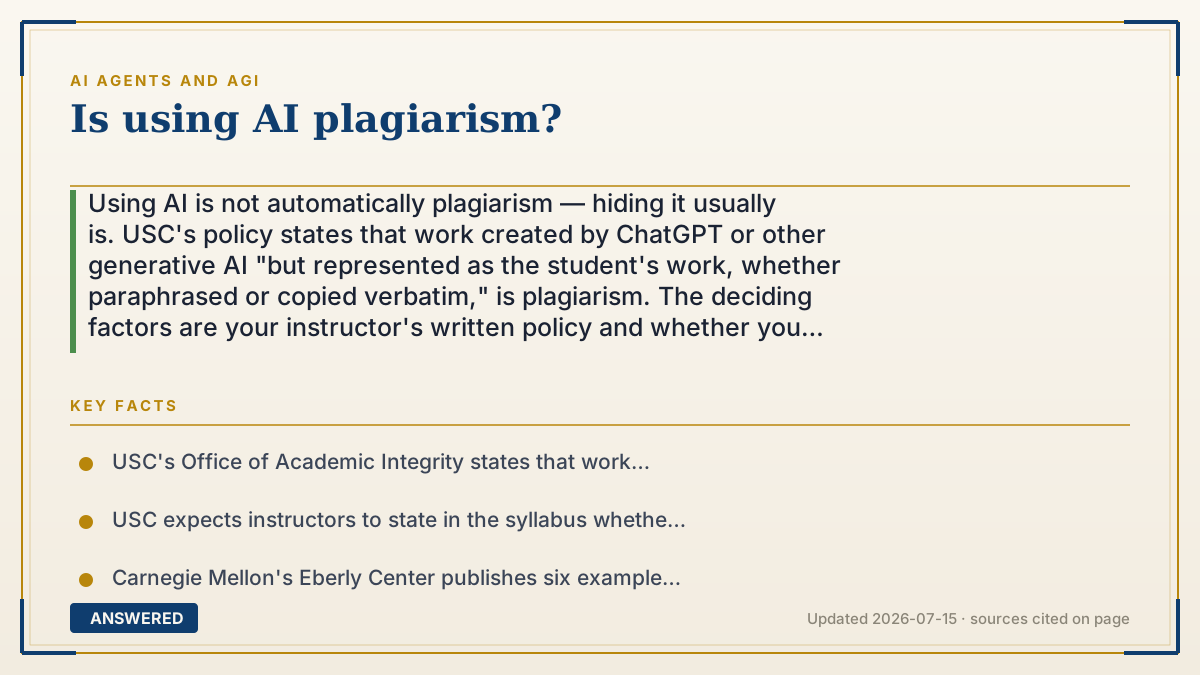
Using AI is not automatically plagiarism — hiding it usually is. USC's policy states that work created by ChatGPT or other generative AI "but represented as the student's work, whether paraphrased or copied verbatim," is plagiarism. The deciding factors are your instructor's written policy and whether you disclosed. When the policy is unclear, ask before you submit.
Why — the first-principles explanation
Plagiarism has never been about where words came from. It's about a claim you make when you submit: this represents my work. Copy your roommate's essay and it's plagiarism. Copy a paragraph from a book without quoting it, same. Hire a ghostwriter, same — even though the ghostwriter wrote something original that exists nowhere else. Notice that originality was never the test. The test is whether you let a reader believe you did something you didn't do. AI slots straight into that old rule: the offense isn't using the tool, it's the false claim.
Which is why the answer genuinely depends on the class, and that's not a cop-out. Academic integrity policies are local rules about authorized assistance, not universal laws about text. A calculator is banned on one exam and required on the next; neither fact tells you anything about calculators. Carnegie Mellon's Eberly Center publishes six example course policies that run the full spectrum — from "complete all graded assignments yourself, without any use of generative artificial intelligence" to policies actively encouraging students to "explore the use of generative artificial intelligence (AI) tools... for all assignments." Same university, opposite rules, both legitimate. Your syllabus is the law that binds you.
The rule that survives everywhere is disclosure. Where AI is allowed, institutions ask for citation specific enough to be meaningful: CMU's example policies require that any use "be appropriately acknowledged and cited," with some asking students to disclose "the exact prompt used to generate the content as well as the AI's full response." Vague gestures — "AI tools were used in preparing this paper" — technically disclose while telling the reader nothing about which ideas are yours. The standard is that a reader could tell what you contributed.
And here's what people forget: disclosure doesn't transfer responsibility. CMU's policies emphasize you "are ultimately responsible for the content that you submit," including accuracy. USC's guidance warns instructors that AI tools "often generate fictional sources and misattribute source material." So the student who cites the AI properly and submits a fabricated case citation hasn't committed plagiarism — they've submitted false information under their own name, which is its own problem. Two separate rules: attribution covers honesty about authorship; accuracy is on you regardless.
One practical warning, because the risk is asymmetric. AI-detection tools are unreliable in both directions and have flagged human writing as machine-written, but an accusation still costs you weeks of stress even when you're right. Keeping your drafts, notes, and version history is the cheapest insurance available.
An example that makes it click
Think about a math test with a calculator. Using a calculator isn't cheating — unless the teacher said no calculators, in which case it absolutely is. The device didn't change. The rule did. Nobody finds this confusing.
Now raise the stakes. Suppose instead of a calculator you hire your brilliant cousin to do the homework, and you copy it in your handwriting. That's not about a tool at all — it's the lie in the handoff. You're letting the teacher believe you did the thinking. And here's the twist that makes AI its own thing: your cousin might be confidently, cheerfully wrong. He hands you a page with a made-up formula on it. You copy it, you turn it in, and when the teacher circles it, "my cousin said so" gets you exactly nowhere. Your name is on the page. That's both rules in one story: be honest about who did the work, and remember that being honest about it doesn't make it right.
How to do it
- Read the syllabus and the assignment prompt first. Course policy overrides everything you've read online, and Carnegie Mellon's own examples run from total prohibition to active encouragement.
- If the policy is silent or vague, email your instructor and get an answer in writing before you submit. 'The syllabus didn't say' is a weak defense; a saved reply is a strong one.
- If AI is permitted, disclose specifically — which tool, for which parts, and how. Some policies ask for the exact prompt and the AI's full response. Vague blanket statements meet the letter but not the standard.
- Never submit AI text as your own words. USC's policy treats AI-created material represented as the student's work, verbatim or paraphrased, as plagiarism.
- Verify every fact and citation yourself. AI tools generate fictional sources and misattribute material, and you remain responsible for accuracy regardless of disclosure.
- Keep your process: drafts, notes, version history, and chat logs. If you're ever wrongly flagged by a detector, that record is your defense.
- For work outside school — jobs, publishing, grants — check that organization's own AI policy. Different rules apply, and some require disclosure by contract.
Key facts
- USC's Office of Academic Integrity states that work "authored by another (including material created by ChatGPT and other Generative AI tools) but represented as the student's work, whether paraphrased or copied verbatim or in near-verbatim form, is considered plagiarism."
- USC expects instructors to state in the syllabus whether generative AI is encouraged, permitted for specific assignments, or prohibited entirely — making course policy the operative rule.
- Carnegie Mellon's Eberly Center publishes six example course policies spanning outright prohibition ("without any use of generative artificial intelligence") to encouragement ("explore the use of generative artificial intelligence (AI) tools... for all assignments and assessments").
- CMU's permitted-use example policies require that AI use "be appropriately acknowledged and cited," with some requiring disclosure of "the exact prompt used to generate the content as well as the AI's full response."
- CMU's policies state students "are ultimately responsible for the content that you submit," including accuracy and detecting AI hallucinations or biased content.
- USC advises instructors to "verify citations and quotes," noting AI tools "often generate fictional sources and misattribute source material."
▶ The 60-second explainer (script)
Using AI is not automatically plagiarism. Hiding it usually is. Here's the principle. Plagiarism was never about where words came from — it's about a claim you make when you hit submit: this represents my work. Copy your roommate's essay, that's plagiarism. Hire a ghostwriter, also plagiarism — even though the ghostwriter wrote something original that exists nowhere else. Originality was never the test. The test is whether you let a reader believe you did something you didn't. AI drops right into that old rule. USC's policy says it plainly: material created by ChatGPT or other generative AI, but represented as the student's work — paraphrased or verbatim — is plagiarism. So why does everyone get a different answer? Because academic integrity policies are local rules about authorized assistance, not universal laws about text. Carnegie Mellon publishes six example course policies that run the whole spectrum — from complete all assignments without any use of generative AI, to policies actively encouraging students to explore AI on every assignment. Same university, opposite rules, both legitimate. Your syllabus is the law that binds you. The rule that holds everywhere is disclosure, and it has to be specific. Some CMU policies want the exact prompt and the AI's full response. Saying 'AI tools were used' tells the reader nothing about which ideas are yours. And one last thing people miss: disclosing doesn't transfer responsibility. You're still on the hook for accuracy — and these tools invent sources that don't exist. Cite it honestly, and check every fact anyway.
What authoritative sources say
People also ask
Is using ChatGPT to write an essay plagiarism?
If you submit it as your own writing, yes — USC's policy explicitly covers AI-created material represented as the student's work. If your course permits AI and you disclose your use as required, it isn't.
Is using AI for grammar or spell-check plagiarism?
Almost never. Fixing grammar doesn't change who did the thinking. The line blurs when a tool rewrites your argument or generates content rather than correcting mechanics — check your syllabus if you're unsure.
How do I cite AI in a paper?
Follow your instructor's rule first. CMU's example policies ask that AI use be acknowledged and cited, with some requiring the exact prompt and the AI's full response. Major style guides also publish AI citation formats.
Can AI detectors prove I cheated?
They're not reliable enough to be proof, and they have flagged human writing as AI-generated. But being wrongly accused is still costly — keep drafts, notes, and version history as evidence of your process.
What if my syllabus says nothing about AI?
Ask your instructor in writing before you submit. Silence isn't permission — many policies treat any unauthorized assistance as a violation, and a saved email is your best protection.
Is it plagiarism if I heavily edit the AI's output?
Possibly. USC's language covers material that is paraphrased or near-verbatim, not just copied. If the ideas and structure came from the AI, editing the wording doesn't make you the author.