What does AI look like?
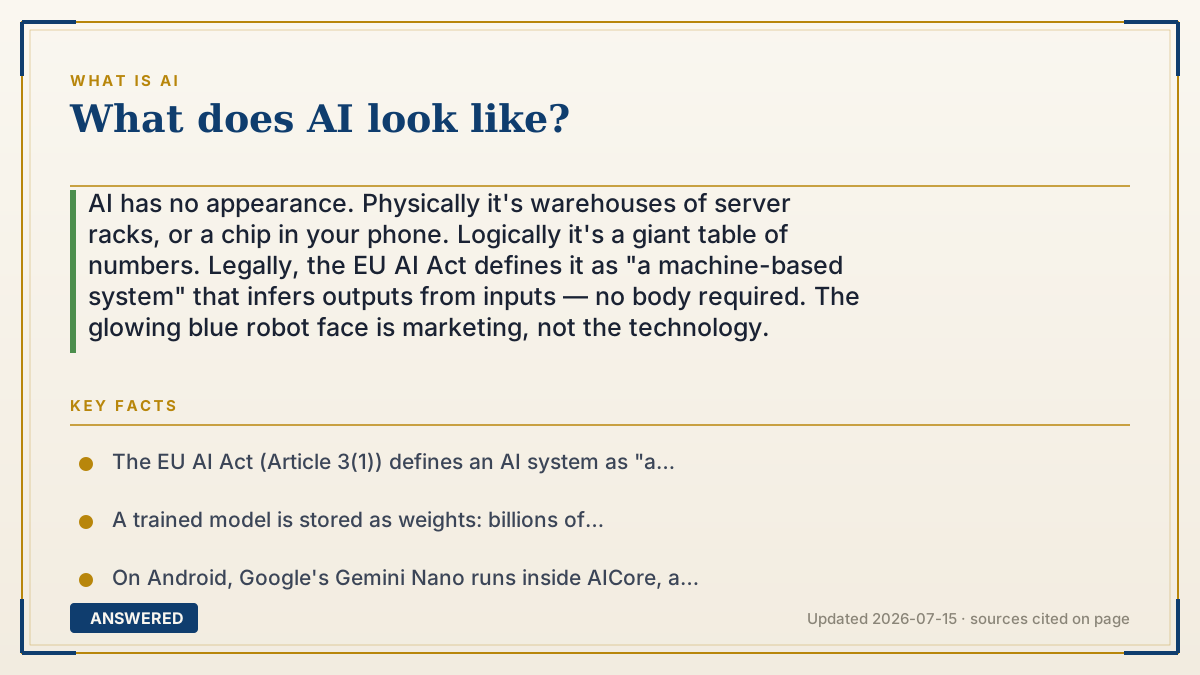
AI has no appearance. Physically it's warehouses of server racks, or a chip in your phone. Logically it's a giant table of numbers. Legally, the EU AI Act defines it as "a machine-based system" that infers outputs from inputs — no body required. The glowing blue robot face is marketing, not the technology.
Why — the first-principles explanation
The honest answer is that asking what AI looks like is a bit like asking what arithmetic looks like. Arithmetic doesn't look like anything. It has implementations that look like things — a calculator, an abacus, chalk on a board, neurons firing — but the thing itself is a procedure, not an object. AI is the same. The EU AI Act's legal definition is deliberately physical-form-agnostic: a machine-based system that, for explicit or implicit objectives, infers from its input how to generate outputs like predictions, content, recommendations, or decisions. Nothing in there about a face.
So what is actually there when AI runs? A model is a file of numbers — the weights. Billions of them, each a decimal. When you ask a question, your words get turned into numbers, those numbers get multiplied against the weights in a long cascade, and numbers come out the other end and get turned back into words. That's it. That's the whole thing. The "intelligence" is entirely in the specific values of those decimals, which were set by grinding through enormous amounts of text. If you printed a modern model's weights, you'd get a phone book with no names — millions of pages of digits, completely unreadable, and completely sufficient to reproduce the model's behavior.
The hardware it runs on does look like something, and it's aggressively boring. Big models live in data centers: rows of steel racks in cold, extremely loud rooms, packed with GPUs, wrapped in power distribution and cooling. Think industrial warehouse, not laboratory. No screens showing scrolling green code. No one is in the room. Small models look like even less — Google's Gemini Nano runs inside AICore, an Android system service with no icon and no user interface at all. There's AI on that phone in your pocket right now, and it looks like nothing, because there's nothing to look at.
Why do we picture a chrome humanoid with glowing eyes, then? Because cameras need a subject. A newspaper can't photograph a matrix multiplication, so it uses a stock photo of a robot. Decades of film needed AI to have a face so actors could talk to it. The image is real — it's just an image of our storytelling constraints, not of the technology. The practical cost of this confusion is that people look for AI in the wrong place. They watch for robots while the actual systems are quietly deciding loan applications, ranking their feed, and transcribing their meetings — invisibly, with no appearance whatsoever.
An example that makes it click
Think about electricity. What does electricity look like? You could point at a lightning bolt, or a power plant, or a wall socket, or the glow of a lamp. But none of those is electricity — they're places it shows up. Electricity itself is electrons moving, and you have never seen one and never will. Nobody finds this troubling. Nobody demands a picture of electricity before they'll believe their toaster works.
AI is at that stage now, minus the calm. Its "lightning bolt" is a data center: a loud, freezing warehouse full of steel racks and blinking lights, with nobody inside. Its "wall socket" is the chat box on your screen. Its "lamp glow" is the meeting summary in your inbox. And the thing itself — the model — is a very long list of decimal numbers sitting in a file, doing arithmetic. That's what AI looks like: a warehouse, a text box, and a phone book full of digits.
Key facts
- The EU AI Act (Article 3(1)) defines an AI system as "a machine-based system that is designed to operate with varying levels of autonomy" and that "infers, from the input it receives, how to generate outputs such as predictions, content, recommendations, or decisions" — with no requirement for any physical form.
- A trained model is stored as weights: billions of numeric parameters in a file. The model's behavior is fully determined by those values plus the code that multiplies them.
- On Android, Google's Gemini Nano runs inside AICore, a system-level service with no user-facing app — it is invoked by other apps through ML Kit GenAI APIs and the AI Edge SDK.
- AICore is designed to isolate each request and does not store input data or outputs after processing.
- NIST's AI Risk Management Framework 1.0 (January 26, 2023) governs AI systems by function — Govern, Map, Measure, Manage — not by physical form.
- Large models run on GPU clusters in data centers; the visible hardware is racks, power distribution, and cooling — the humanoid robot is a media convention, not an implementation.
▶ The 60-second explainer (script)
AI doesn't look like anything. That's the real answer, and it's more interesting than the robot. Start with the law. The EU AI Act defines an AI system as a machine-based system that infers from its input how to generate outputs — predictions, content, recommendations, decisions. Notice what's missing. No body. No face. No form of any kind. So what's actually there? A model is a file of numbers. Billions of decimals called weights. Your words get converted to numbers, multiplied through those weights in a long cascade, and numbers come out and turn back into words. Print those weights and you'd get a phone book with no names — millions of pages of unreadable digits that completely define the thing's behavior. The hardware does look like something, and it's boring. A data center. Rows of steel racks in a freezing, deafeningly loud warehouse. Nobody's in the room. No green scrolling code. And small AI looks like even less. Gemini Nano on Android runs inside something called AICore — a system service with no icon, no interface, nothing to open. There's AI on your phone right now and there is literally nothing to look at. So why the glowing chrome android? Because you can't photograph a matrix multiplication. Movies needed AI to have a face so actors could talk to it. That picture isn't AI. It's a picture of our need for a picture.
What authoritative sources say
People also ask
Is AI a robot?
No. A robot is a body; AI is a procedure that might control one. Almost all AI in use today controls nothing physical — it ranks your feed, screens applications, or writes text.
Where is AI physically located?
Large models live on GPUs in data centers — industrial warehouses full of racks, power gear, and cooling. Small models run directly on your phone or laptop chip, like Gemini Nano inside Android's AICore.
Can I see what an AI model looks like inside?
You can open the file, but you'll see billions of decimal numbers with no labels or meaning you could read. Nobody, including the people who built it, can look at the weights and tell you what any single one does.
Why is AI always drawn as a blue glowing brain or a robot face?
Because the real thing is unphotographable. Editors need an image, so they use a visual shorthand. It has no relationship to how the technology is built.
How can I tell if I'm using AI right now?
Often you can't by looking. AI runs invisibly in autocomplete, spam filters, photo sorting, and meeting summaries. On Android, AICore has no icon at all — apps call it in the background.