What is agentic AI?
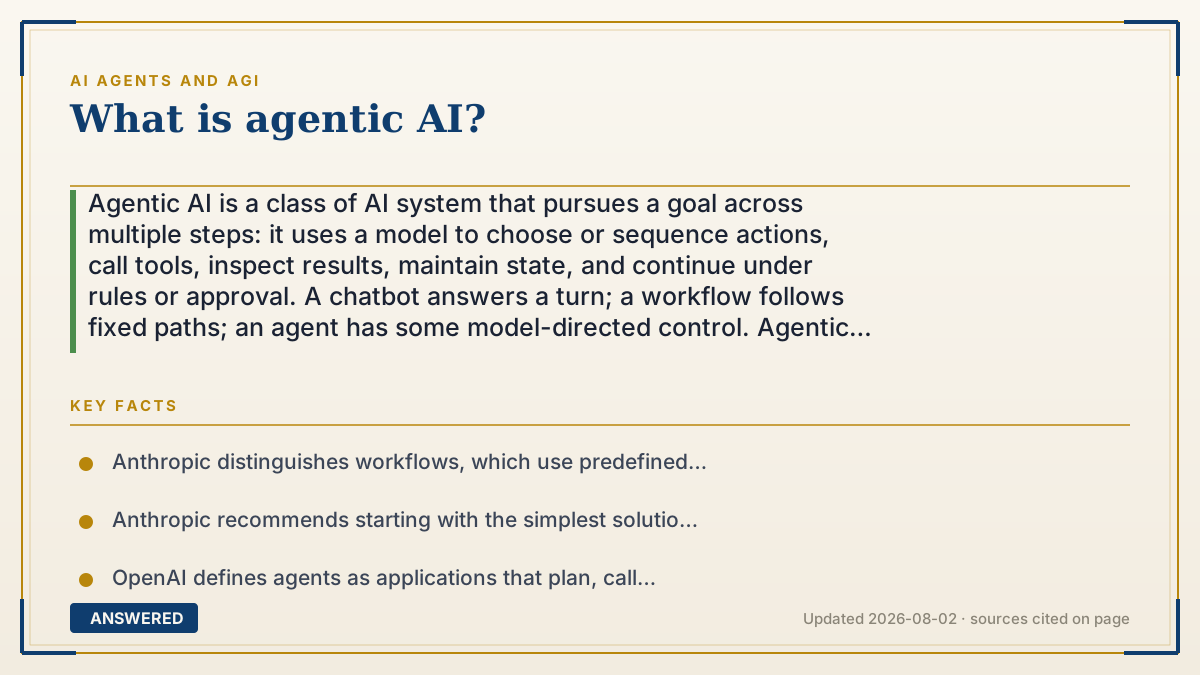
Agentic AI is a class of AI system that pursues a goal across multiple steps: it uses a model to choose or sequence actions, call tools, inspect results, maintain state, and continue under rules or approval. A chatbot answers a turn; a workflow follows fixed paths; an agent has some model-directed control. Agentic AI is not a synonym for AGI or a guarantee of autonomy.
Why — the first-principles explanation
“Agentic AI” is an umbrella label, not a single model or a universally fixed certification. The useful question is how much control the system has over the next step and what it is allowed to do.
A typical agentic system combines an AI model with a goal or instruction, tools, state, a control loop and safety checks. The model may decide to search, call an API, read a file, run code or ask another specialist. The application feeds the result back into the run, checks whether the task is complete and either continues, stops, asks for approval or falls back to a human. That loop is what makes the system more than a one-shot answer; it does not make the system infallible or human-like.
Anthropic draws a practical architectural line: a workflow orchestrates language models and tools through predefined code paths, while an agent lets the model dynamically direct its process and tool use. Google describes agents using capabilities such as reasoning, planning, acting, observing, memory and adaptation, while distinguishing more autonomous agents from assistants that work under user direction and bots that follow predefined rules. These are useful comparison dimensions, not a promise that every product using the word “agent” has all of them.
Autonomy must be bounded. OpenAI’s agent documentation includes guardrails, human review, resumable approvals, state and evaluation as separate design concerns. Tool permissions, stop conditions, logging and an escalation path matter as much as the model. Multi-step runs also trade more flexibility for latency, token/tool costs and the possibility of compounding errors. Anthropic recommends starting with the simplest solution and adding agentic complexity only when a workflow or single model call is not enough.
To evaluate a product, ignore the label and ask: What goal can it pursue? Which tools can it call? Who grants permission? Can a human approve risky actions? What state is stored? Can you replay and evaluate runs? What happens when a tool fails or the budget is reached? Those answers reveal whether you have a bounded agent, a deterministic workflow, an assistant, or marketing language around a chatbot.
An example that makes it click
Consider customer support. A rule-based bot sends a fixed password-reset link. A workflow classifies the ticket and runs a scripted sequence. An agent can inspect the request, search the account policy, ask a billing tool for status and draft a reply, but a human approval gate can still be required before issuing a refund. The value is flexible task completion; the risk is that every extra permission needs evidence, limits and monitoring.
How to do it
- Define the outcome and the allowed side effects: answer, draft, update data, send a message, purchase or refund are different risk levels.
- Check whether a normal program, retrieval step, single model call or deterministic workflow solves the task. Use an agent only when the next steps genuinely depend on what the system observes.
- Specify the tools, data scope, state and stop conditions. Give each tool the least privilege needed and make failures explicit.
- Add guardrails, human approval for consequential actions, a budget or time limit, logs and a safe fallback before enabling autonomous runs.
- Evaluate representative tasks, tool errors, adversarial inputs and incomplete information. Measure task success, factuality, latency, cost, unwanted actions and escalation rate.
- Explain the system honestly: say what the model can decide, what code decides, what a person must approve and what the system cannot access.
Key facts
- Anthropic distinguishes workflows, which use predefined code paths, from agents, in which the language model dynamically directs its process and tool usage.
- Anthropic recommends starting with the simplest solution because agentic systems can trade latency and cost for task performance and can introduce compounding errors.
- OpenAI defines agents as applications that plan, call tools, collaborate across specialists and keep enough state to complete multi-step work.
- OpenAI’s agent documentation treats guardrails, human review, approvals, state, tracing and evaluations as distinct parts of a production design.
- Google Cloud describes AI agents using capabilities such as reasoning, acting, observing, planning, collaborating and possible adaptation, while distinguishing agents from assistants and rule-based bots.
- Google’s Agent Development Kit documentation combines prompts and tool calls with graph workflows, evaluation and deployment; a framework does not remove the need for application-level permissions and review.
- Agentic AI does not mean artificial general intelligence, unlimited autonomy, guaranteed learning or a specific vendor/model. It describes a system design and a degree of model-directed action.
Choose the right level of autonomy
Move from the agentic-AI label to a work use case, cost boundary and tool comparison you can verify.
▶ The 60-second explainer (script)
What is agentic AI? It is a system that pursues a goal across multiple steps. A model chooses or sequences actions, calls tools, reads the results, updates its state and decides whether to continue, stop or ask for approval. A chatbot usually answers a turn. A workflow follows paths engineers wrote in advance. An agent has some model-directed control over the path. Anthropic uses that workflow-versus-agent distinction, while OpenAI documents tools, state, guardrails, approvals and evaluations as separate production concerns. Google describes reasoning, planning, acting and observing as agent capabilities. Agentic does not mean infallible, human or generally intelligent. It can add flexibility, but also latency, cost, permissions risk and compounding errors. Evaluate the goal, tools, approvals, state, logs and failure path—not the marketing label.
What authoritative sources say
People also ask
Is agentic AI the same as an AI agent?
Nearly. An AI agent is an application or system; agentic AI describes the degree of goal-directed, multi-step and model-directed behavior it has. The label is a spectrum, not a guarantee that every product has the same autonomy.
Is agentic AI just a chatbot with tools?
Not necessarily. A chatbot that calls one tool and returns an answer may still be a single-turn assistant. An agentic system can continue through a bounded loop, inspect tool results, choose another step and stop or request approval according to its policy.
What is the difference between an agent and a workflow?
A workflow follows predefined code paths. An agent lets the model dynamically choose parts of the process and tool use. Many useful products combine both: deterministic gates around a model-directed section.
Does agentic AI require a new kind of model?
No. It can be built around a language or multimodal model plus tools, state, orchestration and guardrails. The model’s capabilities still limit what the system can do, and the surrounding software determines permissions and control.
Is agentic AI autonomous?
Only within its configured scope. An agent can choose next steps, but tools, credentials, policies, budgets, stop conditions and human approvals bound its actions. “Autonomous” should never be read as unlimited access or guaranteed independence.
When should a business use an AI agent?
Use one when the task is multi-step, tool-dependent and hard to specify completely in advance. Start with a simpler workflow when the path is stable; otherwise the added latency, cost and failure surface may not be worth the flexibility.
How do I compare agentic AI products?
Compare the goal, tool permissions, data access, state retention, approval gates, logs, evaluation method, cost per run, failure recovery and human handoff. A product’s agentic label is weaker evidence than a reproducible demo and clear limits.
The same question, asked other ways
- What does agentic AI mean?