What is AI automation?
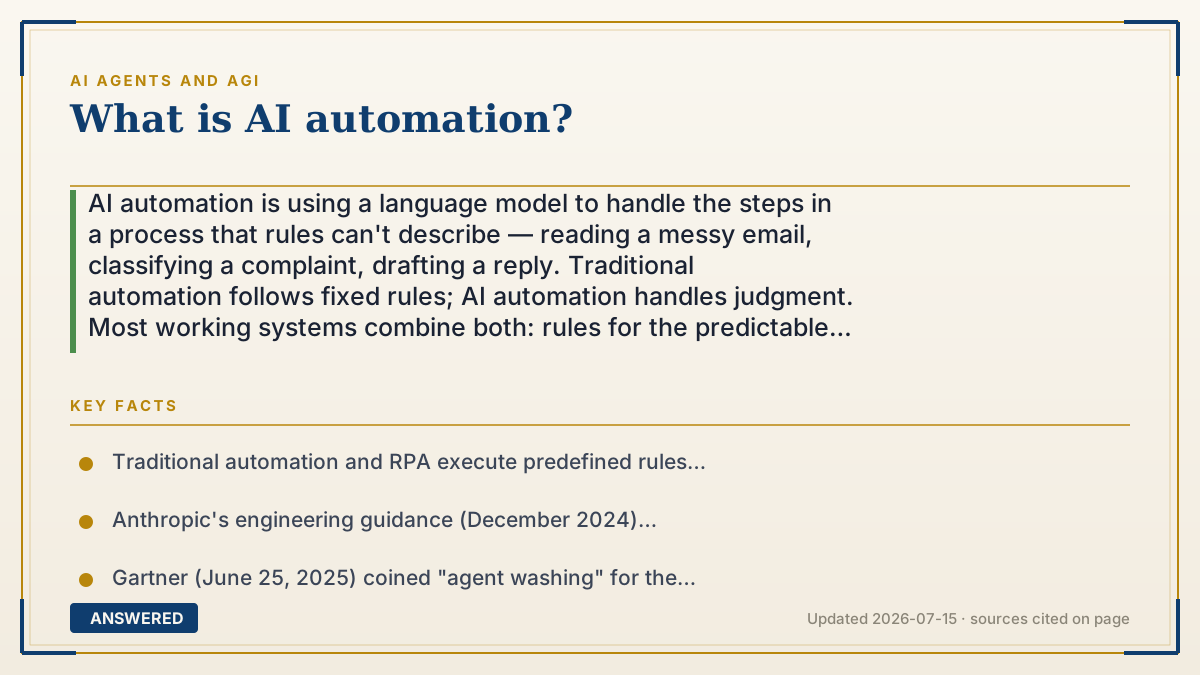
AI automation is using a language model to handle the steps in a process that rules can't describe — reading a messy email, classifying a complaint, drafting a reply. Traditional automation follows fixed rules; AI automation handles judgment. Most working systems combine both: rules for the predictable parts, AI for the fuzzy ones.
Why — the first-principles explanation
Automation has always failed at the same place. You can write a rule for "if invoice total > $500, route to manager." You cannot write a rule for "if the customer sounds like they're about to cancel." Traditional automation — scripts, Zapier zaps, robotic process automation — needs the world to arrive in tidy, predictable shapes. And the world mostly doesn't. So for thirty years, every automated process had a human-shaped hole in the middle of it: someone reading the email, deciding what it meant, and typing the result into a box so the automation could continue.
AI automation fills that hole. A language model is, mechanically, a fuzzy-input classifier and text generator — you give it messy language and it gives you structure or prose back. That's it. It doesn't make the automation smarter; it makes the automation able to start, because the ambiguous first step no longer requires a person. Everything downstream can stay as rigid, boring, and testable as it always was.
Which points at the real design principle: AI automation should be mostly not-AI. The model is the expensive, non-deterministic, occasionally-wrong part. So you use it for exactly the steps that need judgment and pin everything else down in code, where it's cheap, fast, and testable. A well-built system might be 90% ordinary if-then logic with a model doing one thing in the middle. Teams that instead route everything through the model get systems that cost more, run slower, and fail unpredictably — and this is a large part of why Gartner expects over 40% of agentic AI projects to be canceled by the end of 2027.
It also explains the vocabulary mess. Vendors relabeled RPA and chatbots as "AI automation" and "agents" — Gartner named this agent washing and estimated only about 130 of thousands of agentic vendors were genuine. The useful ladder goes: automation (fixed rules), AI automation (fixed rules, with a model handling the judgment steps), and agents (the model decides the steps too). Each rung buys flexibility and pays with predictability. Most businesses need the middle rung and are being sold the top one.
An example that makes it click
Picture a mailroom in an old office building. The sorting machine is fantastic — it reads a ZIP code and fires the envelope into the right bin, thousands an hour, never tired. That's traditional automation. But it's helpless with the envelope where someone scrawled "attn: the lady who fixed my account, thank you!!" across the front. So there's a person at a stool whose entire job is to look at the weird ones and write a proper ZIP on them before dropping them back on the belt.
AI automation is a machine that can read the scrawl. It doesn't replace the sorter — the sorter is faster, cheaper, and never wrong. It replaces the stool. And that's the whole design lesson in one image: you don't rip out the belt and ask the reading machine to also carry envelopes across the room. You put it exactly where the handwriting is, and let the belt do everything else.
Key facts
- Traditional automation and RPA execute predefined rules; a language model adds the ability to handle unstructured input — free text, images, ambiguous requests — that rules can't specify.
- Anthropic's engineering guidance (December 2024) distinguishes workflows, where LLMs and tools are "orchestrated through predefined code paths," from agents, where LLMs "dynamically direct their own processes and tool usage."
- Gartner (June 25, 2025) coined "agent washing" for the rebranding of existing assistants, RPA, and chatbots as agentic AI, estimating only about 130 of thousands of vendors were genuine.
- Gartner predicts 33% of enterprise software applications will include agentic AI by 2028, up from less than 1% in 2024.
- Gartner predicts over 40% of agentic AI projects will be canceled by end of 2027 on escalating costs, unclear business value, and inadequate risk controls, from a poll of 3,400+ organizations.
▶ The 60-second explainer (script)
AI automation means using a language model to handle the steps in a process that rules can't describe. Here's why that's a big deal. Automation has always broken in the same spot. You can write a rule for 'if the invoice is over five hundred dollars, send it to a manager.' You cannot write a rule for 'if the customer sounds like they're about to cancel.' So for thirty years, every automated process had a human-shaped hole in the middle — somebody reading the email, deciding what it meant, and typing the answer into a box so the machine could continue. A language model fills that hole. Mechanically it's a fuzzy-input reader: you give it messy language, it gives you structure back. It doesn't make your automation smarter. It makes it able to start, because the ambiguous first step no longer needs a person. Which leads to the design rule almost everyone gets wrong: good AI automation is mostly not AI. The model is the expensive, unpredictable, occasionally-wrong part. So you use it only for the judgment steps and pin everything else down in code, where it's cheap and testable. A well-built system might be ninety percent ordinary if-then logic with a model doing one thing in the middle. And watch the labels. Gartner calls it agent washing — old chatbots and RPA rebranded as AI — and estimated only about a hundred thirty of thousands of vendors are real. Rules are predictable. Agents are flexible. AI automation is the useful middle, and it's what most businesses actually need.
What authoritative sources say
People also ask
What's the difference between AI automation and regular automation?
Regular automation follows rules you wrote and breaks on anything unexpected. AI automation adds a model that can read messy, unstructured input — free text, images, vague requests — and turn it into something the rules can handle.
Is AI automation the same as an AI agent?
No. In AI automation the steps are fixed and a model handles the judgment inside them. In an agent, the model chooses the steps too. Automation trades flexibility for predictability; agents do the reverse.
Is RPA dead now?
No — RPA is still better at the deterministic parts: faster, cheaper, exactly repeatable. The winning pattern is RPA doing the clicking with a model handling the one step that needed a human to read something.
What should I automate with AI first?
The step where a person currently reads something and types a summary or category into a box. That's the human-shaped hole, and filling it usually delivers value without touching anything irreversible.
Why do AI automation projects fail?
Usually by over-using the model. Routing every step through an LLM makes systems slow, costly, and non-deterministic. Gartner also points to unclear business value and inadequate risk controls as top cancellation causes.