What is AI bias?
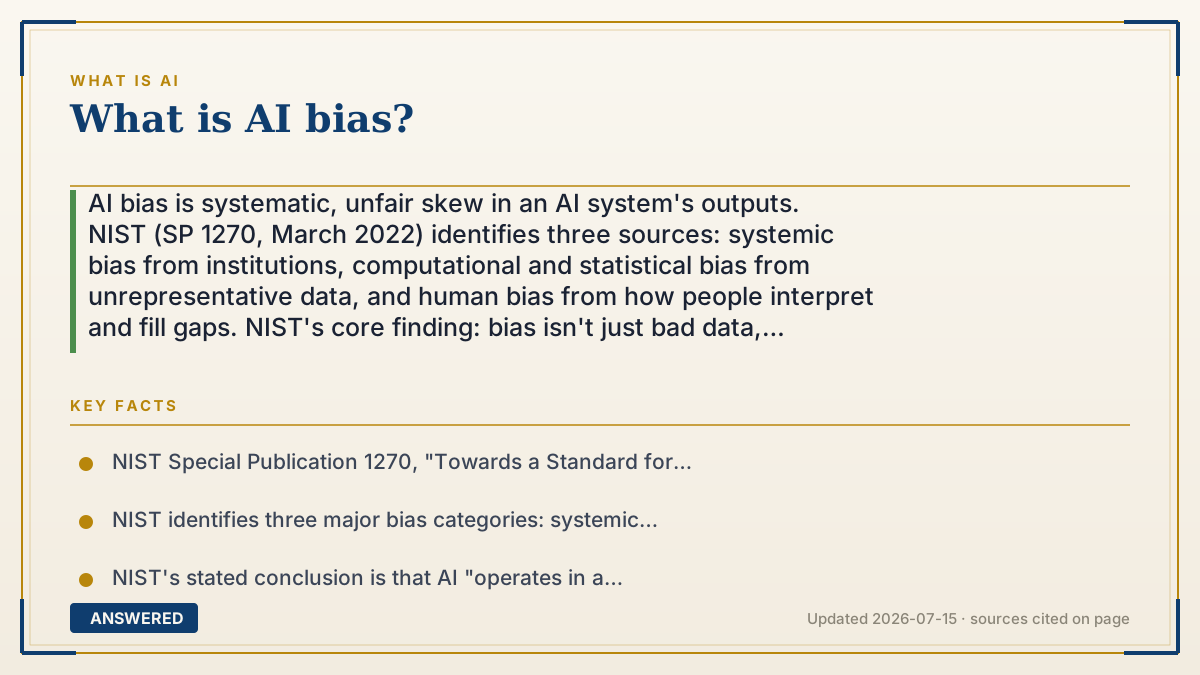
AI bias is systematic, unfair skew in an AI system's outputs. NIST (SP 1270, March 2022) identifies three sources: systemic bias from institutions, computational and statistical bias from unrepresentative data, and human bias from how people interpret and fill gaps. NIST's core finding: bias isn't just bad data, and purely technical fixes "will come up short."
Why — the first-principles explanation
Start with what a model is actually optimizing. It has one instruction: find the pattern that minimizes error on the training data. That's it. It has no concept of fairness, no concept of a protected class, and no concept of whether the world it's learning from is the world you want. If the historical data reflects a pattern — including a pattern produced by discrimination — that pattern reduces error, so the model will find it and use it. The bias isn't a malfunction. It's the model succeeding at exactly the job you gave it, on the data you gave it.
This is why the naive fix fails. "Just don't give it race" sounds obvious, and it does almost nothing, because the model doesn't need the label — it will reconstruct it from correlates. ZIP code, name, school, purchase history, phone type. Delete one proxy and it finds another, because in a society with residential segregation, geography is a race variable whether you named it or not. You cannot make a variable invisible to a system whose entire skill is inferring hidden structure from visible traces.
NIST's central contribution in SP 1270 (March 15, 2022) was widening the frame past data. It names three categories. Computational and statistical bias is the familiar one — training on a dataset that underrepresents a gender or ethnic group. Human bias is how people fill in missing information, like letting someone's neighborhood shape how likely they seem to be a suspect. And systemic bias is institutions operating in ways that disadvantage social groups. That third one is the reason a technically flawless model can still produce unjust outcomes: if arrests were unevenly distributed to begin with, a model that perfectly predicts arrests perfectly reproduces the unevenness. NIST's conclusion is blunt — AI systems "do not operate in isolation," AI "operates in a larger social context," and "purely technically based efforts to solve the problem of bias will come up short."
There's one more layer people miss: fairness is not a single thing you can maximize. There are several reasonable mathematical definitions — equal accuracy across groups, equal false-positive rates, equal treatment of equally-qualified people — and it has been proven that when base rates differ between groups, you cannot satisfy all of them at once. So "is this model fair?" has no purely technical answer. Someone has to choose which fairness to buy and which to sacrifice. That's a value judgment wearing a lab coat, and it's why NIST recommends bringing in "experts from various fields — not just engineering" and listening to "communities about the impact of AI."
An example that makes it click
Say you're hiring, and you build a model to spot good engineers. You train it on ten years of your own hiring: everyone you interviewed, and who you ended up promoting. Clean data. No bugs. The math is perfect.
The model learns to prefer men. Not because anyone told it to, and not because someone slipped "gender" into the columns — you removed that. It learned because for ten years your company mostly hired and promoted men, so "resembles the people we promoted" is the winning pattern, and it will rebuild gender out of anything left in the data: the college, the hobbies, the phrasing, whether the resume mentions a women's coding group.
The machine didn't invent a prejudice. It found one, in you, and wrote it down in numbers — and now it applies it to 50,000 candidates a year instead of 200, with a straight face and an air of mathematical authority. That's AI bias: not a computer becoming unfair, but a mirror that scales.
Key facts
- NIST Special Publication 1270, "Towards a Standard for Identifying and Managing Bias in Artificial Intelligence," was published March 15, 2022.
- NIST identifies three major bias categories: systemic bias (institutions operating in ways that disadvantage certain social groups), computational and statistical bias (e.g., training data underrepresenting a gender or ethnic group), and human bias (people filling in missing information using assumptions).
- NIST's stated conclusion is that AI "operates in a larger social context — and that purely technically based efforts to solve the problem of bias will come up short."
- NIST recommends a socio-technical approach: involving "experts from various fields — not just engineering" and listening to "communities about the impact of AI."
- Removing a protected attribute does not remove bias, because models reconstruct it from correlated variables such as ZIP code, name, or school.
- NIST's AI Risk Management Framework 1.0 (January 26, 2023) addresses bias through its Govern, Map, Measure, and Manage functions rather than as a one-time technical fix.
▶ The 60-second explainer (script)
AI bias is systematic, unfair skew in what an AI system outputs. And the most useful thing to understand is that it's usually not a bug. A model has exactly one instruction: find the pattern that minimizes error on the training data. That's all. It has no concept of fairness, no concept of a protected group, no idea whether the world it's learning from is the world you'd want. So if history contains a pattern — including one produced by discrimination — that pattern reduces error. The model finds it and uses it. It's not malfunctioning. It's succeeding at the job you gave it. Which is why the obvious fix doesn't work. "Just don't give it race." It doesn't need race. It rebuilds it from ZIP code, name, school, phone type. Delete one proxy, it finds another — because in a segregated society, geography is a race variable whether you labeled it or not. You can't hide a variable from a system whose entire skill is inferring hidden structure. NIST published the key document here in March 2022, Special Publication 1270, and its contribution was widening the frame. Three sources of bias. Computational and statistical — the data underrepresents a group. Human — how people fill in gaps, like letting a neighborhood shape who looks like a suspect. And systemic — institutions that already disadvantage certain groups. That third one is why a technically perfect model can still be unjust. If arrests were uneven to begin with, perfectly predicting arrests perfectly reproduces the unevenness. NIST's own words: purely technical efforts to solve bias will come up short.
What authoritative sources say
People also ask
Can you just remove race or gender from the data to fix bias?
No. Models reconstruct protected attributes from correlated variables like ZIP code, name, school, or purchase history. Removing the label often makes the bias harder to detect without making it smaller.
Is AI bias always caused by bad data?
No, and that's NIST's central point in SP 1270. Data bias is one of three categories. Systemic bias from institutions and human bias in interpretation can produce unfair outcomes even when the data is technically accurate.
Can an AI system be perfectly fair?
Not by every definition at once. Several reasonable fairness metrics conflict mathematically when groups have different base rates, so someone has to decide which fairness to prioritize. That's a values decision, not a technical one.
Is AI more biased than humans?
Different, not necessarily worse. AI applies one consistent bias at enormous scale, while human bias is inconsistent and case-by-case. Consistency makes AI bias easier to measure — and easier to audit — but far larger in reach when it's wrong.
Who should be involved in checking for AI bias?
NIST recommends experts from various fields, not just engineering, and directly listening to communities affected by the system — because bias emerges from social context, not only from code.