What is AI?
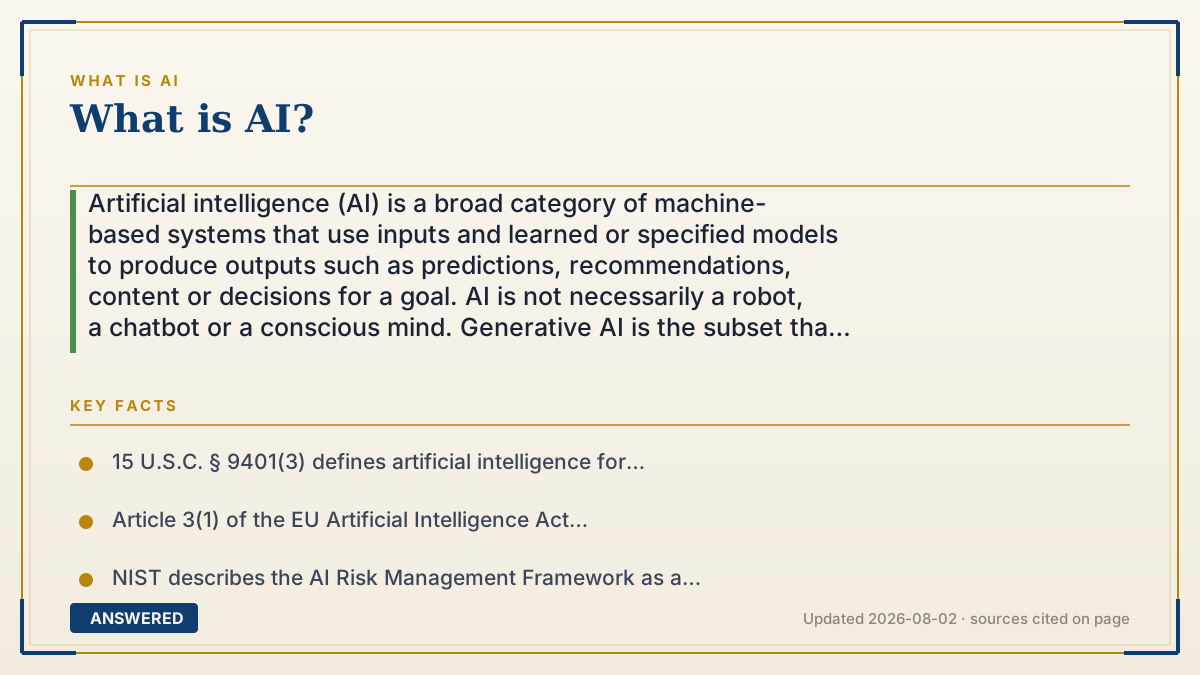
Artificial intelligence (AI) is a broad category of machine-based systems that use inputs and learned or specified models to produce outputs such as predictions, recommendations, content or decisions for a goal. AI is not necessarily a robot, a chatbot or a conscious mind. Generative AI is the subset that creates text, images, audio, video or code; any AI output still needs task-appropriate testing and human review.
Why — the first-principles explanation
Traditional software starts with rules a person writes: if a price is over a threshold, apply a discount. That works when the rules can be stated explicitly. It is much harder to write every rule for recognizing an image, translating a sentence or choosing which support ticket needs attention.
An AI system takes inputs, represents patterns in a model and uses inference to produce an output for a human-defined or operational objective. A useful mental model is objective → data and context → model → inference → output → evaluation and oversight. During training, a model may adjust parameters from examples or other signals; during use, it applies the learned relationship to new inputs. Inference can be useful without being a proof that the output is true.
There is no single definition that serves every purpose. U.S. law describes AI as a machine-based system that uses model inference to make predictions, recommendations or decisions for human-defined objectives. The EU AI Act describes an AI system through machine-based operation, varying autonomy, inference from inputs and outputs that can influence physical or virtual environments. Those are legal definitions for particular contexts, not a claim that every jurisdiction or academic field uses identical wording.
AI is broader than chatbots. A spam filter, fraud score, recommendation system, image classifier, route optimizer and language model can all be AI, although their inputs, outputs, training data and failure modes differ. A robot is a physical machine that may use AI; most AI products are software services with no physical body. A fluent interface is a presentation layer, not the definition of the underlying system.
Machine learning is one common way to build AI: software called a model learns from data to make predictions or generate content. Supervised learning uses labeled examples, unsupervised learning looks for structure in unlabeled data, and reinforcement learning uses feedback signals. Generative AI is a class of models that creates content from input. These are overlapping technical categories, not interchangeable marketing labels.
The practical limitation is the gap between a plausible output and a dependable result. A model can inherit blind spots from data, fail on examples unlike its training distribution, expose sensitive information, or optimize a proxy that is not the real goal. Generative systems can produce text, images, audio, video or code that is fluent but factually wrong, unauthorized or unsafe to publish. More parameters or a smoother conversation do not remove the need for evaluation.
Risk comes from use and context, not just the model name. Brainstorming a headline is usually lower stakes than making a medical triage, employment, education, credit or legal decision. NIST's voluntary AI Risk Management Framework organizes responsible practice around governing, mapping, measuring and managing risk, and its generative-AI profile adds risks specific to generative systems. The same model can be acceptable in one workflow and inappropriate in another.
If you are choosing a product, start with the task and acceptance test rather than the word AI. Decide what data may leave your systems, what accuracy or latency is required, who can approve an output, how errors are corrected, and how usage is billed. Then compare tools, plans, limits, integrations and support. The best AI purchase is the one that reliably improves a measured workflow under your privacy and review constraints.
An example that makes it click
A calculator follows explicit arithmetic rules. An image classifier instead learns patterns from examples and estimates what a new image contains. A chatbot generates a likely continuation from language patterns. A recommendation system ranks options against an objective. All four can be called AI, but each needs a different test: arithmetic correctness, classification quality, factual grounding or ranking outcomes. The label alone tells you little about reliability.
How to do it
- Name the objective and the decision or content the system must produce. A vague goal makes a vague AI requirement.
- Identify inputs, outputs and the people affected. Separate a prediction, recommendation, generated draft and automated action.
- Classify the technique honestly: fixed rules, machine learning, generative model, retrieval, tool use or a combination. Do not confuse a chatbot interface with the whole system.
- Ask what data shaped the model and what data the product will receive. Check privacy, retention, training choices, connectors and access permissions before uploading sensitive material.
- Create a representative test set with normal cases, edge cases, failure costs and a human review rule. A polished demo is not an evaluation.
- Measure the outcome that matters: factual support, error rate, recall, quality, latency, cost per approved result or time saved. Document uncertainty and disagreement.
- Keep a person accountable for consequential decisions and provide a correction or appeal path. Automation should not erase responsibility.
- When choosing a consumer tool, compare current free access, plans, credits, limits, integrations, export controls and cancellation terms before subscribing.
- Re-test after a model, prompt, data source, policy or pricing change. AI products evolve faster than a static “best AI” list.
Key facts
- 15 U.S.C. § 9401(3) defines artificial intelligence for that U.S. statute as a machine-based system that makes predictions, recommendations or decisions for human-defined objectives and uses model inference.
- Article 3(1) of the EU Artificial Intelligence Act defines an AI system through machine-based operation, varying autonomy, inference from input and outputs that can influence physical or virtual environments.
- NIST describes the AI Risk Management Framework as a voluntary, use-case-agnostic resource for incorporating trustworthiness into the design, development, use and evaluation of AI; NIST says the framework is being revised.
- NIST's generative-AI profile identifies additional risks and actions for organizations using generative AI systems; it is guidance, not a universal legal definition.
- Google's machine-learning guidance describes ML as training software called a model to make predictions or generate content from data, and distinguishes supervised, unsupervised and generative approaches.
- AI includes predictive, classificatory, recommender, generative and tool-using systems; a chatbot is one interface rather than the definition of AI.
- Generative AI can create text, images, audio, video or code, but plausibility does not guarantee truth, originality, safety, permission or fitness for publication.
- The same model can be low-stakes for brainstorming and high-stakes when used for medical, employment, education, financial or legal decisions; use context-specific evaluation and human review.
Move from the definition to a responsible next step
Choose a real task first, then compare free access, privacy, limits and integrations; do not treat a fluent answer as verified fact.
▶ The 60-second explainer (script)
What is AI? Artificial intelligence is a broad category of machine-based systems that use inputs and models to produce predictions, recommendations, content or decisions for a goal. It is not automatically a robot, chatbot or conscious mind. Machine learning is one way to build AI, and generative AI is the subset that creates text, images, audio, video or code. The important question is not whether a product says AI; it is what it infers, what data it uses, what happens when it is wrong and how the result is reviewed. Start with a real task, test representative cases, compare privacy and limits, and only then choose a tool or plan.
What authoritative sources say
People also ask
What is AI in simple terms?
AI is a machine-based system that uses inputs and a model to produce an output such as a prediction, recommendation, generated draft or decision for a goal. The output still needs testing and review appropriate to the task.
Is AI the same as a robot?
No. AI is a software or system capability that infers outputs from inputs. A robot is a physical machine that may or may not use AI; most consumer AI runs in software with no physical body.
What is the difference between AI, machine learning and generative AI?
AI is the broad category. Machine learning is a common method for building systems that learn patterns from data. Generative AI is a subset that creates new text, images, audio, video or code.
What does AI actually do?
It maps inputs and context to an output under an objective. Depending on the system, that output can classify, predict, rank, recommend, generate content or trigger a tool. Inspect the input, output and action boundary rather than relying on the label.
Does AI understand or think like a person?
Do not infer human understanding from fluent output. Many systems generate or select outputs from learned patterns and can be confidently wrong. Claims about consciousness require a separate scientific and philosophical argument.
Is AI always accurate?
No. Accuracy depends on the data, model, prompt, context and task. Test representative examples, verify important outputs and require qualified human review for high-stakes decisions.
What are examples of AI?
Examples include spam filters, fraud detection, recommendations, image classification, speech recognition, route optimization, language assistants and generative tools. Their risks and useful metrics are different.
How should a beginner start using AI?
Begin with a task you can judge, provide relevant context, treat the first answer as a draft and verify facts. Compare free access, privacy, limits, integrations and export terms before paying.
How do I choose an AI tool?
Define the workflow and acceptance test first. Then compare capability, evidence, privacy, permissions, limits, latency, cost per approved result, support and the ability to correct or export your work.
The same question, asked other ways
- What is an AI?
- What is AI (artificial intelligence)?
- What is artificial intelligence (AI)?
- What exactly is AI?
- What is the definition of AI?
- What is AI technology?
- How is AI defined?
- What AI is?
- What is a AI?
- Who is AI?
- What exactly does AI do?