What is an AI source?
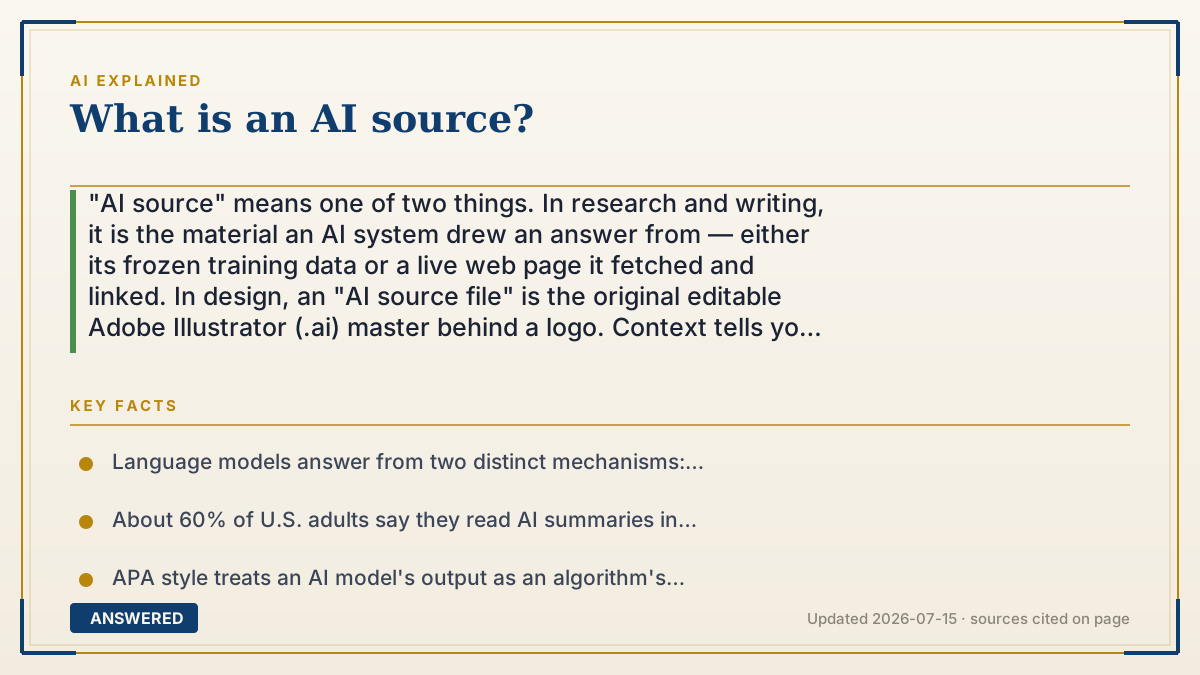
"AI source" means one of two things. In research and writing, it is the material an AI system drew an answer from — either its frozen training data or a live web page it fetched and linked. In design, an "AI source file" is the original editable Adobe Illustrator (.ai) master behind a logo. Context tells you which.
Why — the first-principles explanation
Start with the research meaning, because that is where the word does real work. A language model has two completely different ways of knowing something, and only one of them has a source you can click.
The first is training data. During training, the model read an enormous pile of text and adjusted billions of internal numbers to get better at predicting the next word. That process is lossy and one-way: the text is not filed away, it is dissolved into weights. So when a model answers from training alone, there is no source to point at — no more than you can name the exact page where you learned that Paris is in France. This is exactly why models confidently invent citations. The mechanism that produces fluent text is the same one that produces plausible-looking fake URLs, because the model is generating what a citation looks like, not retrieving one.
The second is retrieval. Modern assistants search the web or a document store at question time, paste the results into the prompt, and answer from that text. Now there genuinely is a source — a specific page, fetched at a specific moment. Those are the links you see under an AI summary. Roughly 60% of Americans say they read search engines' AI summaries, so this is the version most people meet daily. A retrieved source is checkable. A training-data claim is not.
The practical rule: a real AI source is one you can open. If the AI names a study, click through. If there is no link, treat the claim as the model's memory, not as evidence. And note the second-order problem — a retrieved source can be a garbage blog. Retrieval tells you where the AI got it, not whether it is true.
The design meaning is unrelated and simpler. "AI" there is short for Adobe Illustrator. The "source file" is the layered, editable .ai master that all the flat PNGs and JPEGs were exported from.
An example that makes it click
Imagine asking a friend two questions. "What's the capital of France?" — she answers instantly from memory, and if you demand a source she'll shrug or make one up. "What did the city council vote last night?" — she pulls out her phone, opens the local paper, and reads it to you. She can hand you that phone.
The first is training data. The second is retrieval. Only the second has a source, and even then, the newspaper could still be wrong. The AI is quoting; it isn't vouching.
How to do it
- Decide which meaning you need — research/citation, or a design file.
- For research: look for a clickable link or footnote next to the claim. No link means no verifiable source.
- Click it. Confirm the page actually exists and actually says what the AI said it says.
- Check the tier: a government agency, peer-reviewed study, or official vendor doc beats a blog summarizing one.
- If you're citing the AI itself rather than its sources, cite the model as an algorithm output — e.g. APA style treats the developer as the author.
- For design: ask the designer for the .ai file (or PDF/SVG saved with editing capabilities preserved), not a PNG export.
Key facts
- Language models answer from two distinct mechanisms: frozen training weights (no retrievable source) and live retrieval (a specific, clickable source).
- About 60% of U.S. adults say they read AI summaries in search engines, per Pew Research Center's survey of 5,119 adults fielded February 17–23, 2026.
- APA style treats an AI model's output as an algorithm's output, not a personal communication, and lists the developer as author — e.g. OpenAI. (2023). ChatGPT (Mar 14 version) [Large language model].
- In design, .ai stands for Adobe Illustrator; the .ai source file stores artwork as vectors and preserves layers, editable text and effects that flat exports lose.
▶ The 60-second explainer (script)
"AI source" means two different things, so figure out which room you're in. In research and writing, an AI source is the material the model drew its answer from. And here's the part nobody explains: a language model knows things two ways. Some knowledge is baked into its training — billions of numbers adjusted by reading text. That text isn't stored; it's dissolved. So there's no source to click, which is exactly why models invent citations that look real. They're generating what a citation looks like. The other way is retrieval. The assistant searches the web at question time, reads actual pages, and answers from them. Those are the links under an AI summary. About 60% of Americans say they read those summaries. Those sources are real and checkable. So the rule is simple: a real AI source is one you can open. No link, no source. And even a real link can point at a bad blog — retrieval tells you where the AI got it, not whether it's true. The other meaning is unrelated. In design, AI means Adobe Illustrator. The AI source file is the editable master your logo's PNGs were exported from.
What authoritative sources say
People also ask
Why do AI chatbots make up sources?
Because when answering from training data alone, the model is generating text that resembles a citation rather than retrieving a real one. Fluent-looking fake URLs are produced by the same machinery as correct sentences.
Are the links under an AI summary real sources?
Usually yes — those come from live retrieval, so the page was actually fetched. But check that it says what the summary claims, and check the quality of the site. Retrieval doesn't filter for truth.
Can I cite an AI chatbot as a source in a paper?
You can cite the model itself, but most instructors want the underlying evidence. APA has you list the developer as author, the model as title, and the version. Always check your instructor's or journal's own rule first.
What is an AI source file in graphic design?
The editable Adobe Illustrator (.ai) master. It keeps layers, live text and effects. PNGs and JPEGs are one-way exports from it and can't be scaled up or re-edited cleanly.