What is conversational AI?
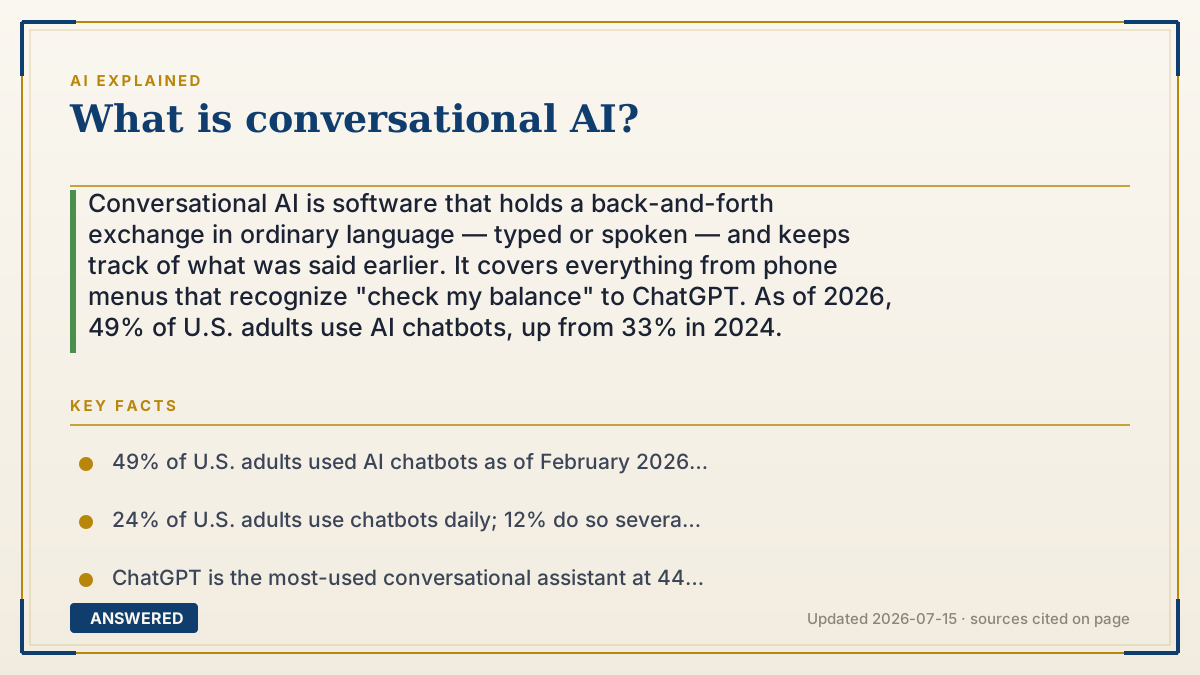
Conversational AI is software that holds a back-and-forth exchange in ordinary language — typed or spoken — and keeps track of what was said earlier. It covers everything from phone menus that recognize "check my balance" to ChatGPT. As of 2026, 49% of U.S. adults use AI chatbots, up from 33% in 2024.
Why — the first-principles explanation
The whole category exists to solve one problem: computers demand exact commands, people speak approximately. A form has a box for a date. A person says "sometime next Thursday-ish." Conversational AI is the layer that absorbs that mismatch, and there have been two very different engineering answers to it.
The old answer — still running most phone trees and bank bots — is intent classification. Engineers hand-write a list of things users might want ("check_balance", "reset_password"), collect example phrasings for each, and train a classifier to sort incoming sentences into one bucket. Then a scripted flow takes over. This is why old bots feel like a maze: they can only recognize intents someone predicted in advance, and anything else falls into "I didn't get that." The system never understood language; it pattern-matched into a menu.
The new answer is large language models. Instead of a fixed intent list, the model predicts the next word given everything said so far. Because "everything said so far" includes the whole conversation, memory of context comes free — the model doesn't need a separate module to remember you said "my dog" three turns ago. That single change is why modern assistants can handle requests nobody anticipated. It's also why they fail differently: an old bot says "I didn't get that," while an LLM confidently makes something up, because generating plausible text is the only thing it does.
A voice assistant stacks three components: speech-to-text turns sound into words, the language layer decides what to say, and text-to-speech turns the reply into sound. Only the middle piece is the conversation. Most "my smart speaker is dumb" complaints are actually the first piece mishearing you.
An example that makes it click
Think of a vending machine versus a barista. The vending machine has buttons: B4 gets you a granola bar. Press nothing it recognizes and it just sits there. That's the old intent-based bot — a menu wearing a microphone.
The barista is different. You say "same as yesterday but less sweet, and my friend wants whatever's warm," and it works, because she's tracking the conversation, not matching buttons. That's an LLM assistant. The catch: if she doesn't know yesterday's order, the vending machine says nothing, but the barista might cheerfully make something up and hand it to you.
Key facts
- 49% of U.S. adults used AI chatbots as of February 2026, up from 33% in 2024 — Pew Research Center, 5,119 adults, fielded February 17–23, 2026.
- 24% of U.S. adults use chatbots daily; 12% do so several times a day, and 4% almost constantly (Pew, 2026).
- ChatGPT is the most-used conversational assistant at 44% of U.S. adults, followed by Gemini at 24%, Copilot 17%, Meta AI 14%, Grok 8% and Claude 6% (Pew, 2026).
- The top reported use of chatbots is searching for information (42%), ahead of work tasks (38% of employed adults) and entertainment (25%).
- Voice assistants combine three separate systems: speech-to-text, a language model or intent classifier, and text-to-speech — only the middle handles the conversation.
▶ The 60-second explainer (script)
Conversational AI is software you can talk to in normal language, that remembers what you already said. Phone menus, customer service bots, Siri, ChatGPT — all the same category. It exists because computers want exact commands and people speak approximately. A form wants a date. A person says "sometime next Thursday-ish." There have been two answers. The old one is intent matching: engineers write a list of things you might want — check balance, reset password — and a classifier sorts your sentence into a bucket, then a script runs. That's why old bots feel like a maze. They only recognize what someone predicted in advance. Anything else gets "sorry, I didn't get that." The new answer is a language model. It just predicts the next word given the entire conversation so far. Because the conversation is the input, memory comes free — no separate module needed. That's why modern assistants handle things nobody scripted. It's also why they fail differently: the old bot admits confusion, the new one confidently invents an answer, because generating plausible text is all it does. As of 2026, Pew finds 49% of American adults use AI chatbots — up from 33% two years earlier. About a quarter use one every day.
What authoritative sources say
People also ask
Is conversational AI the same as a chatbot?
A chatbot is one kind of conversational AI. The category also includes voice assistants, phone systems that understand speech, and in-app copilots. "Chatbot" usually implies a text window.
Is Siri conversational AI?
Yes, though it started as the older intent-matching kind rather than a large language model. Every major voice assistant is being rebuilt on LLMs, which is why their behavior has changed noticeably.
Why do customer service bots feel so much worse than ChatGPT?
Most are intent-based systems restricted to a fixed script, often deliberately — a company doesn't want its bot improvising about refunds. The limitation is usually a business decision, not a technical one.
Does conversational AI actually understand me?
It predicts language extremely well, which produces behavior that looks like understanding. There's genuine disagreement among researchers about whether that counts as understanding. Practically: it's often right, and it's confidently wrong often enough that you should check anything that matters.