What is edge AI?
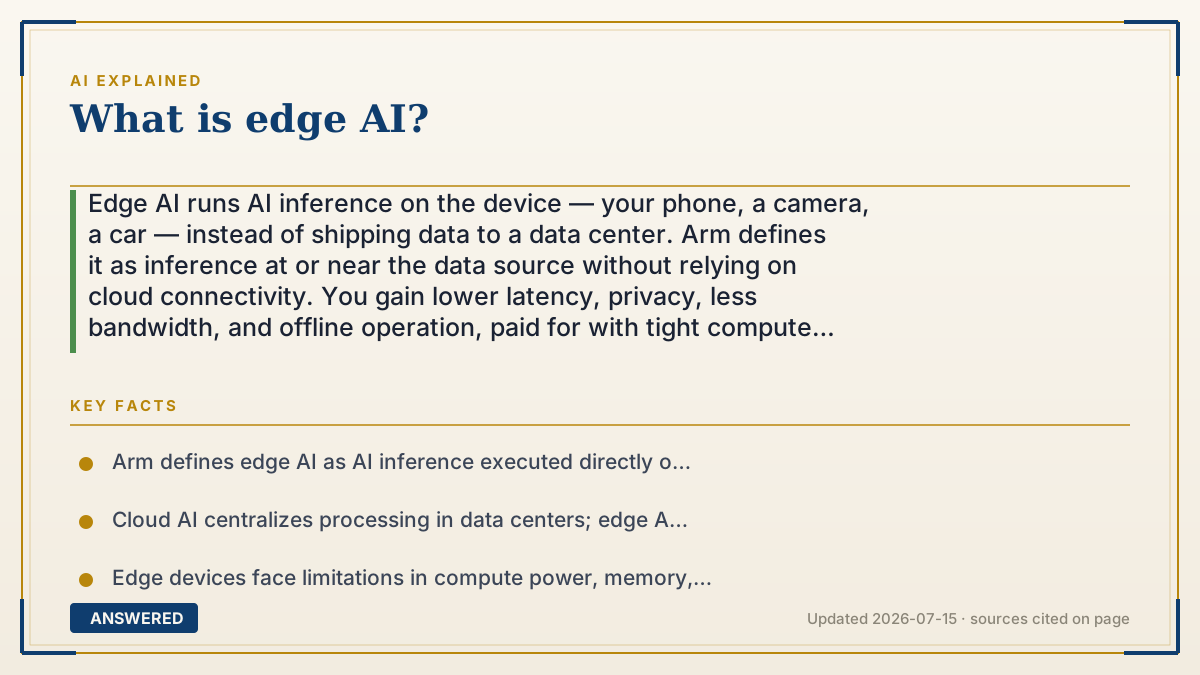
Edge AI runs AI inference on the device — your phone, a camera, a car — instead of shipping data to a data center. Arm defines it as inference at or near the data source without relying on cloud connectivity. You gain lower latency, privacy, less bandwidth, and offline operation, paid for with tight compute and memory limits.
Why — the first-principles explanation
Edge AI exists because of a constraint no amount of engineering can remove: the speed of light, plus the internet.
A round trip to a data center and back takes tens to hundreds of milliseconds — the physical distance, plus routing, plus queuing, plus the server's own time. For a chatbot, nobody notices. For a car deciding whether that shape is a child, or a factory arm deciding whether to stop, the round trip is the whole problem. You can't optimize your way out of geography. So you move the computation to where the data is born. Arm's definition is exactly this: AI inference executed directly on devices at or near the data source, without reliance on cloud connectivity.
That one move solves four problems at once, which is why it keeps spreading. Latency: milliseconds decide outcomes in autonomous vehicles and industrial safety. Privacy: data that never leaves the device can't be intercepted, subpoenaed, or breached at the other end — the strongest privacy guarantee is the request you never send. Bandwidth and cost: a camera streaming 24/7 to the cloud is expensive forever; a camera that processes locally and uploads only "person detected at 3:42" is nearly free. Reliability: the device keeps working when the network doesn't, which matters in a tunnel, a basement, or a factory.
The price is real and unavoidable. Edge devices are limited in compute power, memory, and storage, so the model must be compact and efficient. You can't run a frontier-scale model on a doorbell. So the field is largely about shrinking models — quantization, distillation, pruning — and about dedicated silicon: Arm's Cortex CPUs, Mali GPUs, and Ethos NPUs, plus the neural engines in modern phones. An NPU is not a general processor; it's hardware built for one operation — multiply-accumulate across matrices — done fast at very low power, which is what an entire neural network reduces to.
The practical takeaway is that most real systems are hybrid, not either/or. Your phone wakes on "Hey" locally, then sends the sentence up. The camera detects motion locally and uploads a clip. The split follows the constraints: local for the fast, private, always-on part; cloud for the big, occasional, expensive part.
An example that makes it click
A smoke alarm versus calling the fire department.
The alarm doesn't phone anyone to ask whether that's smoke. It decides, in your hallway, in a fraction of a second, and screams. It works when the power's out and the WiFi's down, and it never tells anyone what you burned for dinner.
Calling the fire department is the cloud: enormously more capable, much slower, needs a working line, and now somebody else knows. You want both. You just don't want the alarm to require a phone call before it screams.
Key facts
- Arm defines edge AI as AI inference executed directly on devices at or near the data source, without reliance on cloud connectivity.
- Cloud AI centralizes processing in data centers; edge AI processes locally, resulting in lower latency, better privacy, and reduced bandwidth usage.
- Edge devices face limitations in compute power, memory, and storage, requiring efficient, compact AI models — but keep functioning offline, independent of network connectivity.
- Arm's edge AI hardware stack includes Cortex CPUs, Mali GPUs, and Ethos NPUs (neural processing units) for efficient on-device inference.
- Filtering data locally before transmission substantially reduces network traffic and cloud infrastructure costs.
- Latency matters most in autonomous vehicles and industrial safety applications, where milliseconds determine outcomes.
▶ The 60-second explainer (script)
Edge AI means the AI runs on the device — your phone, a camera, a car — instead of shipping your data to a data center. Arm's definition: inference executed directly at or near the data source, without relying on cloud connectivity. And it exists because of a constraint nobody can engineer away: the speed of light, plus the internet. A round trip to a data center and back takes tens to hundreds of milliseconds. Distance, routing, queuing, the server's own time. For a chatbot, nobody cares. For a car deciding whether that shape is a child — the round trip is the entire problem. You cannot optimize your way out of geography. So you move the computation to where the data is born. And that one move solves four things at once. Latency: milliseconds decide outcomes. Privacy: data that never leaves the device can't be intercepted or breached — the strongest privacy guarantee is the request you never send. Bandwidth: a camera streaming to the cloud forever is expensive; a camera that uploads 'person detected at 3:42' is nearly free. And reliability: it works in a tunnel. The price is real. Edge devices are limited in compute, memory, and storage, so models must be small. That's why the field is about shrinking models, and about special silicon — NPUs, which aren't general processors at all. They do one thing: multiply-accumulate across matrices, fast, at low power. Which is what a neural network actually is. Think smoke alarm versus calling the fire department. The alarm doesn't phone anyone to ask if that's smoke. It decides in your hallway, in a fraction of a second, with the power out. You want both. You just don't want the alarm making a phone call first.
What authoritative sources say
People also ask
What's the difference between edge AI and cloud AI?
Location. Cloud AI centralizes processing in data centers; edge AI runs inference on or near the device producing the data, which cuts latency, keeps data local, and works without a network.
Is edge AI more private?
Structurally, yes. Data that never leaves the device can't be intercepted in transit or breached at a server. The strongest privacy guarantee is the request you never send.
What is an NPU?
A neural processing unit — silicon built for one job: doing the matrix multiply-accumulate math a neural network reduces to, quickly and at very low power. It's not a general-purpose processor.
Why can't my phone just run a big model locally?
Compute, memory, storage, and battery. Frontier models need data-center-scale hardware. Edge models are deliberately shrunk — quantized, distilled, pruned — trading capability for the ability to run at all.
Where is edge AI actually used?
Wake words on phones, camera person-detection, autonomous vehicle perception, factory safety systems, and hearing aids. Anywhere latency, privacy, bandwidth, or offline operation matters more than raw model size.