What is Lovable AI?
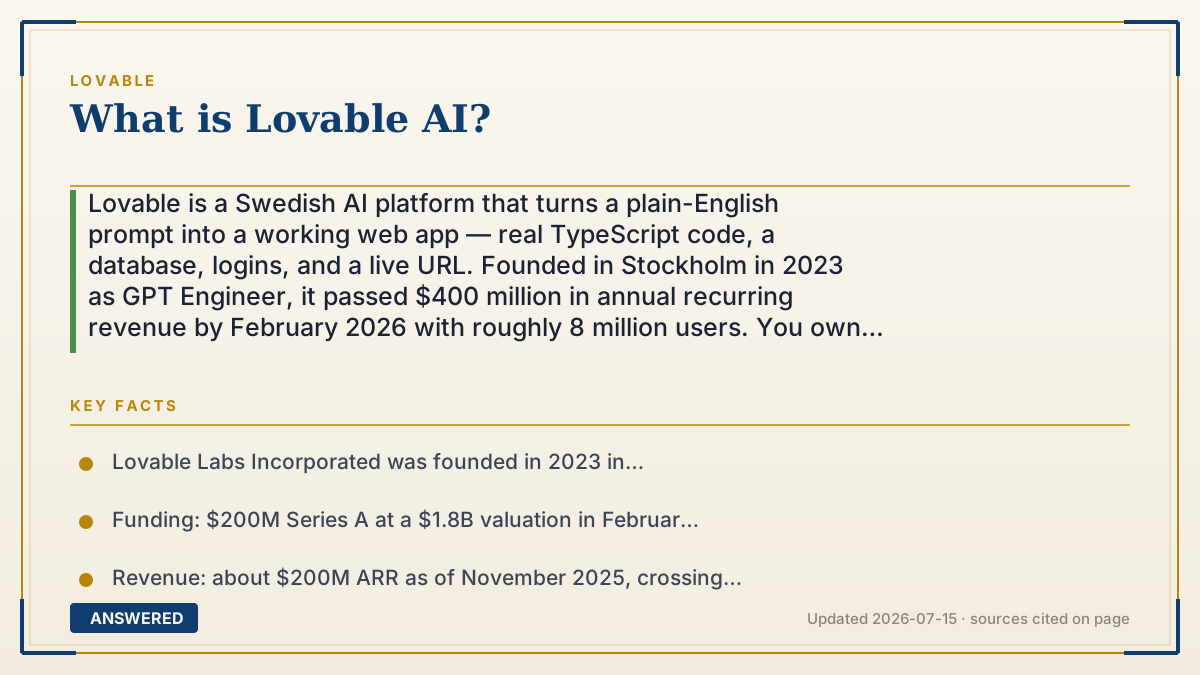
Lovable is a Swedish AI platform that turns a plain-English prompt into a working web app — real TypeScript code, a database, logins, and a live URL. Founded in Stockholm in 2023 as GPT Engineer, it passed $400 million in annual recurring revenue by February 2026 with roughly 8 million users. You own the code and can export it.
Why — the first-principles explanation
Start with what actually happens when you type a sentence into it. Lovable is not a drag-and-drop website builder with a template library. An AI agent writes real source files — a TypeScript frontend styled with Tailwind CSS, a Postgres database, user login, file storage — then runs them in a live preview and hosts the result at a URL. The company describes it as a full-stack development platform, and the important word there is full-stack: it produces the database and the backend logic, not just a pretty page. Per Lovable's own docs, apps created from May 13, 2026 onward are generated on TanStack Start with server-side rendering; apps made before that use React + Vite with prerendering. That detail matters because almost every article about Lovable still describes the old stack.
Why does this work at all? Because the target is much narrower than it looks. Strip the branding off most web apps and you find the same skeleton: show a list of things, add a thing, edit a thing, log in, take a payment. That pattern appears in millions of public code repositories. The model isn't inventing architecture — it's assembling a route that has been walked ten million times. This also explains the cliff every user eventually hits. The first prompt feels like magic because it lands in dense, well-mapped territory. The twentieth prompt is a grind because your specific business rule — the odd discount logic, the weird approval workflow — exists nowhere in that training data, and the model keeps confidently building the wrong thing.
Now the economics, which is where most complaints come from. Plans are priced by credits, not seats, and a credit is roughly a unit of inference over your codebase. That means you are not paying for the app. You are paying for the conversation, and the conversation gets more expensive as the app grows, because each message makes the model read more context. As of 2026-07 the free tier grants 5 build credits per day, up to 30 a month, plus 20 monthly Cloud credits. There is also a second, usage-based layer for the Cloud hosting and AI that your shipped app consumes. Iteration is billed. Undo is not free the way it is in a design tool — a rewrite costs the same as the original write.
The part that separates Lovable from classic no-code is the exit. You own the generated code and can sync it to GitHub, which means the ceiling isn't a wall. When you outgrow the tool, a developer can pick up the repository and keep going. That single property is why the company grew from $200 million ARR in November 2025 to over $400 million by February 2026, raised $330 million at a $6.6 billion valuation, and was reported in June 2026 to be in talks at around $12 billion — the fastest revenue ramp of any European software startup on record.
An example that makes it click
Imagine a contractor who has personally built the same three-bedroom house ten thousand times. You say "three bedrooms, two baths, garage on the left," and by lunch it's standing there, wired and plumbed. It feels supernatural.
Now ask him for a staircase that folds into the wall. He's never built one. But he's confident, so he builds a staircase — the wrong one — and you pay for the lumber. You explain again. He builds another wrong staircase. You pay again. That's the whole shape of Lovable in one image: astonishing on the common 80%, expensive and stubborn on the 20% that's actually yours. The saving grace is that at any point you can take the blueprints and the house, hand them to a real architect, and walk away.
How to do it
- Describe the app you want in plain English — Lovable generates the frontend, database, authentication, and integrations in one pass.
- Review the live preview and refine by chatting. Be specific about one change at a time; vague prompts burn credits on wrong guesses.
- Sync the project to GitHub when it's real. This gives you the code, version history, and an escape route into normal engineering workflows.
- Deploy to the built-in hosting for a live URL, or take the repo and host it yourself.
- Watch both billing layers: subscription credits for building, plus usage-based Cloud and AI charges for what your shipped app consumes.
Key facts
- Lovable Labs Incorporated was founded in 2023 in Stockholm, Sweden by Anton Osika and Fabian Hedin. It grew out of GPT Engineer, an open-source LLM coding tool, and was rebranded to Lovable in December 2024.
- Funding: $200M Series A at a $1.8B valuation in February 2025 (led by Accel); $330M Series B at a $6.6B valuation in December 2025 (led by CapitalG and Menlo Ventures). Forbes reported in June 2026 that it was in talks to raise at roughly $12B.
- Revenue: about $200M ARR as of November 2025, crossing $400M ARR by February 2026 — reaching $100M annualized within roughly 8 months of launch. Around 8 million users.
- Generated stack: apps created on or after 2026-05-13 use TanStack Start with server-side rendering (except on Enterprise plans); earlier apps use React + Vite with prerendering. Styling is Tailwind CSS; the backend runs on Lovable Cloud, Supabase, and third-party APIs.
- Free tier as of 2026-07: 5 build credits per day (up to 30 per month) plus 20 monthly Cloud credits. Plans are priced by credits, not seats, and workspace members share one credit allocation.
- Code ownership: Lovable's FAQ states the creator owns the project, and code can be exported by transferring it to GitHub. Lovable manages the underlying AI model itself — model choice is not user-configurable.
Open the official product site and confirm the current access, plans and terms.
▶ The 60-second explainer (script)
What is Lovable? It's a Swedish AI platform that turns a sentence into a working web app. You type what you want, and an AI agent writes real code — a TypeScript frontend, a Postgres database, user logins — runs it in a live preview, and puts it on a URL. It is not a drag-and-drop template builder. It writes an actual codebase, and you own it. Here's why it works. Strip the branding off most web apps and they share one skeleton: show a list, add a thing, edit a thing, log in, take a payment. That pattern sits in millions of public code repositories. The model isn't inventing architecture — it's walking a road that's been walked ten million times. Which also explains the cliff. Your first prompt feels like magic because it lands in well-mapped territory. Your twentieth prompt is a grind, because your specific business rule exists nowhere in that training data, and the model keeps confidently building the wrong thing. Then there's the bill. Plans are priced in credits, not seats, and a credit is basically inference over your codebase. So you're not paying for the app — you're paying for the conversation, and it gets pricier as the app grows. Iteration is billed. Rewrites cost as much as writes. The part that matters most: you can sync the project to GitHub and take the code. The ceiling isn't a wall. That's why it went from two hundred million in ARR to over four hundred million in three months, and why investors were reportedly talking about twelve billion dollars in June 2026.
What authoritative sources say
People also ask
Is Lovable free?
There's a free tier: as of 2026-07 it grants 5 build credits per day, up to 30 a month, plus 20 monthly Cloud credits. That's enough to try an idea, not to run a real product. Paid plans add larger monthly credit balances and features like custom domains.
Do you own the code Lovable writes?
Yes. Lovable's FAQ says the creator owns the project, and you can export everything by transferring it to GitHub. This is the main difference from traditional no-code platforms, where leaving means rebuilding from scratch.
Why does Lovable cost more than people expect?
Two billing layers. Your subscription credits pay for building — every message spends credits, and rewrites cost as much as first attempts. On top of that, the Cloud hosting and AI your shipped app consumes is billed by usage. Costs scale with iteration, not with app size.
Do you need to know how to code to use it?
No, to get something working. Yes, to get something finished. Non-developers routinely ship the common 80% — lists, forms, logins, payments. The trouble starts with logic unique to your business, where a developer who can read the generated code fixes in minutes what costs an hour of failed prompts.
How is Lovable different from Cursor or v0?
Cursor is an AI code editor for people already writing code in a repo. v0 focuses mainly on UI generation. Lovable aims at the full stack — frontend, database, auth, hosting — for people who'd rather describe an app than build one, while still leaving a real GitHub repo behind.