What is nlp in AI?
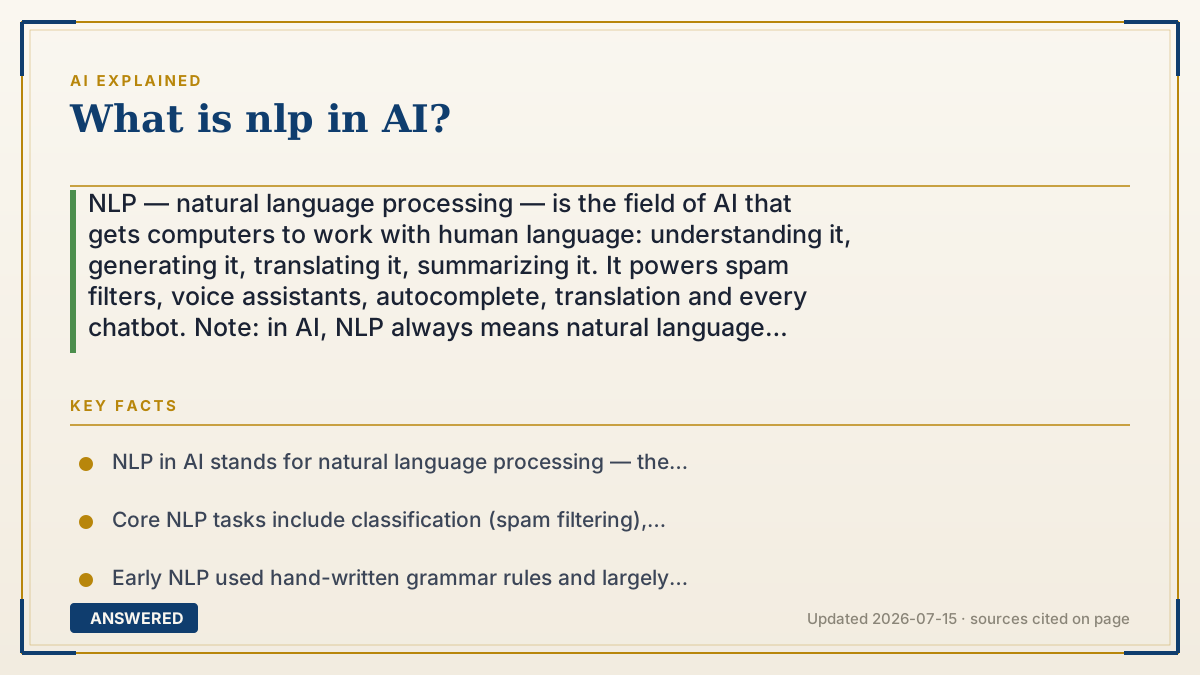
NLP — natural language processing — is the field of AI that gets computers to work with human language: understanding it, generating it, translating it, summarizing it. It powers spam filters, voice assistants, autocomplete, translation and every chatbot. Note: in AI, NLP always means natural language processing, never neuro-linguistic programming.
Why — the first-principles explanation
First, clear the name collision, because it sends real people to the wrong page. In AI, NLP means natural language processing. There's an unrelated self-help methodology from the 1970s called neuro-linguistic programming that shares the initials and has nothing to do with computing. Different field, different everything.
Now the actual problem NLP solves. A computer manipulates numbers. Language is not numbers — it's ambiguous, context-dependent, and full of things that are never said. "I saw her duck" has two meanings. "It's cold in here" is often a request to close a window, not a temperature report. Meaning lives outside the words, in context a machine doesn't have. That's why language resisted computers for fifty years while chess fell in one afternoon. Chess has rules. Language has vibes.
The first fifty years attacked it with grammar. Linguists hand-wrote rules — a sentence is a noun phrase plus a verb phrase, here are the exceptions — and it never worked, because the exceptions are infinite and native speakers break the rules constantly while remaining perfectly understood. The breakthrough was giving up on rules and using statistics instead: don't teach the machine grammar, show it billions of sentences and let it learn which words tend to follow which. First step is turning words into numbers — representing each word as a list of numbers positioned so that words appearing in similar contexts land near each other. "King" ends up near "queen" not because anyone said they're related, but because they show up in similar company. Once language is numbers, the math machine can finally work on it.
That's what modern NLP is, and it explains the technology's whole personality. A chatbot doesn't understand your question and then answer. It converts your text to numbers and computes the statistically likely continuation, word by word. This is why it's fluent in any register, handles sentences no one ever wrote, and translates idioms — and equally why it invents citations, since a plausible-sounding fake reference is an excellent statistical continuation. Fluency and truth are separate properties, and NLP only ever optimized the first. The results are real: in a study of 5,179 customer-support agents, an NLP assistant raised issues resolved per hour by 14% on average and 34% for novices. But it does that by producing likely text, not correct text — a distinction that never stops mattering.
An example that makes it click
Imagine teaching someone to cook without ever explaining cooking.
The old way: hand them a rulebook. "Onions go in before garlic. Salt at the end. Never combine fish and cheese." They follow it exactly and produce something technically legal and slightly wrong. Every real kitchen situation is an exception the rulebook didn't cover. That was NLP for fifty years — linguists writing grammar rules that native speakers cheerfully violated all day while being perfectly understood.
The new way: sit them in the corner of a busy kitchen for ten thousand hours. Nobody explains anything. They just watch what follows what — the pan, then the oil, then the onion, then the sound, then the garlic. Eventually they can cook, brilliantly, and they cannot tell you a single rule. They just know what comes next.
That's a language model. And it explains the weird part: ask them to cook something plausible-sounding that doesn't actually exist, and they'll do it confidently — because in ten thousand hours, “what comes next” was always the goal. Never “is this real.”
Key facts
- NLP in AI stands for natural language processing — the discipline of making computers understand, generate and manipulate human language. It is unrelated to neuro-linguistic programming, a 1970s self-help methodology that shares the acronym.
- Core NLP tasks include classification (spam filtering), translation, summarization, named entity recognition, sentiment analysis, speech recognition and text generation.
- Early NLP used hand-written grammar rules and largely failed; the modern field is statistical — models learn patterns from large text corpora rather than being taught grammar.
- NLP represents words as numeric vectors positioned so that words used in similar contexts sit near each other, which is what allows mathematical operations on language.
- Modern chatbots generate text by predicting likely continuations word-by-word — optimizing for plausibility, not truth, which is the mechanical reason they fabricate confident-sounding citations.
- In a study of 5,179 customer-support agents, an NLP-based conversational assistant increased issues resolved per hour by 14% on average and 34% for novice workers (NBER w31161).
- Microsoft Copilot (announced September 21, 2023) and Google Gemini (renamed from Bard February 8, 2024) are mainstream consumer NLP products.
▶ The 60-second explainer (script)
What is NLP in AI? It stands for natural language processing — getting computers to work with human language. And first, a warning: there's a totally unrelated 1970s self-help thing called neuro-linguistic programming with the same initials. Not this. Different universe. So here's the actual problem. Computers do numbers. Language isn't numbers — it's ambiguous and it leans on context. “I saw her duck” has two meanings. “It's cold in here” usually isn't about temperature, it's asking you to shut the window. Meaning lives outside the words. That's why chess fell to computers in an afternoon and language took fifty years. Chess has rules. Language has vibes. And for fifty years we tried rules anyway. Linguists hand-wrote grammar: noun phrase, verb phrase, here are the exceptions. It never worked — because the exceptions are infinite, and real speakers break the rules constantly and are understood fine. The breakthrough was giving up. Don't teach the machine grammar. Show it billions of sentences and let it learn what tends to follow what. Turn every word into a list of numbers, arranged so words used in similar company sit close together. “King” lands near “queen” — not because anyone said they're related, but because they show up in the same neighborhoods. Once language is numbers, the math machine can finally touch it. And that explains everything about modern AI. A chatbot doesn't understand your question and answer it. It computes the likely next word, over and over. That's why it's fluent about anything — and why it invents fake citations with total confidence. A plausible fake reference is a great statistical continuation. Fluency and truth were never the same target.
What authoritative sources say
People also ask
What does NLP stand for in AI?
Natural language processing — the branch of AI dealing with human language. It has no connection to neuro-linguistic programming, an unrelated self-help methodology that shares the abbreviation.
What are examples of NLP?
Spam filters, autocomplete, voice assistants, machine translation, search engines, sentiment analysis of reviews, meeting transcription, and every chatbot including ChatGPT, Gemini and Copilot.
Is NLP the same as machine learning?
No. Machine learning is the general method of learning patterns from data. NLP is the application area — language. Modern NLP is built with machine learning, but ML also handles images, audio and forecasting.
How does NLP turn words into something a computer can use?
It maps each word to a list of numbers — a vector — arranged so that words appearing in similar contexts sit close together. Once language is numeric, mathematical operations become possible.
Why does NLP produce fluent but false answers?
Because it's trained to predict likely text, not verified text. A convincing fabrication scores well on plausibility. Truth isn't a separate check the system runs — it's a side effect of having read mostly accurate material.