What is Perplexity AI?
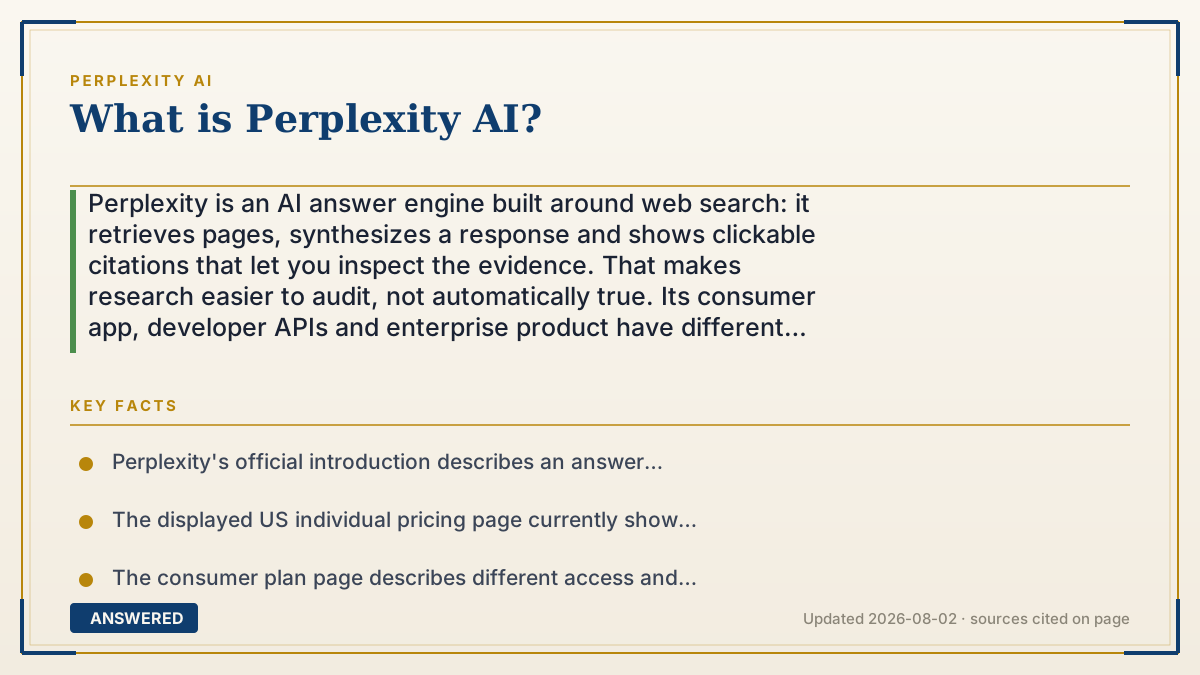
Perplexity is an AI answer engine built around web search: it retrieves pages, synthesizes a response and shows clickable citations that let you inspect the evidence. That makes research easier to audit, not automatically true. Its consumer app, developer APIs and enterprise product have different models, limits, billing and data terms, so check the current official page for the product you will actually use.
Why — the first-principles explanation
A language model on its own generates a plausible continuation from learned patterns. That is useful for drafting, but it may not know what changed yesterday and can state an invented fact fluently. An answer engine changes the order: it searches first, retrieves source material, gives that material to a model and returns a synthesized answer with links back to the sources. Perplexity describes this as an answer engine that searches the internet in real time.
Citations are the product's checking interface, not a truth certificate. A cited page can be outdated or wrong; the model can misread it, use a snippet without enough context or make a sentence stronger than the source. Open the cited page, check the publication date and scope, and prefer primary documents for important claims. A citation shortens the path to verification; it does not outsource judgment.
There are several product layers. In the consumer app, a quick search is different from a reasoning task or a broader research report. Perplexity's developer documentation groups model use cases into Search, Reasoning and Research, with different trade-offs between speed, depth and cost. Use the smallest mode that can answer the question, then escalate when the evidence or analysis is insufficient.
The individual pricing page currently displays Free at $0/month, Pro at $20/month and Max at $200/month for the listed US plans. The paid tiers add some combination of advanced model access, deeper research, premium sources, uploads, connectors, Computer or other credit-based features. Exact quotas, regional prices, taxes and included credits can change, so the live plan page is the source of truth rather than a cached comparison article.
A consumer subscription is not the same thing as API access. Perplexity publishes separate Search, Gateway, Agent and Sonar API billing. Search is metered by successful request; Gateway and Agent usage is token or tool metered; Sonar has its own token and search-context pricing. Budget the API from the workload and read the endpoint-specific rate table before shipping a feature.
Privacy also depends on the surface. The consumer privacy notice covers websites, apps and related services and says Perplexity may use collected data to improve or create services, including AI models, subject to its stated choices and legal terms. The API privacy page separately states zero retention and no training for the Chat Completions API, while the enterprise page says enterprise customer data is not used to train its LLMs. Those are different contractual contexts: do not infer that a consumer setting, every API endpoint or every connected app has the same treatment.
For a team, the question is governance as much as answer quality. Perplexity Enterprise advertises controls such as SSO and SCIM, user management, configurable file retention, SOC 2 Type II and connectors to internal knowledge. Confirm the security and retention commitments in the order form and trust documentation that apply to your region and plan before uploading confidential material.
A defensible workflow is simple: state the question, date range and acceptable sources; run the least expensive suitable mode; open several citations; triangulate important claims against primary sources; save the evidence and prompt; and have a qualified person approve high-stakes decisions. This is where Perplexity is strongest—as a fast research interface with a visible trail—not as an automatic authority.
An example that makes it click
Suppose you need a current market brief. Ask Perplexity for a dated answer restricted to regulator filings, company releases and named research institutions. Inspect the citations, remove claims supported only by a snippet or secondary blog, and keep a table of claim, source, date and confidence. If the task is repeated inside a product, compare API request and token costs; if it contains confidential files, review the API or enterprise data terms instead of assuming the consumer app is equivalent.
How to do it
- Define the job: a quick current fact, a multi-source report, a file analysis, a team workspace or an API feature. The job determines the right product surface.
- Start with a question whose answer you can evaluate. Use a precise scope, date range and source preference instead of asking for an unbounded summary.
- Click several citations and check that each one actually supports the nearby sentence. Read the surrounding context, not only the highlighted snippet.
- Use Search for straightforward retrieval, Reasoning for multi-step analysis and Research for broad reports when the official model documentation says that trade-off fits your task.
- For important claims, triangulate against primary documents and record the source URL, publication date and any disagreement. Treat uncited or weakly sourced statements as leads.
- Try Free first, then identify the bottleneck that would justify Pro or Max: model choice, research volume, premium sources, uploads, connectors, Computer features or credits.
- Before paying, check the live plan page for price, limits, credit resets, cancellation, regional availability and data choices. Do not treat a subscription as API access.
- If building software, price Search, Gateway, Agent and Sonar separately, set rate and spend limits, and test latency and citation behavior on representative queries.
- For private work, classify the data first. Review consumer privacy choices, endpoint-specific API retention terms or enterprise controls before uploading sensitive files or connecting services.
- For medical, legal, financial, employment or other high-stakes decisions, use the cited sources and qualified review; an AI answer is not the final authority.
Key facts
- Perplexity's official introduction describes an answer engine that searches the internet in real time and returns answers with clickable citations.
- The displayed US individual pricing page currently shows Free at $0/month, Pro at $20/month and Max at $200/month; regional, tax, annual and promotional terms can differ.
- The consumer plan page describes different access and credits across Free, Pro and Max; included features and quotas can change.
- Perplexity's model documentation separates Search, Reasoning and Research use cases so users can trade off retrieval speed, multi-step analysis and report depth.
- Developer billing is separate from the app subscription: Search API uses request pricing, while Gateway, Agent and Sonar have their own token, tool or search-context charges.
- The consumer privacy notice and the API/enterprise policies are separate documents. The API page states zero retention and no training for Chat Completions API requests; enterprise materials state enterprise customer data is not used to train LLMs.
- Enterprise materials advertise SSO, SCIM, user management, configurable file retention, connectors and SOC 2 Type II; verify the terms that apply to the purchased plan.
- A citation makes a response easier to audit, not automatically correct. Verify the source's date, context, authority and support for the exact claim.
Try source-backed search first, then compare current Pro/Max research limits, credits and billing before upgrading.
Choose your next step
Compare current options, limits and terms before you decide.
▶ The 60-second explainer (script)
What is Perplexity AI? It is an answer engine built around web search. You ask a question, it retrieves pages, synthesizes an answer and returns clickable citations. That makes the evidence trail easier to inspect, but a citation is not a guarantee: the page may be wrong or outdated, or the generated sentence may overstate it. Perplexity separates consumer search, reasoning and research experiences from Search, Gateway, Agent and Sonar APIs. Its displayed US individual plans are Free at zero dollars, Pro at twenty dollars and Max at two hundred dollars a month, with limits and credits that change. API and enterprise privacy terms are separate from the consumer app. Start with the smallest suitable product, verify the sources, and upgrade only when a measured bottleneck justifies it.
What authoritative sources say
People also ask
What is Perplexity AI used for?
It is useful for current fact-finding, source-backed summaries, multi-source research and follow-up questions. Use it as a research starting point, then open and verify the cited sources before relying on the result.
Is Perplexity free?
Perplexity currently displays a Free plan with citations and limited usage. Pro and Max add more models, research, credits and creation features. Check the live plan page for the limits and price that apply to your region.
What is the difference between Perplexity Free, Pro and Max?
Free is for lighter search. Pro is for regular research and adds higher access to advanced features. Max is for very heavy users who need the highest access to research, Computer or credit-based features. The exact contents and quotas change, so compare the current page before paying.
Is Perplexity better than ChatGPT or Google?
Perplexity is optimized for retrieving and citing web sources. Google is primarily a link and discovery system, while ChatGPT is a broader assistant that can also search. The best choice depends on whether your first need is source-backed research, open-ended work, files, coding or an existing ecosystem.
Can Perplexity citations be wrong?
Yes. A cited page can be outdated or wrong, and the generated sentence can overstate what the page says. Open the source, read the surrounding context and use primary documents for important claims.
What are Perplexity Search, Reasoning and Research modes?
Perplexity's developer documentation uses those categories for quick retrieval and synthesis, complex multi-step analysis and broad report-style research. Choose based on the task and verify the current model catalogue because names and availability can change.
Does a Perplexity subscription include API access?
Do not assume so. Perplexity publishes separate Search, Gateway, Agent and Sonar APIs with metered pricing. Review the developer pricing, limits and API account terms separately from the consumer plan.
Is Perplexity private enough for confidential research?
It depends on the product and plan. The consumer privacy notice, API privacy page and enterprise terms are separate. Review retention, training, connectors and access controls before uploading sensitive files; for high-risk data, obtain your organization's security approval.
Does Perplexity Enterprise have administrative controls?
Perplexity's enterprise materials advertise SSO, SCIM, user management, configurable file retention, connectors and security certifications. Confirm the exact controls, retention period and contractual commitments for your plan and region.