What is the best AI chatbot?
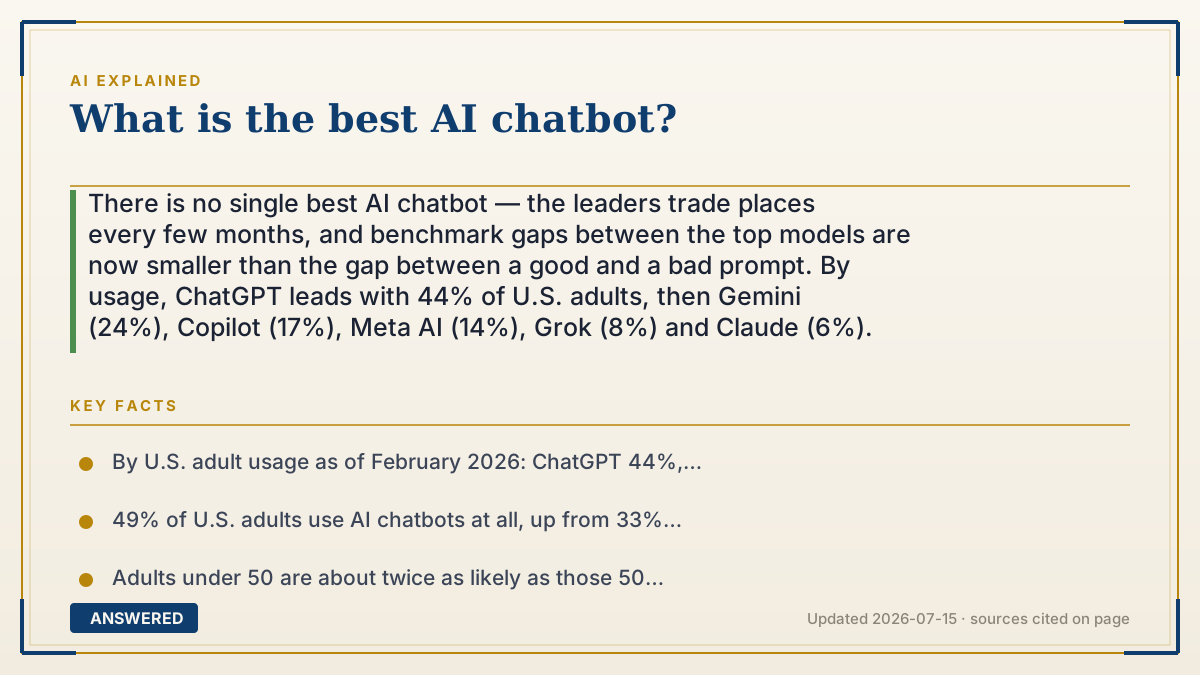
There is no single best AI chatbot — the leaders trade places every few months, and benchmark gaps between the top models are now smaller than the gap between a good and a bad prompt. By usage, ChatGPT leads with 44% of U.S. adults, then Gemini (24%), Copilot (17%), Meta AI (14%), Grok (8%) and Claude (6%).
Why — the first-principles explanation
The honest answer is unsatisfying for a structural reason. The top models are trained on overlapping data, with overlapping techniques, by labs that read each other's papers and hire each other's staff. Convergence is the expected outcome. When a lab does find an edge, the others reproduce it within months. So the ranking churns, and any article confidently naming "the best chatbot" is really reporting the date it was written.
The deeper trap is that "best" isn't a property of the chatbot — it's a property of the fit between the tool and your task. Chatbots differ less in raw intelligence now than in the scaffolding around them: what they're wired to, how long a document they'll hold, whether they search the web, whether they run code, whether they can see your files. Microsoft 365 Copilot can summarize your company's actual emails because it's connected to the Microsoft Graph. That's not the model being smarter — it's the plumbing. Ask a smarter model with no access to your inbox and it will lose every time.
Watch out for benchmark theater. Public leaderboards are useful signal but they're gameable, and labs choose which to publish. Head-to-head vote sites measure which answer people like, which rewards confident, well-formatted prose — not accuracy. A model that says "I don't know" loses votes to one that invents a tidy answer. Treat leaderboards as weak evidence, not a verdict.
The useful reframe: stop asking which is best and ask which is best at your thing. Then test it. Take three real tasks from your own week, run them through two chatbots, and compare. That's a ten-minute experiment that beats any listicle, because it measures the only thing that matters — your work, not an exam.
An example that makes it click
Asking "what's the best AI chatbot" is like asking "what's the best vehicle." A pickup truck, a motorcycle and a minivan aren't competing for one crown. The right answer depends entirely on whether you're hauling lumber, splitting traffic, or driving four kids to soccer.
And there's a twist. The model connected to your files is like the minivan that already has the car seats installed. It might have a weaker engine than the sports car, but for the school run it wins every time — not because it's faster, but because it's the one that fits the kids.
How to do it
- Write down the three tasks you'd actually use it for this week — not hypothetical ones.
- Ignore the leaderboards. They measure exam performance and formatting preferences, not your job.
- Check the plumbing first: does it need to read your files, search the web live, run code, or handle images? That narrows the field faster than any benchmark.
- Pick two candidates and run the same three real tasks through both. Use the free tiers.
- Score them on the failure that costs you most — usually confident wrong answers, not clumsy phrasing.
- Re-check in six months. The ranking will have moved.
Key facts
- By U.S. adult usage as of February 2026: ChatGPT 44%, Gemini 24%, Copilot 17%, Meta AI 14%, Grok 8%, Claude 6% — Pew Research Center, 5,119 adults, fielded February 17–23, 2026.
- 49% of U.S. adults use AI chatbots at all, up from 33% in 2024 — meaning about half the country is not in this market yet.
- Adults under 50 are about twice as likely as those 50 and older to use ChatGPT (57% vs 28%).
- The most common reported use is searching for information (42%), followed by work tasks (38% of employed adults), entertainment (25%) and image or video creation (24%).
- Microsoft 365 Copilot's differentiator is integration with organizational data via the Microsoft Graph rather than model capability alone.
- 63% of Americans say AI is advancing too quickly, and 71% believe AI will make personal information less secure.
Compare current chatbot options
There is no permanent best chatbot; compare the provider's current capabilities, privacy terms and account requirements for your task.
▶ The 60-second explainer (script)
There is no single best AI chatbot, and anyone who names one is really telling you what month they wrote their article. Here's why. The top models are trained on overlapping data, with overlapping methods, by labs that read each other's papers and poach each other's staff. Convergence is the expected result. When one finds an edge, the others copy it within months. So the leaderboard churns constantly. The bigger point: best isn't a property of the chatbot. It's a property of the fit between the tool and your task. These models differ less in raw intelligence now than in what they're plugged into — whether they search the web, read your files, run code, hold a long document. Microsoft's Copilot can summarize your company's actual email. That's not a smarter model, that's plumbing. A genius with no access to your inbox loses that job every time. And be skeptical of vote-based leaderboards. They measure which answer people like — which rewards confident, well-formatted prose. A model that admits it doesn't know loses to one that invents something tidy. So: take three real tasks from your own week, run them through two chatbots, compare. Ten minutes. Beats every listicle, because it tests your work instead of an exam. For context, Pew's 2026 numbers: ChatGPT 44% of U.S. adults, Gemini 24%, Copilot 17%, Meta AI 14%, Grok 8%, Claude 6%.
What authoritative sources say
People also ask
Which AI chatbot is most popular?
ChatGPT, by a wide margin — 44% of U.S. adults report using it, versus 24% for Gemini and 17% for Copilot (Pew, February 2026). Popularity reflects brand recognition and a head start, not necessarily superiority.
Are the paid tiers worth it?
It depends on volume and task difficulty. Paid tiers typically buy higher usage limits, more capable models, and features like file analysis or code execution. If your three real tasks succeed on the free tier, don't pay. As of 2026-07, check each vendor's current pricing page — tiers change frequently.
Can I trust AI chatbot leaderboards?
Treat them as weak evidence. Vote-based rankings measure which answer people prefer, which rewards confident, well-formatted writing over accuracy. Benchmark scores are gameable and labs choose which to publish.
Which chatbot hallucinates the least?
There's no stable answer, and the ranking shifts with each release. Practically, hallucination drops sharply for any model when it retrieves real sources instead of answering from memory — so a chatbot with live web search and visible citations is usually the safer choice regardless of brand.
Should I use more than one?
Many heavy users do, precisely because the tools differ in plumbing rather than intelligence. Using two free tiers costs nothing and gives you a cross-check on anything important.