What is the best AI for organic chemistry?
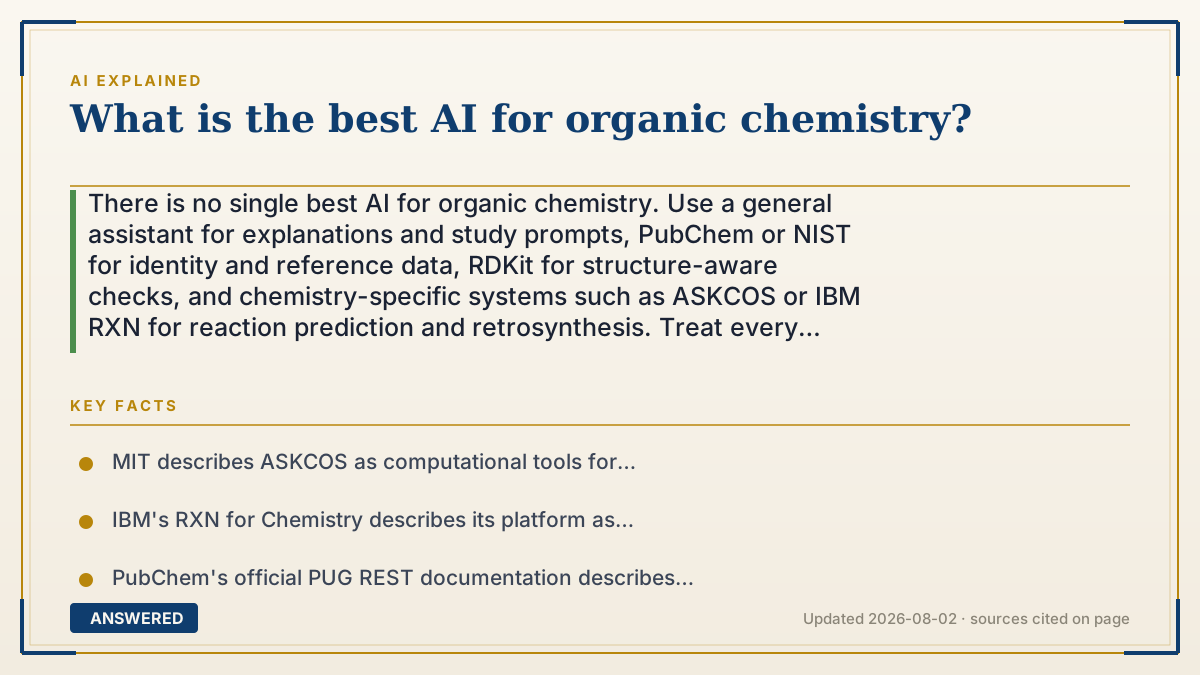
There is no single best AI for organic chemistry. Use a general assistant for explanations and study prompts, PubChem or NIST for identity and reference data, RDKit for structure-aware checks, and chemistry-specific systems such as ASKCOS or IBM RXN for reaction prediction and retrosynthesis. Treat every predicted mechanism or route as a hypothesis to verify against structures, primary literature, safety data and a qualified chemist—not as a lab protocol.
Why — the first-principles explanation
“Best” is really a question about the job and the evidence required. Organic chemistry combines language and diagrams with molecular identity, connectivity, stereochemistry, reaction conditions, measured properties and hazards. A general language model can be useful at the explanatory layer: it can compare mechanisms, define terms and turn a difficult passage into a study plan. Fluent text is not proof that a structure, atom map, condition or product is correct, though. A model may accept a name or SMILES and still miss a charge, stereocenter, regiochemical constraint or incompatible reagent.
The safer split is between retrieval, deterministic checking, prediction and explanation. PubChem and NIST let you retrieve identifiers, structures and reference measurements. RDKit is a cheminformatics toolkit for parsing and manipulating molecules, descriptors and substructures; it can catch representation problems, but it does not certify that a reaction will work. ASKCOS and IBM RXN are narrower systems for reaction analysis and synthetic planning; their output is a ranked prediction or route to inspect, not an experimental guarantee. Literature and safety sources remain the authority for a procedure, exposure control or scale-up decision.
That is why a chemistry workflow should use a chatbot as a tutor and interface, while a specialist or primary source supplies the claim that matters. Save the exact structure, source URL, software/version, reaction conditions and date. If a result could affect a real experiment, have a qualified chemist review it and follow the institution’s SOP and current SDS.
Safety has its own evidence boundary. A hazard database or AI summary can help you locate a chemical and frame questions, but it is not a substitute for the current supplier SDS, local risk assessment, engineering controls, waste rules or trained supervision. NIOSH describes its Pocket Guide as general industrial-hygiene information and warns that it does not provide every relevant datum; use it as orientation, not as permission to run a reaction.
An example that makes it click
Suppose you want to make a substituted aromatic compound. A general assistant can explain why an electrophilic aromatic substitution might be plausible and point out questions to ask. PubChem can resolve the starting material’s identifiers and properties; RDKit can parse the SMILES and inspect valence or substructures; ASKCOS or IBM RXN can suggest disconnections or a reaction prediction. You still need to locate the actual published procedure, check the current SDS and assess whether the route is appropriate for your lab. Each tool answers a different question, so a polished chatbot paragraph is never the whole evidence chain.
How to do it
- Define the job and the risk: tutoring, structure/identifier lookup, property retrieval, reaction prediction, retrosynthesis, literature search or an actual lab decision.
- For a mechanism or exam concept, ask a general assistant to explain one step at a time and show the electron movement. Redraw the structure yourself and treat disagreement between fresh runs as a verification signal.
- Resolve names, CAS numbers, InChI, SMILES and basic compound properties with PubChem; use NIST Chemistry WebBook when a standard thermochemical, spectral or related reference datum is available.
- Parse and inspect the structure with a structure editor or RDKit. Check valence, formal charge, aromaticity, atom mapping and stereochemistry before reasoning about a reaction.
- For reaction prediction or retrosynthesis, use a chemistry-specific system such as ASKCOS or IBM RXN. Inspect every proposed disconnection, precursor availability, condition and route score; a prediction is not a yield or safety claim.
- For a procedure, search the primary paper, patent or institutional literature database and read the experimental section. Confirm scale, work-up, purification, analytical data, waste and current SDS information.
- Record the structure representation, source, date, software/model version and assumptions. Do not put an unverified chatbot procedure into a real experiment or make a safety decision without qualified review.
Key facts
- MIT describes ASKCOS as computational tools for synthetic planning and organic chemistry, including interactive path planning, tree building and forward-synthesis analysis.
- IBM's RXN for Chemistry describes its platform as predicting reactions, finding retrosynthesis pathways and deriving experimental procedures; those outputs still require chemical and safety review.
- PubChem's official PUG REST documentation describes programmatic access to compound, substance and assay records, including identifiers, structures and individual properties.
- RDKit's official overview describes an open-source cheminformatics toolkit with molecular data structures, 2D/3D operations, descriptors and substructure functionality.
- NIST Chemistry WebBook is Standard Reference Database 69 and provides curated reference data and search tools for thermochemical, spectral and related chemical properties.
- A language-model explanation can be useful without being independently validated. Structure checks, source retrieval and qualified review are separate controls, not optional polish.
- NIOSH says its Pocket Guide gives general industrial-hygiene information for workplace chemicals, helps users recognize and control hazards, and does not provide all relevant data.
Match the chemistry job to the evidence
Compare tools by task, then verify structures, reactions and safety with authoritative sources before relying on the result.
▶ The 60-second explainer (script)
What is the best AI for organic chemistry? It depends on what you need to be true. For a mechanism explanation or study plan, a general assistant can be a useful tutor—but fluent text is not proof of a correct structure or stereochemical assignment. For names, identifiers and basic properties, retrieve the record from PubChem or a reference source such as the NIST Chemistry WebBook. For structure-aware checks, use a drawing tool or RDKit to inspect valence, charge, aromaticity and stereochemistry. For reaction prediction and retrosynthesis, use chemistry-specific systems such as ASKCOS or IBM RXN, then inspect every route and assumption. For an actual procedure, go to the primary paper or institutional database, read the experimental section and check the current SDS and SOP. The winner is not one chatbot. The winning workflow matches each claim to the right evidence—and never treats AI output as permission to run an experiment.
What authoritative sources say
People also ask
What is the best AI for learning organic chemistry?
Use a general assistant as a Socratic tutor: ask for definitions, one mechanism step at a time and alternative explanations. Redraw structures and verify stereochemistry, names and exceptions against your textbook or instructor; do not outsource the final reasoning to a fluent answer.
What is the best AI for retrosynthesis?
A chemistry-specific planner such as ASKCOS or IBM RXN is a more appropriate starting point than a general chatbot. Compare multiple routes, inspect the proposed reactions and precursors, and verify each step in primary literature. A route score is not a guarantee of yield, availability or safety.
What should I use to check a SMILES or chemical structure?
Resolve the identity with PubChem, then use a structure editor or RDKit to parse the representation and inspect valence, charge, aromaticity and stereochemistry. A chatbot can explain what a string appears to mean, but it should not be the only validator.
Can AI find a reliable organic chemistry procedure?
It can help form search terms or summarize a paper, but the reliable procedure is the primary paper, patent or institutional database record. Read the experimental details, confirm the exact substrate and scale, and check the current SDS and local SOP before any work.
Can I use AI to decide whether a reaction is safe?
No—not by itself. Hazard classification, incompatibilities, engineering controls, waste and emergency procedures must come from current SDS documents, institutional SOPs and qualified safety or chemistry review. Never treat generated text as authorization to experiment.
Is a paid general AI plan automatically better for chemistry?
A paid plan may offer more usage or stronger reasoning, but it does not replace structure validation, reaction data or safety review. Test the exact tasks you have, count verification and rework time, and check the current vendor limits and data policy before paying.
Is the NIOSH Pocket Guide or an AI answer enough for lab safety?
No. NIOSH calls the Pocket Guide general industrial-hygiene information and says it does not include every relevant datum. Use the current supplier SDS, institutional risk assessment and SOP, required engineering controls, waste and emergency procedures, and qualified supervision for an actual experiment.
The same question, asked other ways
- Best AI for organic chemistry?
- Best AI for chemistry?
- AI for organic chemistry?
- Best AI chemistry solver?