What is the purpose of AI?
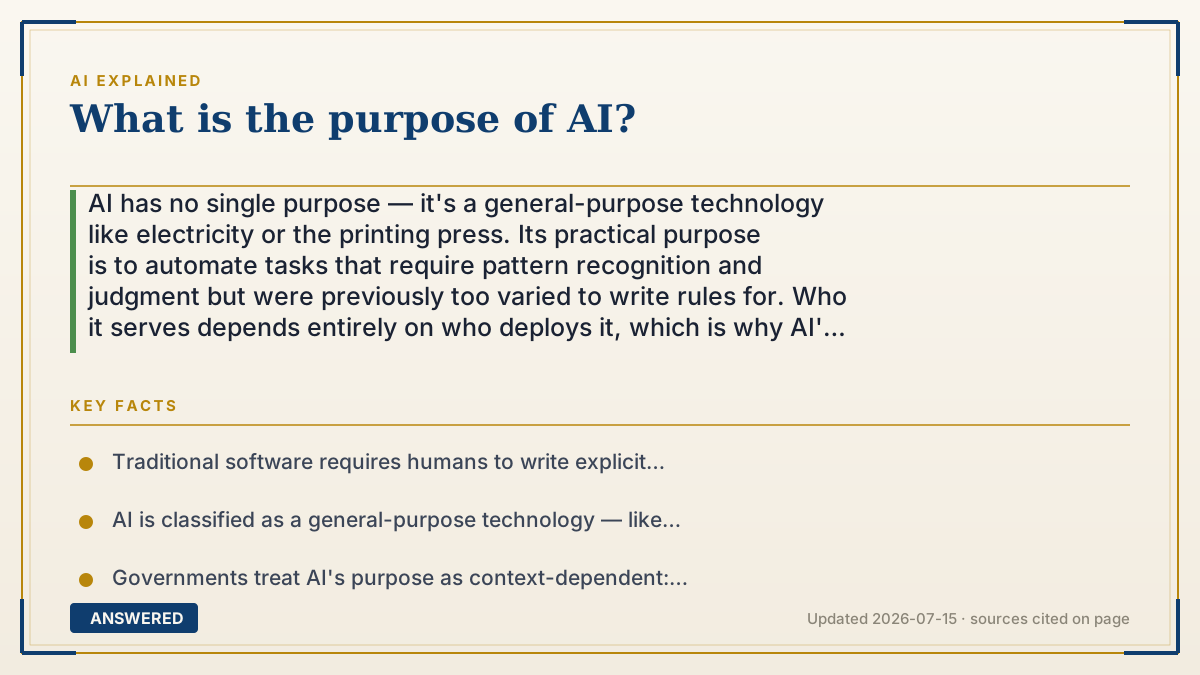
AI has no single purpose — it's a general-purpose technology like electricity or the printing press. Its practical purpose is to automate tasks that require pattern recognition and judgment but were previously too varied to write rules for. Who it serves depends entirely on who deploys it, which is why AI's purpose is a political question, not a technical one.
Why — the first-principles explanation
For seventy years, software could only do what someone wrote explicit rules for. If you wanted a program to spot a cat in a photo, you had to describe a cat in code — whiskers, ears, fur texture — and it never worked, because the world has too many exceptions. The rule-writing was the bottleneck, and it was a bottleneck of human patience, not computer power.
Machine learning removed that bottleneck by inverting the process. Instead of writing rules, you show examples and let the system derive its own rules by adjusting millions of numbers until its guesses stop being wrong. That's the whole trick. So the real purpose of AI, stated technically, is: do the jobs where the pattern is obvious to a human but impossible to write down. Recognizing a face. Judging whether a sentence sounds angry. Noticing that a scan looks abnormal. Humans do these instantly and can't explain how. That's precisely the gap AI fills.
But "purpose" usually means something bigger than that, and here's the honest answer: a general-purpose technology doesn't have a purpose, it has owners. Electricity's purpose isn't lighting or torture; it's whatever you wire it to. AI is at the same level of generality. It's currently wired to search ads, drug discovery, customer service deflection, weapons targeting, radiology, homework, and surveillance — simultaneously. Asking what AI is for is like asking what a hammer is for. It's for whatever the person holding it wants.
That's why the interesting question isn't "what's the purpose of AI" but "whose purpose?" The current answer is heavily shaped by cost: the technology takes billions of dollars to train, so the entities that can build it are large companies and states, and their goals become its default goals. That's not a conspiracy — it's just what happens when a tool is expensive to make and cheap to copy. The uses that get funded are the ones with a payer, which is why customer service automation is further along than, say, diagnosing rare diseases in poor countries.
An example that makes it click
Think about writing instructions for tying a shoelace. You've done it ten thousand times. Now write it down, precisely enough that someone who's never seen a shoe can follow it, in the dark. You'll be there all day, and they'll still end up with a knot.
That's every hard problem in old-school programming. AI's answer is: stop writing instructions. Just show the machine fifty thousand people tying shoelaces and let it figure out the pattern itself. It still can't explain how — same as you.
Key facts
- Traditional software requires humans to write explicit rules; machine learning derives rules from examples instead, which is what allows it to handle tasks too varied to specify.
- AI is classified as a general-purpose technology — like electricity or the internet, it has no inherent application domain and takes on the goals of whoever deploys it.
- Governments treat AI's purpose as context-dependent: NIST's AI Risk Management Framework (released 2023-01-26) is built around a 'Map' function precisely because risk and value can only be assessed in a specific deployment context.
- The EU AI Act regulates AI by use case and risk tier rather than by the technology itself — legal recognition that the same model can be benign or dangerous depending on purpose.
- Training frontier models requires infrastructure investment at the scale of hundreds of billions of dollars, concentrating who gets to set AI's default purposes.
▶ The 60-second explainer (script)
AI doesn't have a purpose. It's a general-purpose technology, like electricity. But let's take the question seriously, because there is a real technical answer. For seventy years, software could only do what someone wrote explicit rules for. Want a program to spot a cat in a photo? You had to describe a cat in code. Whiskers, ears, fur. And it never worked, because the world has too many exceptions. The bottleneck wasn't computer power — it was human patience. Machine learning flipped that. Instead of writing rules, you show examples, and the system adjusts millions of numbers until its guesses stop being wrong. So the technical purpose of AI is: do the jobs where the pattern is obvious to a human but impossible to write down. Recognizing a face. Hearing anger in a sentence. Noticing a scan looks off. You do those instantly and you can't explain how. That's exactly the gap. But if you mean purpose in the bigger sense — here's the honest answer. Electricity's purpose isn't lighting. It's whatever you wire it to. AI is at that level of generality. Right now it's wired to search ads, drug discovery, weapons targeting, radiology, homework, and surveillance, all at once. So the real question was never what is AI for. It's whose purpose. And since training these things costs billions, the people who can afford to build it get to set the defaults. That's not a conspiracy. That's just what happens when a tool is expensive to make.
What authoritative sources say
People also ask
Was AI invented to replace humans?
No. It was invented to handle tasks that couldn't be written as rules. Replacement happens when a company decides the automation is cheaper than the person — that's a business decision, not a property of the technology.
What was the original goal of AI research?
The founding goal in the 1950s was to build machines that could reason like people — general intelligence. Most commercial AI today is narrower: pattern recognition applied to one domain at a time.
Does AI have goals of its own?
Current systems optimize objectives their builders specify. They don't have independent desires. The genuine research concern is that optimizing a badly-specified objective can produce behavior nobody intended — which is a specification problem, not a motivation problem.
Is there a purpose AI is uniquely good for?
Its clearest edge is anywhere the pattern is real but nobody can articulate it — reading medical scans, detecting fraud, translating idiom. Those are tasks where humans succeed without being able to explain their own reasoning.