What is the smartest AI?
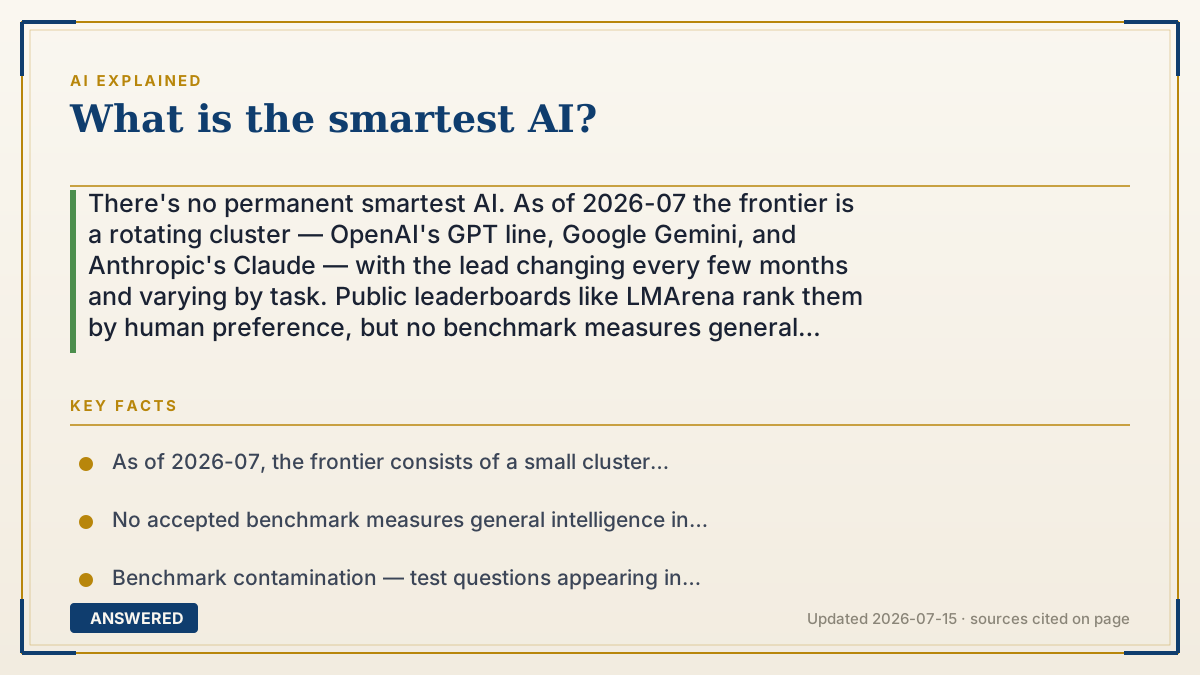
There's no permanent smartest AI. As of 2026-07 the frontier is a rotating cluster — OpenAI's GPT line, Google Gemini, and Anthropic's Claude — with the lead changing every few months and varying by task. Public leaderboards like LMArena rank them by human preference, but no benchmark measures general intelligence, and top models sit within a few points of each other.
Why — the first-principles explanation
"Smartest" assumes intelligence is one number you can rank things by. For AI it isn't, and the reason is mechanical. A language model's abilities come from what was in its training data and what it was tuned to do afterward — not from a general intelligence dial. So one model is better at competitive math because it was trained heavily on math traces; another writes better prose because it was tuned on human preference for writing. Those are different skills produced by different choices, not different amounts of a shared substance.
This is why benchmarks disagree, and why you should be suspicious of any single number. Benchmarks also suffer from contamination: if a test's questions leaked into training data, the model has effectively seen the exam. High scores can mean recall rather than reasoning. That's why LMArena's approach — anonymous head-to-head battles judged by humans — became influential. But it measures which answer people prefer, which rewards confident, well-formatted, agreeable responses. A model that says "I don't know" when it doesn't know is being smarter and scoring worse.
The deeper trap: these systems are jagged, not uniformly capable. A model can solve a graduate physics problem and then miscount the letters in a word. Human intelligence is correlated — someone who does hard math can generally count. AI intelligence isn't correlated that way, because it didn't develop through a path where counting was a prerequisite for physics. So "as smart as a PhD" is a category error. It's superhuman on some cells of the grid and subhuman on adjacent ones, and there's no reliable rule for which is which.
Practically, this means the smartest model for you is discovered, not looked up. The frontier models are close enough that the difference between them is usually smaller than the difference between a good prompt and a lazy one.
An example that makes it click
Ask "who's the best athlete?" A marathoner, a powerlifter, and a gymnast all have a case, and the question quietly dissolves once you notice they'd each lose badly at the others' sport. There's no single athleticism number.
AI is that, but weirder — imagine a gymnast who can do a triple backflip but sometimes trips walking to the mat. That's what jagged means. The trick isn't finding the athlete with the highest number. It's knowing which event you're entering.
How to do it
- Define your actual task first — coding, long-document analysis, creative writing, math, or research with citations. The rankings differ by category.
- Check a live leaderboard rather than an article. LMArena publishes human-preference rankings that update continuously; static 'best AI of 2026' posts go stale within weeks.
- Run your own three-prompt test: take a real task you do weekly and give it identically to two or three frontier models.
- Judge on the failure, not the win. See what each model does when it doesn't know — the one that admits uncertainty is often more useful than the one that scores higher.
- Re-check every few months. The lead genuinely rotates, and switching costs are near zero.
Key facts
- As of 2026-07, the frontier consists of a small cluster — OpenAI's GPT models, Google Gemini, and Anthropic's Claude — with leadership rotating on a scale of months rather than years.
- No accepted benchmark measures general intelligence in AI; scores are task-specific and vary widely across math, coding, writing, and reasoning categories.
- Benchmark contamination — test questions appearing in training data — inflates scores and is a known, unresolved problem in model evaluation.
- LMArena ranks models via anonymous head-to-head comparisons judged by human voters, which measures preference rather than correctness.
- Model capability is 'jagged': the same system can solve graduate-level problems while failing elementary tasks like character counting, because ability tracks training data rather than a developmental hierarchy.
▶ The 60-second explainer (script)
There is no smartest AI, and the reason is more interesting than the non-answer sounds. As of mid-2026 the frontier is a rotating cluster — OpenAI's GPT models, Google's Gemini, Anthropic's Claude — and the lead changes every few months. But here's the real issue. 'Smartest' assumes intelligence is one number. For AI, it isn't. A model's abilities come from what was in its training data and what it was tuned for afterward. There's no general intelligence dial. One model is better at math because it saw more math. Another writes better because it was tuned on human preference for writing. Different skills, different choices — not different amounts of the same stuff. And benchmarks lie to you in a specific way. If test questions leaked into the training data — that's called contamination — the model has already seen the exam. A high score can mean recall, not reasoning. That's why human head-to-head leaderboards like LMArena got popular. But those measure which answer people prefer, which rewards confidence and good formatting. A model that admits it doesn't know is being smarter and scoring worse. The deepest thing to understand is that these systems are jagged. A model can solve a graduate physics problem and then miscount the letters in a word. Human intelligence is correlated — if you can do hard math you can count. AI's isn't. So 'as smart as a PhD' is a category error. Pick by your task, and test it yourself.
What authoritative sources say
People also ask
Is GPT smarter than Gemini or Claude?
It depends on the task and the month. As of 2026-07 they trade places on different benchmarks and the gaps are small. The honest advice is to test all three on a task you actually do.
What's the highest IQ AI?
IQ tests are designed for humans and assume correlated abilities. AI capability is jagged, so an IQ score on a model is close to meaningless — it can ace the test and fail tasks a child handles.
Why do AI companies all claim to be the best?
Because you can pick the benchmark. With dozens of tests available and no agreed standard, nearly every frontier lab can find a chart where it leads.
Is a smarter AI always better for me?
No. Frontier models cost more and run slower. For summarizing emails or drafting a message, a smaller cheaper model is often indistinguishable in quality and much faster.