What percentage of jobs will be automated by 2030?
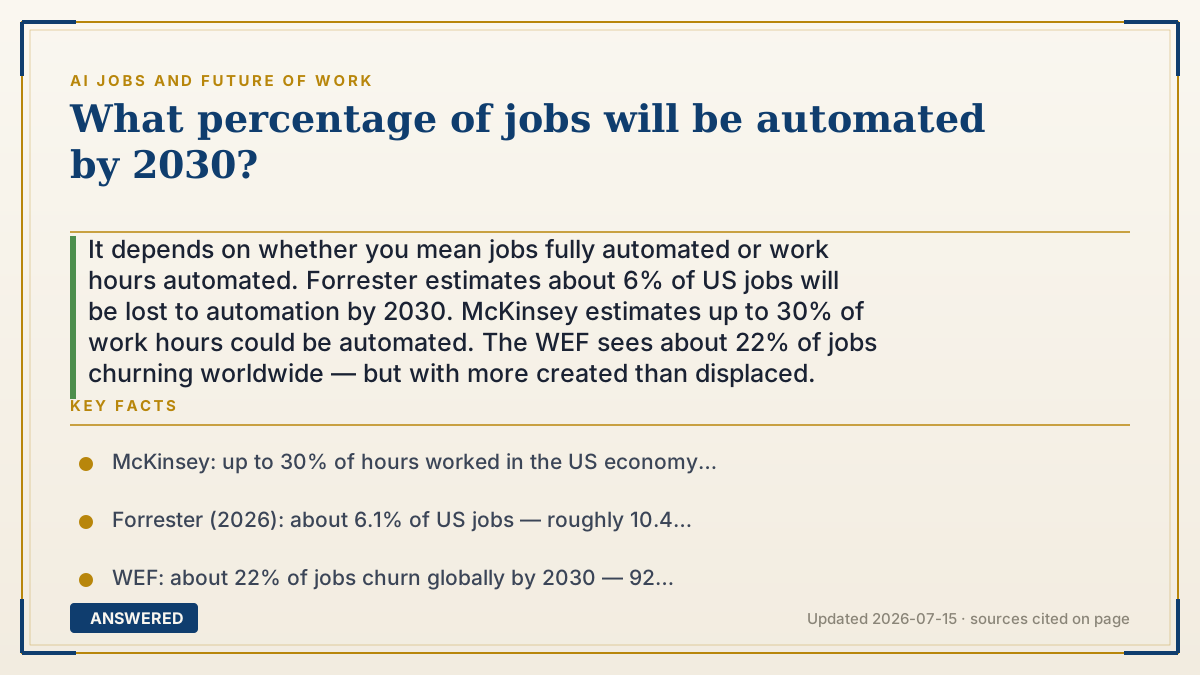
It depends on whether you mean jobs fully automated or work hours automated. Forrester estimates about 6% of US jobs will be lost to automation by 2030. McKinsey estimates up to 30% of work hours could be automated. The WEF sees about 22% of jobs churning worldwide — but with more created than displaced.
Why — the first-principles explanation
The phrase "percentage of jobs automated" hides a crucial distinction, and pinning it down dissolves most of the confusion. There's a huge difference between the share of jobs that disappear and the share of work hours that get automated — and studies quote one or the other, producing numbers from 6% to 30% that all describe reality.
Start with hours. McKinsey estimates that by 2030, activities accounting for up to 30% of hours worked in the US economy could be automated, accelerated by generative AI. But automating 30% of hours does not delete 30% of jobs — it mostly means each worker's routine tasks get faster, freeing time inside the same role. That's why the hours figure is high but not alarming: it's a measure of task automation, not unemployment.
Now jobs. When you count jobs actually eliminated, the numbers drop sharply. Forrester's 2026 forecast puts US net job loss from AI and automation at about 6% by 2030 (roughly 10.4 million). The World Economic Forum's global view shows about 22% churn — but that's 92 million displaced and 170 million created, for net growth. So the best single-sentence answer is: expect roughly a quarter to a third of work hours to be automatable, but only a single-digit percentage of jobs to actually vanish on net — because automation reshapes far more jobs than it removes.
An example that makes it click
Imagine a class of 100 students each doing a 10-task worksheet. A helper robot can do 3 of the 10 tasks for everyone. If you ask "what percentage of the work got automated?" the answer is 30% — three of ten tasks. If you ask "how many students got sent home because the robot replaced them?" the answer is close to zero — they all still have a worksheet, just with fewer tasks to do themselves, so they finish faster and take on harder problems.
Maybe a few students whose whole worksheet was those 3 easy tasks do get sent home — that's the 6% of jobs actually lost. But confusing "30% of tasks" with "30% of students gone" is exactly the mistake behind scary headlines. Hours automated is big; jobs eliminated is small.
Key facts
- McKinsey: up to 30% of hours worked in the US economy could be automated by 2030 (29.5% with generative AI versus 21.5% without).
- Forrester (2026): about 6.1% of US jobs — roughly 10.4 million — net lost to automation by 2030.
- WEF: about 22% of jobs churn globally by 2030 — 92 million displaced, 170 million created, net +78 million.
- McKinsey estimates about 12 million occupational transitions in the US by 2030, affecting 7.5% of employment.
- Hours automated is much larger than jobs eliminated because AI reshapes roles rather than deleting most of them.
▶ The 60-second explainer (script)
What percentage of jobs will be automated by 2030? The answer swings from six percent to thirty percent, and the reason is a hidden distinction: are we counting jobs that disappear, or work hours that get automated? Those are very different things. Start with hours. McKinsey estimates up to thirty percent of work hours in the US economy could be automated by 2030. But automating thirty percent of hours doesn't delete thirty percent of jobs — it mostly means each worker's routine tasks get faster, freeing time inside the same role. Now count actual jobs lost, and the number drops sharply. Forrester puts US net job loss at about six percent by 2030 — roughly ten million jobs. The World Economic Forum's global view shows about twenty-two percent of jobs churning, but with more created than displaced, for net growth. So here's the clean takeaway: expect roughly a quarter to a third of work hours to be automatable, but only a single-digit percentage of jobs to actually vanish. Hours automated is big. Jobs eliminated is small.
What authoritative sources say
People also ask
Will 30% of jobs be gone by 2030?
No. The 30% figure refers to work hours that could be automated, not jobs eliminated. Actual net job loss is estimated at around 6% in the US by 2030.
What percentage of US jobs will be lost to AI by 2030?
Forrester's conservative estimate is about 6.1% — roughly 10.4 million jobs — while about 20% of jobs are reshaped rather than eliminated.
Why is the 'hours automated' number so much higher?
Because most jobs contain a mix of tasks. AI automates some tasks in many jobs, freeing hours, without removing the whole role — so hours automated far exceeds jobs lost.
Does automation mean fewer jobs overall by 2030?
Globally, no. The WEF projects net job growth — 170 million created versus 92 million displaced — even as automation reshapes about a fifth of all jobs.