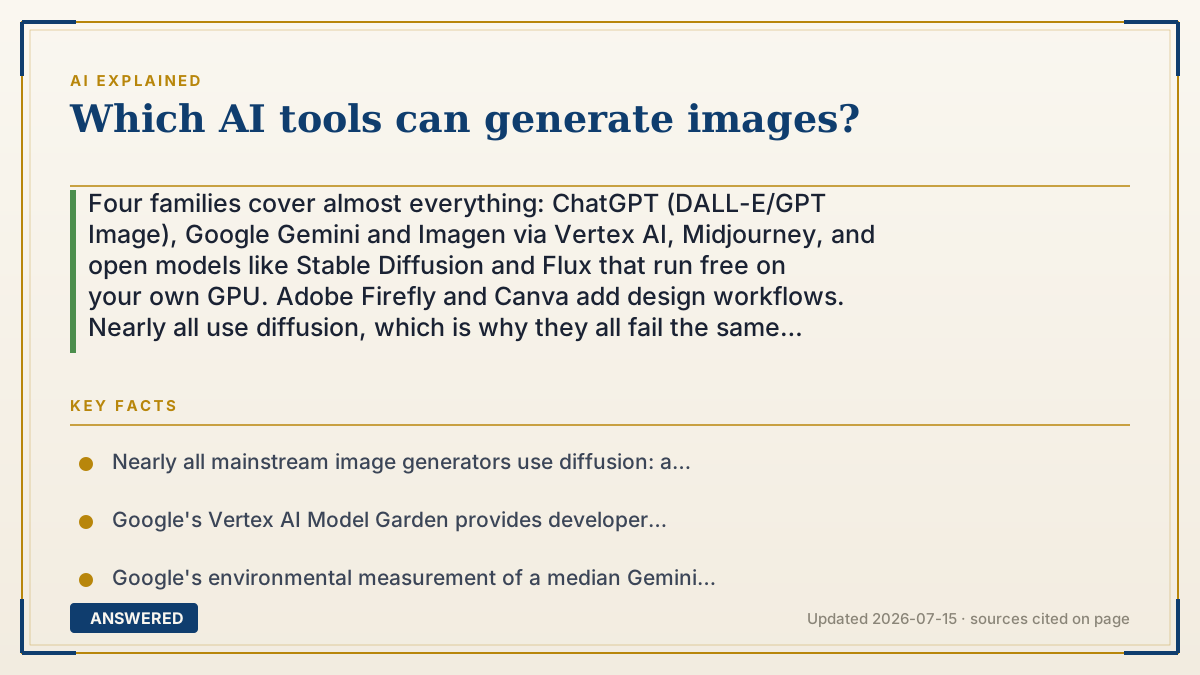
Which AI tools can generate images?
Four families cover almost everything: ChatGPT (DALL-E/GPT Image), Google Gemini and Imagen via Vertex AI, Midjourney, and open models like Stable Diffusion and Flux that run free on your own GPU. Adobe Firefly and Canva add design workflows. Nearly all use diffusion, which is why they all fail the same way.
Why — the first-principles explanation
Almost every image generator you can name works the same way underneath, which is why the choice is about ecosystem and licensing rather than magic. The method is diffusion, and it's an odd trick: you take real images and progressively add random noise until they're static. Then you train a network to undo one step of that — to look at a noisy image and predict what the slightly-less-noisy version looked like. Run that in reverse from pure static, steering with a text description, and a picture assembles itself out of nothing.
That mechanism explains the entire behavior profile. The model never learned objects, rules, or physics — it learned what noise patterns tend to resolve into, given words. So it's superb at texture, light, and style, because those are statistical surface properties. And it's historically bad at hands, text in images, and counting, because those need discrete structure — five fingers, exactly, in a specific arrangement — and diffusion is doing continuous denoising, not counting. Recent models are much better at text and hands, but the weakness comes from the architecture, not from insufficient training.
The practical split is about where the model runs and what license you get:
Hosted, integrated — ChatGPT generates images inside the chat, Gemini does the same in Google's apps, and Google's Imagen models are available to developers through Vertex AI's Model Garden. You get convenience and safety filtering; you get rate limits and no control over the weights.
Hosted, specialized — Midjourney sells subscription tiers for its own models, aimed at people who want the aesthetic and don't want to run anything.
Open weights — Stable Diffusion and Flux publish model files you can download and run on your own GPU. Zero marginal cost per image, full control, no filter, and you own the hardware problem. Same install logic as any open model: a runner plus a weights file.
Design-embedded — Adobe Firefly and Canva put generation inside a design tool, and Adobe pitches training-data provenance for commercial use.
The thing worth checking before you pick: commercial rights and provenance, not image quality. Quality converged; licensing did not. Whether you can sell the output, whether the training data was licensed, and whether the file carries content credentials differ significantly between these tools, and those terms change. Read the current terms of the specific tool.
An example that makes it click
Imagine staring at TV static and being asked, "what's hiding in there? A dog." You squint, and you nudge a few dots — this cluster is a bit more dog-ish. Then again. And again, fifty times. Slowly a dog emerges from the fuzz, and you never drew a dog; you just kept removing everything that wasn't dog.
That's diffusion. And now the failures make sense. Fur is easy — it's basically nice static. Hands are hard, because "five fingers, once each" is a counting rule, and you're not counting. You're squinting. That's why AI images used to have beautiful lighting and six fingers.
How to do it
- Just want an image, no setup: ask ChatGPT or Google Gemini directly in the chat. Easiest path, no separate account.
- Want a specific artistic look: Midjourney, which sells its own subscription tiers.
- Want free and unlimited: run open weights — Stable Diffusion or Flux — locally via a GPU. No per-image cost, no filter, you supply the hardware.
- Building an app: use a model API. Google exposes Imagen models to developers through Vertex AI's Model Garden.
- Working inside a design file: Adobe Firefly or Canva generate in place, with Adobe emphasizing training-data provenance for commercial work.
- Before commercial use: read the current terms for commercial rights, training-data sourcing, and content credentials. These differ by tool and change often.
- Prompt for the mechanism: describe lighting, lens, material, and mood — diffusion models respond strongly to texture and style words, weakly to counting instructions.
Key facts
- Nearly all mainstream image generators use diffusion: a model trained to reverse the progressive addition of noise, steered by a text prompt.
- Google's Vertex AI Model Garden provides developer access to Google's models, including image models, under Google Cloud billing.
- Google's environmental measurement of a median Gemini prompt (0.24 Wh, 0.03 gCO2e, 0.26 mL water) covers text prompts; image and video generation cost substantially more per request.
- Stable Diffusion and Flux are distributed as open weights, so per-image marginal cost after setup is your own electricity rather than a subscription.
- Diffusion models struggle with discrete structure — finger counts, legible text, exact object counts — because the architecture denoises continuously rather than enumerating.
- Figma Make, a design-tool AI feature, ran on Claude 3.7 Sonnet at launch, illustrating that design tools license models rather than build their own.
Choosing a tool for your creative workflow?
The answer above explains the concept; this next step helps you choose by job, limits and current terms.
▶ The 60-second explainer (script)
Which AI tools generate images? Four families cover almost everything. One: hosted and integrated — ChatGPT and Google Gemini make images right inside the chat. Easiest possible path. Two: hosted and specialized — Midjourney, for people who want that specific aesthetic and don't want to run anything. Three: open weights — Stable Diffusion and Flux. Download the model, run it on your own GPU. Free per image, no filter, you own the hardware problem. Four: design-embedded — Adobe Firefly and Canva, generating inside the design file. But here's what nobody tells you: they almost all work the same way underneath. It's called diffusion, and it's weird. You train a model to un-blur static. Show it noisy images, teach it to predict the slightly cleaner version, then run it backward from pure static while steering with words. A picture assembles out of nothing. It's like staring at TV static, being told there's a dog in there, and nudging dots until a dog emerges. You never drew a dog. You removed everything that wasn't dog. And that's exactly why they all fail the same way. Fur is easy — that's just nice static. Hands were hard, because five fingers, once each, is a counting rule, and you're not counting. You're squinting. So pick on ecosystem, not quality — quality converged. What actually differs is commercial rights and where the training data came from. Read the terms.
What authoritative sources say
People also ask
What's the best free AI image generator?
For zero setup, ChatGPT and Gemini both generate images with free-tier limits. For genuinely unlimited free, run open weights like Stable Diffusion or Flux locally — you pay in GPU and electricity instead.
Can I sell AI-generated images?
It depends entirely on the tool's current terms and your jurisdiction. Commercial rights, training-data sourcing, and copyrightability of AI output all differ by tool and are actively litigated. Check the specific terms before you sell.
Why do AI images still mess up hands and text?
Diffusion denoises continuously; it doesn't enumerate. 'Exactly five fingers' and 'spell this word' are discrete structural rules, which is the architecture's weak spot. Newer models are far better but the weakness is structural.
Which tool has the best quality?
Quality has largely converged across the top hosted models, and rankings flip with every release. Choose on ecosystem, licensing, and filter policy — those differ far more than output quality does.
Do image prompts cost more than text prompts?
Yes, substantially. Google's widely-cited 0.24 watt-hour figure is for a median text prompt and explicitly doesn't cover image or video generation, which run far more computation per request.
The same question, asked other ways
- Which AI tools can create images?
- Which AI can generate images?