Which AI will BMW use in its cars?
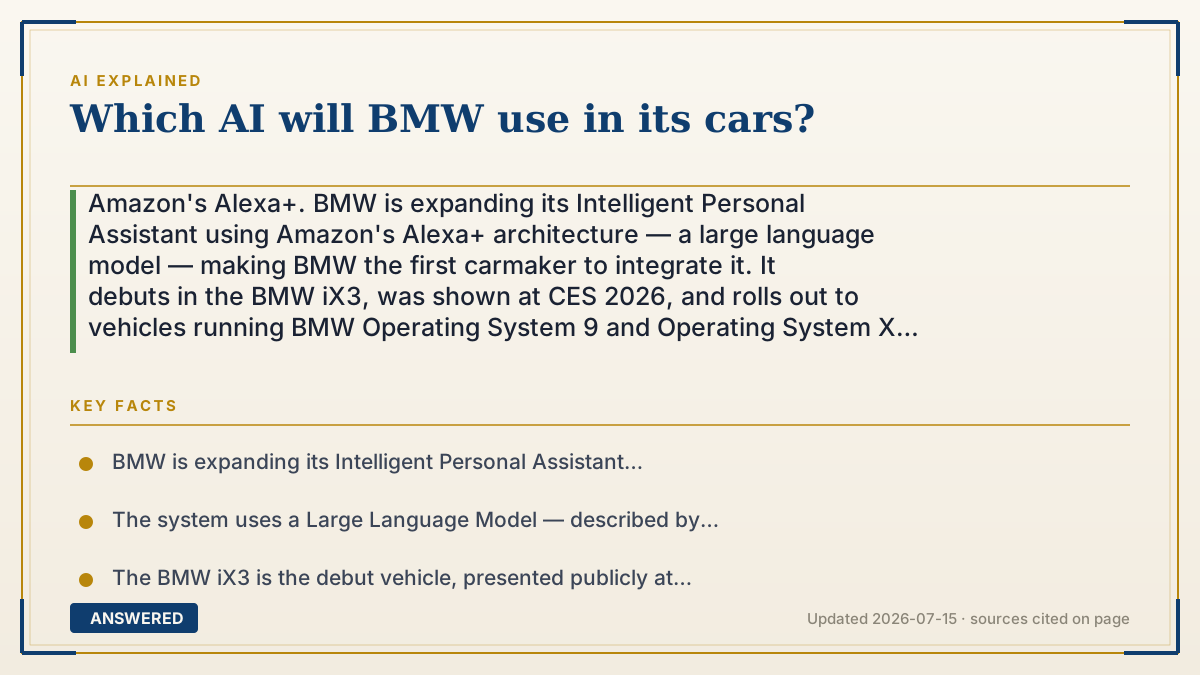
Amazon's Alexa+. BMW is expanding its Intelligent Personal Assistant using Amazon's Alexa+ architecture — a large language model — making BMW the first carmaker to integrate it. It debuts in the BMW iX3, was shown at CES 2026, and rolls out to vehicles running BMW Operating System 9 and Operating System X in the second half of 2026, starting in Germany and the US.
Why — the first-principles explanation
The interesting question isn't which vendor BMW picked — it's why a car company outsourced this at all, when BMW has spent decades insisting on building its own driving experience.
The answer is that in-car voice broke on a specific wall. Old systems were command matchers: a fixed list of phrases mapped to a fixed list of actions. "Navigate to home" worked; "I'm cold" did not, because it wasn't on the list. Every driver learned to speak robot, and everyone hated it. That architecture couldn't be improved incrementally — it was a grammar, and you cannot grammar your way to understanding.
A large language model dissolves that wall because it doesn't match; it interprets. BMW's own framing is that this is a generative AI that understands language and formulates its own responses. The concrete capability BMW highlights: passengers can ask multiple questions in a single sentence, spanning both vehicle functions and general knowledge — for example, asking to navigate to a famous artwork based on an informational query. That's two systems in one breath, the car's controls and the world's facts, which the old command list structurally could not do.
But a frontier language model needs enormous compute and constant retraining — a scale that's rational for Amazon, Google, and OpenAI and irrational for a carmaker who'd be maintaining it alongside suspension geometry. So BMW made the honest trade: rent the brain, keep the body. BMW controls the vehicle integration, the Panoramic iDrive interface, and which functions the assistant can reach; Amazon supplies the language layer.
The deployment details reveal the real constraint — cars aren't phones. This debuts in the iX3, the launch model for the Neue Klasse, and requires BMW Operating System 9 or Operating System X. Older cars aren't getting it, because the hardware isn't there. Launch is second half of 2026, Germany and the US first, with other markets and model series following gradually. BMW says Neue Klasse technologies will reach 40 new models and model updates by 2027. That's the timescale a car company moves on: a phone assistant updates overnight; a fleet takes years.
An example that makes it click
Think about the difference between a vending machine and a shopkeeper.
A vending machine has buttons. Press B4, get pretzels. It works perfectly — as long as you want exactly what's behind a button and you know which button. Say "something salty, not too heavy" to a vending machine and nothing happens. It's not being rude. There's no button for that.
A shopkeeper handles "something salty, not too heavy, and by the way where's the nearest gas station?" without blinking. He answers both halves, because he's understanding rather than matching.
Old car voice control was a vending machine with a very long list of buttons. BMW's update swaps in a shopkeeper. And that's exactly why BMW rented him instead of raising him — training a shopkeeper who knows everything about the world costs more than a car company can justify. So BMW keeps the shop, and Amazon supplies the guy behind the counter.
Key facts
- BMW is expanding its Intelligent Personal Assistant using Amazon's Alexa+ architecture, making BMW the first car manufacturer to integrate the technology.
- The system uses a Large Language Model — described by BMW as generative AI that understands language and is capable of formulating its own responses.
- The BMW iX3 is the debut vehicle, presented publicly at CES 2026 as the launch model for the Neue Klasse.
- Availability requires BMW Operating System X or BMW Operating System 9 — older vehicles are not eligible.
- Customer availability begins in the second half of 2026, launching in Germany and the United States, with other markets and model series following gradually.
- BMW states the assistant can handle multiple questions in a single sentence covering both vehicle functions and general knowledge — for example navigating to a famous artwork based on an informational query.
- The iX3's interface is based on the BMW Panoramic iDrive control concept running BMW Operating System X.
- BMW says Neue Klasse technologies will be integrated into a total of 40 new models and model updates by 2027.
▶ The 60-second explainer (script)
Which AI will BMW use in its cars? Amazon's Alexa Plus. BMW is expanding its Intelligent Personal Assistant using Amazon's Alexa Plus architecture — a large language model — and it's the first carmaker to do it. Debuts in the iX3, shown at CES 2026, rolling out second half of 2026 to cars running BMW Operating System 9 or Operating System X, Germany and the US first. But the interesting question isn't which vendor. It's why BMW outsourced this at all, when they've spent decades insisting on building their own driving experience. Here's why. In-car voice hit a specific wall. Old systems were command matchers — a fixed list of phrases mapped to a fixed list of actions. 'Navigate to home' worked. 'I'm cold' didn't, because it wasn't on the list. Every driver learned to speak robot, and everyone hated it. And you couldn't fix that incrementally. It was a grammar. You cannot grammar your way to understanding. A language model dissolves that wall because it doesn't match — it interprets. BMW's own framing: generative AI that understands language and formulates its own responses. The capability they highlight is telling — you can ask multiple questions in a single sentence, spanning vehicle functions and general knowledge. Like asking it to navigate to a famous artwork based on an informational question. Two systems in one breath. The old command list structurally could not do that. Think vending machine versus shopkeeper. Vending machine: press B4, get pretzels. Perfect — as long as you want what's behind a button and you know which button. Say 'something salty, not too heavy' and nothing happens. There's no button for that. A shopkeeper handles it, plus 'where's the nearest gas station,' without blinking. So why rent instead of build? Because a frontier language model needs enormous compute and constant retraining. That's rational for Amazon. It's irrational for a company also maintaining suspension geometry. So BMW rents the brain and keeps the body — they control the integration, the Panoramic iDrive interface, and which functions the assistant can touch. And the rollout tells you cars aren't phones. It needs OS 9 or OS X. Older cars don't get it — the hardware isn't there. Neue Klasse tech hits forty models by 2027. A phone assistant updates overnight. A fleet takes years.
What authoritative sources say
People also ask
Which AI does BMW use?
Amazon's Alexa+ architecture, integrated into the BMW Intelligent Personal Assistant. BMW is the first carmaker to ship it. BMW controls the vehicle integration and interface; Amazon supplies the language model.
Which BMW models get it?
It debuts in the BMW iX3, the Neue Klasse launch model, and is available for vehicles running BMW Operating System 9 or Operating System X. Older cars without those systems aren't eligible.
When can I actually use it?
Customer availability starts in the second half of 2026, in Germany and the United States first, with other markets and model series following gradually.
What can it do that the old voice control couldn't?
Handle multiple questions in one sentence spanning both car functions and general knowledge — for instance, navigating to a famous artwork based on an informational query. Old command-matching systems structurally couldn't combine those.
Why didn't BMW build its own AI?
Frontier language models require enormous compute and continuous retraining — economics that work for Amazon and don't for a carmaker. BMW rents the language layer and retains control of integration and which vehicle functions the assistant can reach.