Why do people think AI is dangerous?
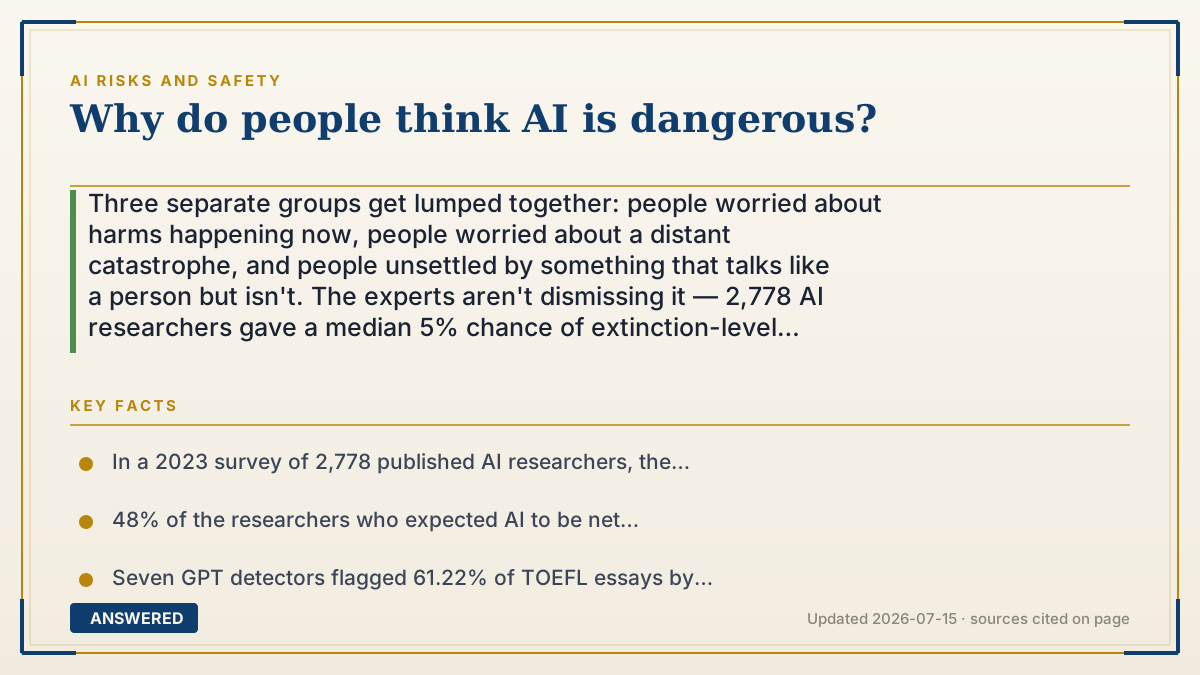
Three separate groups get lumped together: people worried about harms happening now, people worried about a distant catastrophe, and people unsettled by something that talks like a person but isn't. The experts aren't dismissing it — 2,778 AI researchers gave a median 5% chance of extinction-level outcomes.
Why — the first-principles explanation
The belief isn't one belief. It's at least three different worries wearing the same coat, and they barely talk to each other.
Group one worries about now. Their concerns are boring, documented, and mostly about accuracy and power: models that state falsehoods in a confident voice, tools that judge people badly, training data taken without payment, an industry where only a few companies can afford to compete. Their evidence is concrete — seven AI detectors flagged 61% of essays by non-native English writers as machine-written while being near-perfect on U.S.-born eighth graders. They find the extinction talk actively annoying, because it hoovers up attention that belongs to real people being harmed today.
Group two worries about later. Their argument is structural: we're building systems that get more capable every year, we hand them more control every year because it's profitable, and we don't have a reliable method to specify what we actually want. They aren't imagining robot malice — they're pointing out that a competent system pursuing a slightly wrong objective is a known failure mode of every optimization process we've ever built. And crucially, this group includes the field's own researchers: median 5%, mean 16.2%, with 38–51% putting the odds at 10% or more. You can't file that under sci-fi fandom.
Group three has a gut reaction, and it's rational even though it isn't an argument. For your entire evolutionary history, anything that produced fluent language had a mind behind it. That inference was always safe — until 2022. Now something talks like a person with nothing behind it, and your brain throws an error it has no category for. That's the uncanny feeling people describe. It isn't evidence of danger. It's evidence that a very reliable cue just stopped being reliable, which is genuinely disorienting.
The media then flattens all three into "AI might kill us," because that headline outperforms "résumé screening tool has uneven error rates." Which is why the public conversation is loud, dramatic, and mostly about the least likely scenario.
An example that makes it click
Think about how people talked about cars in 1905. One group worried about the real thing — kids getting hit on streets that had no rules yet. Another worried about the structural thing — what happens to cities, air, and the whole shape of life if everyone gets one. A third just found them unnatural and frightening.
All three were right about something. The first got traffic lights. The second got vindicated a lot later, in ways that took decades to see. The third was mostly wrong about the specifics and correct that something big was about to change. Nobody was crazy. They just weren't discussing the same danger — and the newspapers printed the scariest version of all three.
Key facts
- In a 2023 survey of 2,778 published AI researchers, the median probability of AI causing human extinction or severe permanent disempowerment was 5%; mean 16.2%; 38–51% gave at least 10% (Grace et al., arXiv:2401.02843).
- 48% of the researchers who expected AI to be net positive still gave at least a 5% chance to extremely bad outcomes — concern and optimism coexist in the same people.
- Seven GPT detectors flagged 61.22% of TOEFL essays by non-native English writers as AI-generated while performing near-perfectly on U.S.-born eighth graders' essays (Stanford, 2023) — a documented present-day harm.
- A 2023 report by 19 researchers including Bengio and Chalmers found no current AI systems are conscious, meaning the widespread fear of a machine that 'wakes up' is not what informed worriers are worried about.
- Researchers' median date for machines outperforming humans at every task is 2047, versus 2116 for full automation of all occupations — even the alarmed forecasts are measured in decades.
▶ The 60-second explainer (script)
Why do people think AI is dangerous? Because it's not one belief — it's three, wearing the same coat. Group one worries about right now. Their concerns are boring and documented: models stating falsehoods in a confident voice, tools that misjudge people, training data taken without payment. Their evidence is concrete. Seven AI detectors flagged sixty-one percent of essays by non-native English speakers as machine-written, while being nearly perfect on American eighth graders. This group finds extinction talk annoying — it steals attention from real people being harmed today. Group two worries about later. Their argument is structural. Systems get more capable every year. We hand them more control every year, because it's profitable. And we have no reliable way to specify what we actually want. They're not imagining robot malice. They're pointing at a known failure mode of every optimization process ever built. And this group includes the field's own researchers — median five percent chance of extinction-level outcomes. You can't call that sci-fi fandom. Group three has a gut reaction. For your entire evolutionary history, fluent language meant a mind was behind it. Always. Until 2022. Now something talks like a person with nothing behind it, and your brain throws an error it has no category for. That's not evidence of danger. It's a very reliable instinct going offline. Then the media flattens all three into — AI might kill us — because that headline beats: screening tool has uneven error rates.
What authoritative sources say
People also ask
Are the fears mostly from people who don't understand AI?
No — that's the most common and most wrong assumption. The 5% median came from people who publish at NeurIPS and ICML. Understanding the technology does not make the concern go away.
Is science fiction to blame?
For the imagery, yes. Movies gave everyone robot uprisings, which is the least likely scenario and the hardest to think clearly about. Actual researchers worry about badly specified goals and over-delegation — much duller, much more plausible.
Why do 'now' worriers and 'later' worriers argue so much?
They're competing for the same limited attention and regulation. Present-harm advocates think doom talk is a convenient distraction; long-term researchers think present harms are real but survivable. Both have a point.
Which group should I listen to?
All three, for different decisions. The 'now' group for how you use AI this week. The 'later' group for how you feel about policy. The gut reaction — notice it, then set it aside; it's a broken cue, not data.