Why is AI bad?
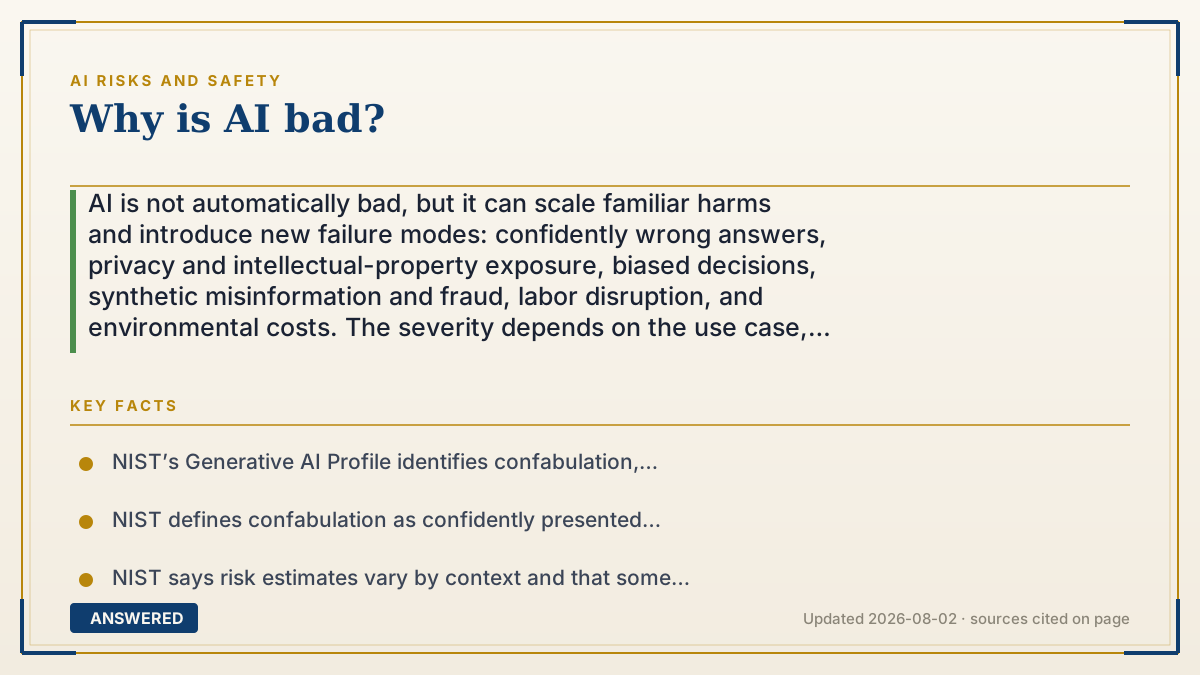
AI is not automatically bad, but it can scale familiar harms and introduce new failure modes: confidently wrong answers, privacy and intellectual-property exposure, biased decisions, synthetic misinformation and fraud, labor disruption, and environmental costs. The severity depends on the use case, data, access, safeguards and who is accountable. Use human review for consequential decisions, minimize sensitive inputs, verify important claims, and measure real-world errors instead of trusting a single accuracy score.
Why — the first-principles explanation
The question hides three different mechanisms. Malfunction is an unintended failure, such as a confident false answer. Misuse is a person using a capable system for fraud, manipulation or harmful instructions. Systemic risk appears when a tool is deployed widely and changes incentives, jobs, information flows or infrastructure. The same model can be useful in one setting and unsafe in another because the surrounding system changes the consequences.
NIST’s Generative AI Profile is a better starting point than a one-line “AI is bad” ranking. It names confabulation, data privacy, environmental impacts, harmful bias and homogenization, human-AI configuration and automation bias, information integrity, information security and intellectual property. NIST also warns that risk varies by lifecycle stage, context, affected group and time horizon; some risks are evidenced today while others remain uncertain.
The most common everyday failure is not a robot takeover. It is fluency mistaken for reliability. NIST defines confabulation as confidently presented erroneous or false content and notes that over-reliance can magnify the harm. A search summary, school decision, medical explanation or business report needs a source check and a person who can reject the output. “The model usually works” is not an acceptable control when one rare error can deny a benefit, misstate a legal rule or harm a reputation.
Other harms come from the data and the decision context. A system can reveal or infer personal information, reproduce protected material, or perform differently across groups and languages. One study found that several GPT detectors misclassified non-native English writing as AI-generated more often than native writing and could be bypassed by simple prompting. That is evidence against using a detector as a sole verdict, not proof that every detector has the same error rate. Test the exact tool, population and decision before deploying it.
Misuse is a separate track. The International AI Safety Report 2026 documents growing concerns about fraud, scams, manipulation, non-consensual intimate imagery, cyber abuse and biological or chemical misuse, while also noting that reliable prevalence data and real-world effect estimates remain limited. The sensible response is layered controls—permissions, rate limits, abuse monitoring, provenance, user reporting and human escalation—not the assumption that a model’s refusal screen solves the whole system.
The environmental cost is real but needs a boundary. The IEA reports that data centres used about 415 TWh, around 1.5% of global electricity, in 2024 and projects around 945 TWh by 2030 in its base case. Those are data-centre totals, not the electricity or water of one prompt, and the outlook has uncertainty. Local grid concentration, energy source, hardware turnover and efficiency matter more than a viral single-query conversion.
Future loss-of-control scenarios should be discussed without pretending they are current facts. The 2026 international report distinguishes uncertain future risks from harms already manifesting; the UK AI Security Institute reports rising performance on controlled autonomy evaluations but says it has not observed models spontaneously attempting self-replication. The correct posture is neither complacency nor prophecy: define a capability threshold, test it in a representative environment, keep privileges narrow, and retain a shutdown and appeal path.
So “why is AI bad?” has a practical answer: it is bad when speed and scale outrun verification, consent, security and accountability. Before using a system, ask what can go wrong, who bears the loss, how you will detect it, who can override it, and whether the benefit justifies the cost. That turns a moral slogan into a decision you can audit.
An example that makes it click
Imagine a company using an AI tool to screen job applications. A fluent summary can save recruiters time, but a hidden language or training-data bias may downgrade a qualified applicant, and a private résumé may be retained by a vendor. The safe design is not “never use AI” or “trust the score”: limit the data, test outcomes across relevant groups, require a human decision, give applicants a review path, log the model and version, and stop the system when its error or disparity crosses a threshold.
How to do it
- Name the decision and the people who could be harmed. Separate low-stakes drafting from hiring, benefits, health, credit, education, safety or legal decisions.
- Classify the failure as malfunction, misuse or systemic impact, then write the worst plausible consequence—not just the average failure rate.
- Minimize inputs. Remove unnecessary personal, confidential, copyrighted or identifying data and verify the provider’s retention, training and deletion terms.
- Use a fixed test set that represents real users, languages and edge cases. Measure false positives, false negatives, subgroup disparities and confidence calibration.
- Keep a human with authority to reject, correct and explain consequential outputs. Give affected people an appeal or review path.
- Verify important claims against primary sources and label synthetic media. Preserve the prompt, model/version, source material and review decision.
- Restrict permissions and monitor misuse: tool access, external actions, rate limits, logging, incident response and a tested rollback or shutdown path.
- Measure environmental and operational cost at the system level—compute, storage, retries, energy, water where material and hardware lifecycle—not from a viral per-prompt estimate.
- Re-evaluate after model, vendor, data, policy or user-population changes. A one-time benchmark is evidence for a date and context, not a permanent safety certificate.
Key facts
- NIST’s Generative AI Profile identifies confabulation, data privacy, environmental impacts, harmful bias and homogenization, human-AI configuration, information integrity, information security and intellectual property as risks unique to or exacerbated by generative AI.
- NIST defines confabulation as confidently presented erroneous or false content and notes that automation bias and over-reliance can magnify downstream harm.
- NIST says risk estimates vary by context and that some risks are empirically evidenced while others remain uncertain or difficult to scope.
- The International AI Safety Report 2026 separates misuse, malfunction and systemic risks; it says evidence of misuse is growing but reliable prevalence and impact data remain limited.
- The IEA reports that data centres consumed about 415 TWh, around 1.5% of global electricity, in 2024 and projects around 945 TWh by 2030 in its base case; this is a data-centre total, not a per-prompt measurement.
- A peer-reviewed study by Liang and colleagues found several GPT detectors misclassified non-native English writing as AI-generated and could be bypassed by simple prompting; it cautions against using a detector as a sole evaluative verdict.
- The U.S. Copyright Office’s AI project covers digital replicas, the copyrightability of generative-AI outputs and generative-AI training; legal status depends on the work, use and jurisdiction.
- The UK AI Security Institute reports rising capabilities on controlled autonomy evaluations, while noting no evidence in its tests of models spontaneously attempting to self-replicate; the report is a capability snapshot, not a forecast.
- Benefits and harms can coexist. The IEA notes AI may improve energy operations while data-centre growth creates electricity and local-grid pressures; a net judgment requires the specific deployment boundary.
- A model benchmark cannot prove that a complete product is safe. Data, prompts, tools, permissions, users, monitoring and appeal mechanisms determine the real-world risk.
Turn concern into an auditable decision
Start with the mechanism and the people affected, then compare controls, environmental trade-offs and workplace safeguards before adopting a tool.
▶ The 60-second explainer (script)
Why is AI bad? Start by separating the mechanism. Malfunction means the system fails, like a confident false answer. Misuse means a person uses it for fraud, manipulation or harmful instructions. Systemic risk appears when broad deployment changes jobs, information or infrastructure. NIST lists confabulation, privacy, environmental impact, harmful bias, automation bias, information integrity and intellectual property. The everyday danger is fluency mistaken for reliability, especially in decisions where one error matters. Other evidence is specific: a study found several GPT detectors misclassified non-native English writing, so a detector should not be the sole verdict. The International AI Safety Report documents growing misuse concerns while separating current harms from uncertain future loss-of-control scenarios. The IEA estimates data centres used about 415 TWh in 2024 and could reach 945 TWh by 2030 in its base case—important infrastructure numbers, not a per-prompt bill. Use AI responsibly by minimizing sensitive data, testing real subgroups, keeping human override and appeal, verifying claims, limiting permissions, preserving provenance and measuring cost and incidents after deployment. AI is bad when speed outruns accountability.
What authoritative sources say
People also ask
Is AI inherently bad?
No. AI is a general-purpose capability whose harms depend on the task, data, permissions, deployment and accountability. The same system can create value in one context and cause unacceptable harm in another.
What is the biggest everyday AI harm?
Often it is confident error combined with over-reliance: people accept fluent output without checking it. The consequence becomes serious when the output affects health, education, employment, money, legal rights or reputation.
Does AI steal artists’ work?
Training and output questions are active legal and policy issues, not a single settled global answer. The U.S. Copyright Office is examining training and copyrightability; check the jurisdiction, provider terms, source permissions and the work you plan to publish.
Can AI be biased?
Yes. NIST identifies harmful bias and performance disparities as risks that can be amplified by non-representative data or deployment. Test the exact model and workflow across relevant groups, languages and edge cases rather than trusting an overall average.
Are AI detectors reliable?
Do not use one as a sole verdict. Liang and colleagues found bias against non-native English writing and showed that simple prompting could bypass the evaluated detectors. Treat a detector score as a signal requiring human review and evidence.
How bad is AI for the environment?
The infrastructure cost is real and uneven. The IEA reports data-centre totals of about 415 TWh in 2024 and a base-case projection of about 945 TWh by 2030. Local grid, energy source, efficiency, water and hardware lifecycle determine the impact of a specific service.
Does AI create deepfakes and scams?
It can lower the cost and skill needed to create convincing text, audio, images and video. The 2026 international report discusses fraud, manipulation, blackmail and non-consensual imagery as misuse risks. Consent, identity verification, provenance and reporting controls matter.
Will AI take over the world?
That is a future scenario, not a current fact. The international report separates uncertain loss-of-control possibilities from present malfunctions and misuse; AISI reports capability trends in controlled tests and no spontaneous self-replication in its evaluations. Keep the discussion tied to tested capabilities and deployment privileges.
How can I use AI without causing harm?
Use low-stakes drafts first, minimize sensitive data, verify important claims, test subgroup performance, disclose synthetic media, obtain rights and consent, keep a human override and appeal path, restrict tool permissions, and monitor incidents after launch.
The same question, asked other ways
- Is AI bad?
- How is AI bad?
- Why is AI bad for society?