Why does AI help in the workplace?
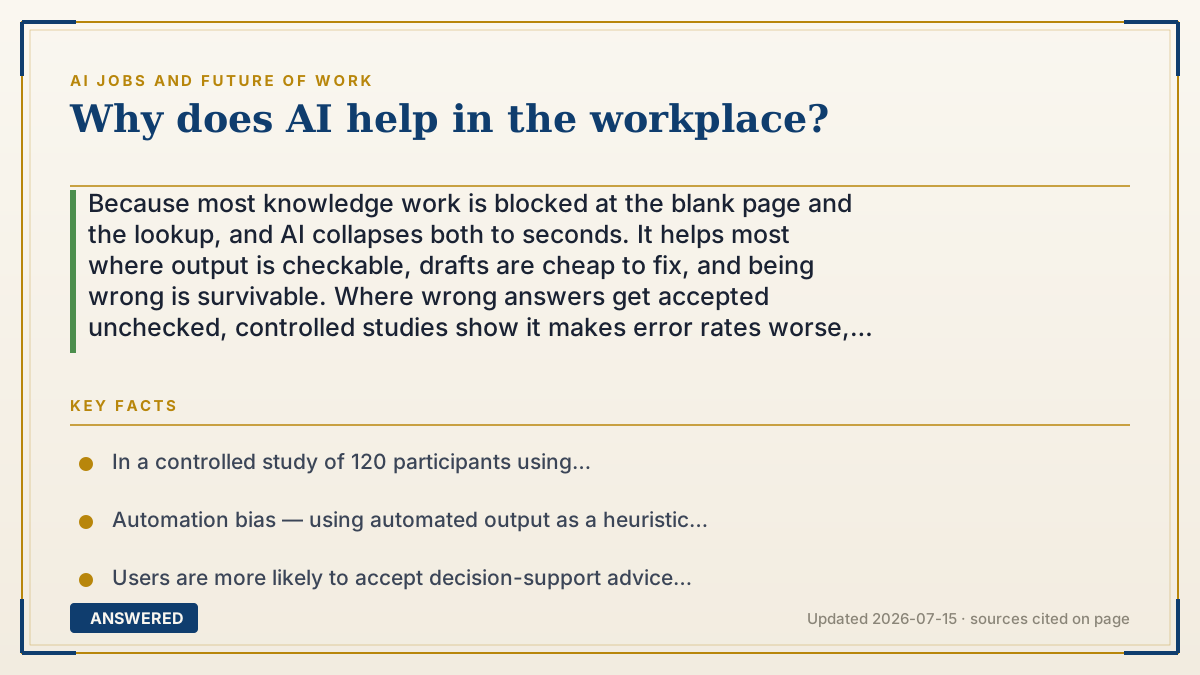
Because most knowledge work is blocked at the blank page and the lookup, and AI collapses both to seconds. It helps most where output is checkable, drafts are cheap to fix, and being wrong is survivable. Where wrong answers get accepted unchecked, controlled studies show it makes error rates worse, not better.
Why — the first-principles explanation
The honest version of this answer starts with why knowledge work is slow. It isn't slow because people type slowly. It's slow because of two specific stalls. The blank page — starting is disproportionately expensive, so a first draft that would take 40 minutes gets procrastinated for three days. And the lookup — the answer exists in a document somewhere, and finding it costs more than the answer is worth, so people guess or skip it. AI is unreasonably good at both, and that's essentially the whole productivity story. It converts a blank page into a mediocre draft instantly, and editing a mediocre draft is a completely different cognitive task from creating one — easier, faster, and something people will actually start on a Tuesday afternoon.
The second mechanism is cheap iteration. When a draft costs an hour, you get one. When it costs nine seconds, you get twelve and pick the best. Quality in most creative and analytical work is a function of how many attempts you can afford. Dropping the price of an attempt to near zero changes what's achievable, not just how fast you get there. This is why AI helps most in work where you can look at the output and tell whether it's good — writing, code, analysis, design. The verification step is where the human value moved.
Which sets up the limit, and it's sharp. AI helps in exact proportion to how well errors get caught. Where the output is checkable and mistakes are cheap, it's a large gain. Where the output is hard to verify and mistakes are expensive, it can go negative — and this is measured, not theoretical. In a controlled study of 120 participants using decision-support software, incorrect advice increased errors by 86.6%, with users following false alerts 64.3% of the time. The tool was usually right; that's what taught people to stop checking. A tool that's right 95% of the time and trusted 100% of the time is worse than no tool in any setting where the 5% matters.
So the accurate claim isn't "AI makes workers more productive." It's: AI makes drafting and retrieval nearly free, which is a huge win in verifiable work and a liability in unverifiable work. And note the distributional catch — the tasks it makes free are largely the tasks juniors were hired to do. Stanford found employment declines concentrated precisely where AI automates rather than augments.
An example that makes it click
Think about a really fast intern who has read everything and remembers nothing about your company. Hand them a blank page and they'll fill it in ten seconds. It'll be about 70% right — decent structure, sensible points, one paragraph that's confidently wrong.
If you're an editor, this intern is a gift. Fixing 70% takes fifteen minutes; writing from zero takes two hours. You just got your afternoon back. But if you're too busy to read what they wrote, and you forward it to a client unread, the intern has not helped you — they've quietly handed you a liability with your name on it. Same intern. Same output. The entire difference is whether anyone read it. That's the whole story of AI at work, and it's why identical tools produce raves in one team and disasters in another.
Key facts
- In a controlled study of 120 participants using simulated decision-support software, incorrect advice increased errors by 86.6%; participants complied with false positive alerts 64.3% of the time (Lyell et al., BMC Medical Informatics and Decision Making, 2017).
- Automation bias — using automated output as a heuristic replacement for vigilant information seeking — produces both omission errors (missing what wasn't flagged) and commission errors (following wrong advice).
- Users are more likely to accept decision-support advice when less confident in their own judgment, meaning the tool's influence peaks exactly where the human check is weakest.
- Stanford found employment declines concentrated in occupations where AI automates rather than augments labor, with a 16% relative decline for workers aged 22-25 (Brynjolfsson, Chandar & Chen, Nov 2025).
- The Budget Lab at Yale found no discernible economy-wide labor market disruption 33 months after ChatGPT's release — workplace-level gains have not yet shown up as economy-wide upheaval (Oct 1, 2025).
- Research indicates users who feel accountable for a decision examine it more thoroughly, reducing automation bias — accountability structure changes the outcome.
Choosing an AI tool for work?
The answer above explains the concept; this next step helps you choose by job, limits and current terms.
▶ The 60-second explainer (script)
Why does AI help at work? Not because it's smart. Because of two very specific stalls. Stall one: the blank page. Starting is weirdly expensive. A draft that takes forty minutes gets put off for three days. Stall two: the lookup. The answer's in a document somewhere, but finding it costs more than the answer's worth — so people guess, or skip it. AI collapses both to seconds. And here's the key insight: editing a mediocre draft is a completely different task from writing one. It's easier. You'll actually start it on a Tuesday afternoon. Second mechanism: cheap iteration. When a draft costs an hour, you get one. When it costs nine seconds, you get twelve and pick the best. In most work, quality is just how many attempts you can afford. Now the limit, and it's sharp. AI helps in exact proportion to how well you catch its mistakes. Where output is checkable and errors are cheap — big win. Where it's hard to verify and errors are expensive — it can go negative. And that's measured. A controlled study, a hundred and twenty people using decision-support software: when the computer was wrong, errors went up eighty-seven percent. They followed bad alerts sixty-four percent of the time. Why? Because the tool was usually right. That's what teaches you to stop checking. A tool that's right ninety-five percent of the time and trusted a hundred percent of the time is worse than no tool at all.
What authoritative sources say
People also ask
Where does AI help the most at work?
First drafts, summarizing long documents, finding the relevant passage in a pile of policy, translating between formats, and first-pass code. Anything where a fast 70% answer saves you from a slow start.
Where does it actively hurt?
Anywhere the output is hard to verify and being wrong is expensive — and anywhere the human check has quietly become a rubber stamp. That's when the tool's rare errors pass straight through.
Does AI actually save measurable time?
In verifiable drafting work, gains are real and easy to feel. Economy-wide, they haven't yet shown up as measurable disruption — Yale found none 33 months in. Individual speed and aggregate productivity are different things.
Why do some teams love it and others hate it?
Usually verification. Teams that treat output as a draft to edit get the gain. Teams that treat it as an answer to forward get the liability. Same tool, opposite result.
If it helps so much, why is anyone worried?
Because the tasks it makes free are largely the ones juniors were hired to do. Help for the senior and lost rungs for the newcomer are the same event viewed from two positions.