Will AI replace teachers?
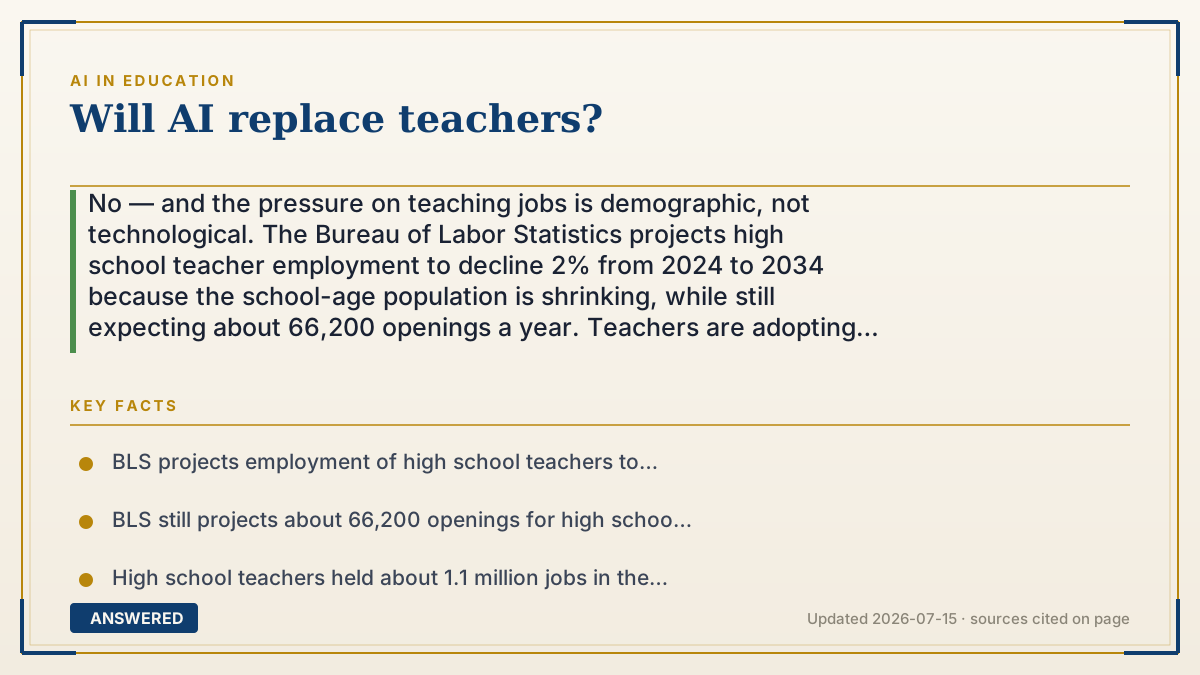
No — and the pressure on teaching jobs is demographic, not technological. The Bureau of Labor Statistics projects high school teacher employment to decline 2% from 2024 to 2034 because the school-age population is shrinking, while still expecting about 66,200 openings a year. Teachers are adopting AI, not being replaced: 53% used it in 2025.
Why — the first-principles explanation
The premise usually hides a wrong assumption: that a teacher's job is delivering information. If that were the job, it would have ended long ago. Textbooks made every fact portable a century ago. Public libraries made them free. YouTube made them free, searchable, and animated. None of that reduced the need for teachers, because the bottleneck was never the supply of explanation. The bottleneck is getting a specific 14-year-old — tired, distracted, convinced they're bad at math — to try anyway, and to keep trying after failing. That is a relational and motivational job, and it's the part nobody has automated.
There's also a hard structural fact people skip: schools have physical and legal custody of minors for roughly seven hours a day. Somebody has to be answerable for a room of thirty children — for their safety, their behavior, and their welfare. No level of model capability removes the need for a responsible adult in that room. Even a perfect tutor doesn't notice a kid hasn't eaten.
What AI actually does is eat the tasks around teaching: lesson plans, worksheets, rubrics, first-pass feedback, report card comments, translating a letter home. That's exactly why teacher-facing AI tools sell, and why 53% of teachers reported using AI for planning or instruction in 2025. This changes the composition of the job, not its existence. And when you automate part of a job whose demand is effectively unlimited — no parent has ever said their child gets too much individual attention — the freed hours tend to flow into the un-automatable part rather than into layoffs.
The real threat to teaching jobs is arithmetic, not algorithms. BLS projects high school teacher employment to decline 2% from 2024 to 2034, explicitly attributing it to projected declines in the school-age population and enrollment — fewer children, not smarter software. Even so, roughly 66,200 openings a year are projected, almost entirely from retirements and people leaving the profession, against about 1.1 million jobs in 2024.
One honest caveat: BLS projections are built from demographic and budget models, not from forecasts about AI capability. So the -2% figure means no AI displacement is currently visible in the data — it is not proof about the 2030s. If AI ever changed staffing ratios materially, this projection wouldn't have anticipated it. Treat it as a measurement of the present, not a guarantee about the future.
An example that makes it click
Autopilot has flown airliners for decades. It handles most of the cruise better than a human would, and it never gets bored. There are more pilots now than when it was introduced, and no airline has proposed an empty cockpit. What changed wasn't the headcount — it was what pilots do during the easy parts.
A classroom is almost never cruise. It's twenty-eight people, several of whom didn't sleep, one of whom is having the worst week of their life, and all of whom can tell instantly whether the adult in the room actually cares. Automating the flight plan doesn't get you closer to automating that.
Key facts
- BLS projects employment of high school teachers to decline 2% from 2024 to 2034, attributing it to projected declines in the school-age population and student enrollment — not to AI
- BLS still projects about 66,200 openings for high school teachers each year on average over the decade, nearly all from workers transferring to other occupations or retiring
- High school teachers held about 1.1 million jobs in the US in 2024
- 53% of ELA, math and science teachers reported using AI for instructional planning or teaching in 2025, with about 13% using it weekly (RAND, surveyed April-June 2025)
- Teacher AI use for any purpose rose from 58% in the 2022-2023 school year to 70% in 2023-2024 — adoption, not displacement
- Only 22% of district leaders agreed that greater AI use will harm critical thinking, versus 61% of parents — the people running schools are the least alarmed group
▶ The 60-second explainer (script)
Will AI replace teachers? No — and the government's own numbers show why the question is aimed at the wrong threat. The Bureau of Labor Statistics projects high school teaching jobs to decline two percent between 2024 and 2034. But read the reason: fewer school-age children. It's demographics, not software. And even with that decline, BLS projects about sixty-six thousand two hundred openings every year, mostly from retirements. Here's the deeper problem with the question. It assumes a teacher's job is delivering information. If that were true, textbooks would have ended teaching in 1900 and YouTube would have finished it in 2010. Information has been free and abundant for a very long time. The bottleneck was never explanation. It's getting one specific tired fourteen-year-old to care, and to keep going after failing. Plus schools have legal custody of children for seven hours a day. Somebody has to be responsible for that room. What AI actually does is eat the tasks around teaching — lesson plans, rubrics, report card comments. That's why fifty-three percent of teachers already use it. It's changing what the job contains, not whether it exists. One honest caveat: BLS models demographics and budgets, not AI capability. So minus two percent means no AI shock is visible in the data today. It isn't a promise about 2035.
What authoritative sources say
People also ask
Is teaching still a safe career to enter?
By the numbers, yes: BLS projects roughly 66,200 high school teacher openings per year through 2034, almost all from retirements and career changes. The projected 2% employment decline reflects fewer school-age children, not automation.
Could AI replace tutoring instead?
That's the more plausible near-term shift, since one-to-one explanation is the most automatable part. But tutoring is a supplement to classroom teaching, not the job itself — and the evidence on AI tutoring's learning outcomes is still thin.
Are teachers actually worried about this?
Adoption suggests otherwise: 53% used AI for planning in 2025, and use rose from 58% to 70% in one year for any purpose. Teachers are treating it as a tool for the paperwork, which is the part most of them want gone.
Do the BLS projections account for AI?
Not directly. They're built from demographic and budget models. So the -2% figure tells you no AI displacement is visible in current data — it isn't a forecast that AI won't matter later.